
If you're buying a home and want to keep your initial monthly payments as manageable as possible, an adjustable-rate mortgage might be worth a closer look. Many homebuyers assume that a fixed-rate loan is the only sensible path, but that's not always the case. Understanding how to get an ARM mortgage for a primary residence could open doors to lower introductory rates, greater purchasing flexibility, and smarter short-term financial planning. This guide breaks down everything you need to know — from how ARM loan terms work to how lenders evaluate your application — so you can move forward with confidence.
What Is an Adjustable-Rate Mortgage and How Does It Work?
An adjustable-rate mortgage, commonly called an ARM, is a home loan with an interest rate that changes over time based on market conditions. Unlike a fixed-rate mortgage, where your rate stays the same for the life of the loan, an ARM typically starts with a lower fixed rate for an initial period — then adjusts periodically afterward.
Most ARM products are described with two numbers, such as a 5/1 ARM or a 7/1 ARM. The first number tells you how many years your initial rate is locked in. The second number tells you how often the rate adjusts after that. So a 5/1 ARM means your rate is fixed for the first five years, then adjusts once per year going forward.
The adjusted rate is tied to a financial index — commonly the Secured Overnight Financing Rate (SOFR) — plus a set margin determined by your lender. When the index rises, your rate may increase. When it falls, your rate could decrease. Most ARMs also include rate caps that limit how much your rate can change at any single adjustment and over the life of the loan, which provides a layer of protection for homeowners.
For primary residence buyers who plan to sell or refinance within a few years, this structure can be a genuinely appealing option — especially when initial ARM rates are noticeably lower than comparable fixed-rate offerings.
Common ARM Mortgage Options for Homeowners to Consider
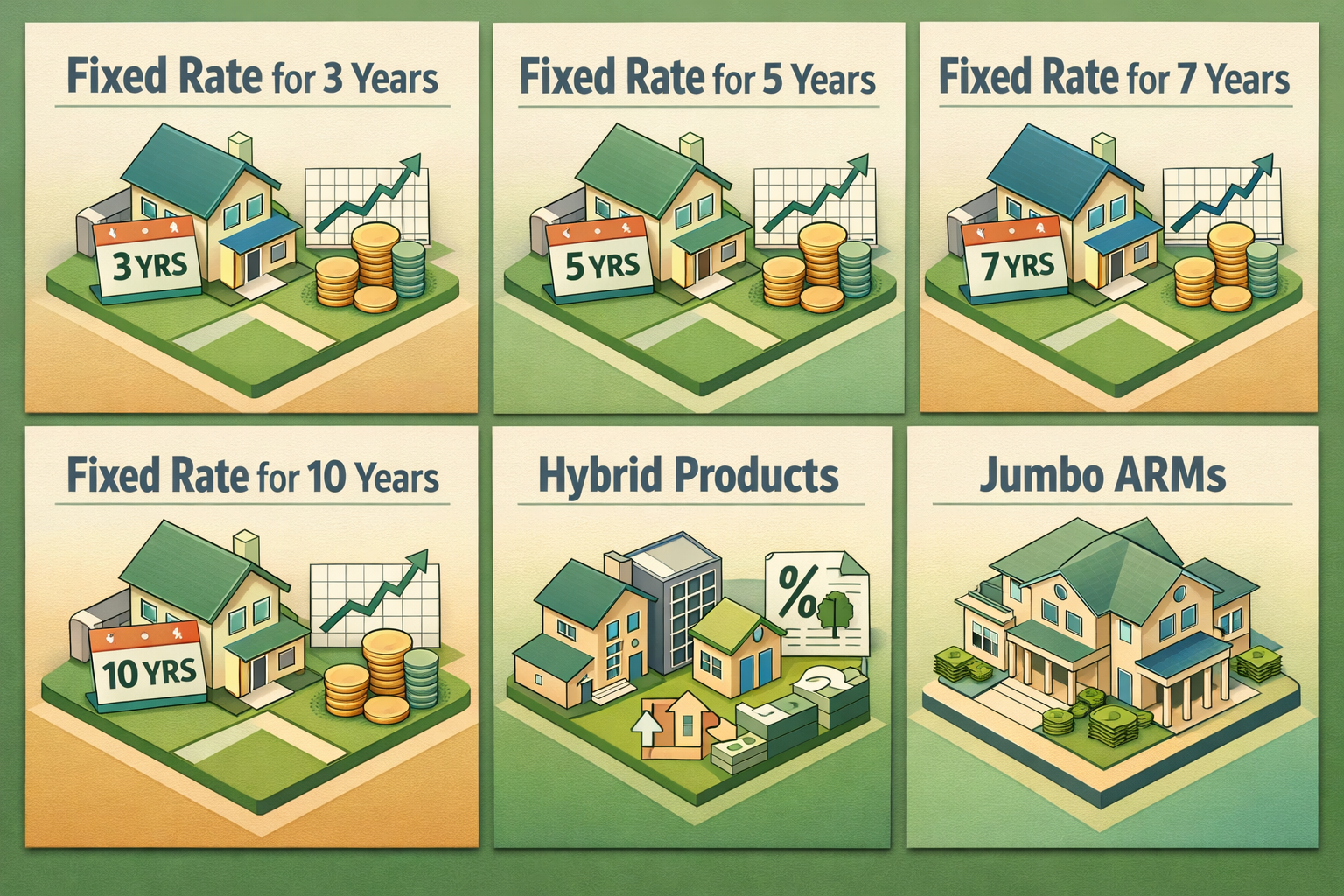
When exploring ARM mortgage options for homeowners, you'll find that lenders typically offer several structures to fit different financial timelines and goals. Here are the most widely available types:
- 3/1 ARM: Fixed rate for three years, then adjusts annually. Best suited for buyers with a very short expected stay in the home.
- 5/1 ARM: One of the most popular choices, offering five years of rate stability before annual adjustments begin. Often used by first-time buyers or those expecting income growth.
- 7/1 ARM: Provides seven years of predictable payments, making it a solid middle-ground option for homeowners who may sell or refinance within a decade.
- 10/1 ARM: Offers a full decade of fixed payments. Rates are typically slightly higher than shorter-term ARMs but still often lower than 30-year fixed rates.
Beyond these standard options, some lenders also offer hybrid products or interest-only ARM periods, though these may carry additional risk and stricter qualification criteria. It's worth comparing the full range of products available to find the structure that aligns with your homeownership plans.
Additionally, jumbo ARMs — adjustable-rate loans above the conforming loan limit — are commonly used by buyers purchasing higher-value primary residences. These may offer competitive introductory rates, especially in higher-cost housing markets.
How to Get an ARM Mortgage for a Primary Residence: Step-by-Step
Knowing how to get an ARM mortgage for a primary residence starts with understanding that the qualification process is largely similar to applying for any conventional home loan. Here's a practical overview of the steps involved:
Step 1: Check Your Credit Profile
Lenders typically look for a credit score of at least 620 for a conventional ARM, though scoring requirements may vary by lender and loan program. Higher scores generally unlock better initial rates. Before applying, review your credit reports for errors, pay down revolving balances where possible, and avoid opening new credit accounts.
Step 2: Assess Your Debt-to-Income Ratio
Your debt-to-income (DTI) ratio — the percentage of your gross monthly income going toward debt payments — is a key factor in loan approval. Most conventional lenders prefer a DTI at or below 43%, though some programs may allow slightly higher ratios with compensating factors like strong reserves or a larger down payment.
Step 3: Gather Your Financial Documents
Lenders will typically request recent pay stubs, W-2s or tax returns, bank statements, and documentation of any assets you're using for your down payment and closing costs. Self-employed borrowers may need to provide additional documentation such as profit-and-loss statements.
Step 4: Get Pre-Approved
A pre-approval gives you a clearer picture of what loan amount you may qualify for and signals to sellers that you're a serious buyer. During pre-approval, the lender will conduct a hard credit pull and review your financial profile in detail.
Step 5: Compare ARM Products and Lenders
Not all ARM products are created equal. Compare the initial rate, the index used, the margin, and — crucially — the rate caps. Understanding how high your rate could go during adjustment periods helps you plan for various scenarios.
Step 6: Lock Your Rate and Close
Once you've selected a lender and product, you may have the option to lock your initial ARM rate for a set period before closing. After final underwriting and approval, you'll proceed to closing and sign your loan documents.
Understanding ARM Loan Terms: Caps, Indexes, and Margins Explained
One of the most important parts of evaluating any ARM product is understanding ARM loan terms — specifically, the components that determine how your rate behaves after the initial fixed period ends. Let's break down the key pieces:
Rate Caps
ARM loans typically include three types of caps that limit how much your rate can change:
- Initial adjustment cap: Limits how much the rate can increase at the very first adjustment after the fixed period ends. A common cap is 2%, meaning if your initial rate was 5.5%, it could go no higher than 7.5% at that first change.
- Subsequent adjustment cap: Limits how much the rate can change at each adjustment after the first. This is often 1% or 2%.
- Lifetime cap: Sets the maximum amount your rate can ever increase over the life of the loan. A 5% lifetime cap on a loan starting at 5.5% means your rate could never exceed 10.5%.
The Index
The index is the benchmark interest rate that your ARM is tied to. The SOFR index has become the most common reference point following the phaseout of LIBOR. When the index rises or falls, your rate adjusts accordingly — after the margin is added.
The Margin
The margin is a fixed percentage added to the index to determine your fully adjusted rate. For example, if the index is 4.5% and your margin is 2.75%, your adjusted rate would be 7.25%. The margin is set by your lender at origination and does not change over the life of the loan.
Taking the time to understand these components — rather than focusing solely on the initial teaser rate — is what separates informed borrowers from those who may be caught off guard by future payment increases.
Using an Adjustable Rate Mortgage Calculator to Plan Your Payments
Before committing to any ARM product, it's wise to model out your potential payment scenarios using an adjustable rate mortgage calculator. These tools allow you to input your loan amount, initial interest rate, adjustment caps, and index assumptions to project how your monthly payment might change over time.
Here's what you should typically explore when using these calculators:
- Best-case scenario: What happens if rates stay flat or decline after your fixed period ends? How much could you save compared to a 30-year fixed mortgage?
- Moderate scenario: What if rates rise modestly — say, by 1% to 2% — at each adjustment? Can your budget absorb those increases comfortably?
- Worst-case scenario: What if rates hit the lifetime cap? Does your projected income at that point still support the payment?
Running these projections helps you make a more grounded decision rather than one based purely on today's attractive introductory rate. It's also a useful exercise when comparing an ARM against the best ARM rates for primary home purchases currently available in the market.
Many lenders and mortgage comparison websites offer free adjustable rate mortgage calculator tools online. LoanWise also provides tools to help you model different loan structures side by side, so you can evaluate your options with clarity before speaking with a loan officer.
When an ARM Makes Sense — and When It Might Not
An adjustable-rate mortgage isn't the right fit for every homebuyer or homeowner, but there are situations where it can be a genuinely smart financial strategy. Here's a balanced look at the scenarios where an ARM may work well — and where caution is warranted.
Situations Where an ARM Could Be a Strong Choice
- You plan to sell or move within five to seven years, making it likely you'll exit the loan before the adjustable period begins.
- You expect your income to grow significantly, making future payment increases manageable.
- You're purchasing a higher-value home and the lower initial rate on a jumbo ARM provides meaningful monthly savings.
- You intend to refinance before the fixed period ends, especially if you anticipate rates declining.
Situations Where a Fixed Rate May Be More Appropriate
- You plan to stay in the home long-term and want complete payment predictability.
- Your budget is tight and you'd struggle to absorb a rate increase of even 1% to 2%.
- You're purchasing during a period of historically low fixed rates, reducing the financial advantage of an ARM's initial discount.
- You have a risk-averse financial profile and prefer certainty over potential savings.
It's also worth noting that some borrowers use ARMs strategically as a temporary financing tool — securing a lower initial rate, building equity, and then refinancing into a fixed product once their financial position strengthens. That kind of intentional planning can make an ARM a powerful part of a broader homeownership strategy. For those looking to optimize their financing, exploring the best ARM rates available can be a valuable starting point.
●Conclusion
Learning how to get an ARM mortgage for a primary residence is less complicated than many homebuyers expect — and for the right borrower, it can be a genuinely effective financing strategy. The key is going in with a clear understanding of how the loan works, what the rate caps mean for your worst-case scenario, and whether your financial timeline aligns with the product's structure. Take the time to use an adjustable rate mortgage calculator, compare ARM loan terms across multiple lenders, and run your numbers honestly before committing. If you're ready to explore your options or want personalized guidance on the best ARM rates for your primary home purchase, the LoanWise team is here to help. Reach out today and let's find the mortgage solution that fits your goals.