
Buying a home when your income doesn't come from a traditional paycheck can feel overwhelming. If you're a freelancer who receives 1099s and also collects alimony, you might wonder whether a lender will even take your application seriously. The good news is that it's absolutely possible to qualify for a mortgage — you just need to understand how the process works. Learning how to calculate mortgage affordability with 1099 freelance income and alimony is the first step toward turning your homeownership goals into reality. This guide walks you through exactly how lenders evaluate your financial picture and what you can do to put your best foot forward.
Why Non-Traditional Income Borrowers Face a Different Path
Most mortgage lenders are set up to evaluate borrowers who receive consistent W-2 wages from an employer. When you're self-employed or working as a freelancer, your income may fluctuate from month to month, and that variability introduces uncertainty for lenders. Add alimony into the mix, and your financial picture becomes even more layered.
The challenge isn't that lenders won't work with you — it's that they need to verify your income in a more detailed way. For 1099 earners, lenders typically look at your net income after business deductions, not your gross earnings. This means that if you write off a significant portion of your income on your taxes, the qualifying income a lender uses could be lower than you expect.
Alimony, on the other hand, may be counted as income — but lenders usually require proof that payments are consistent and are expected to continue for at least three years. Whether you're receiving or paying alimony also makes a significant difference in how your affordability is calculated.
How Lenders Calculate Income for 1099 Freelancers
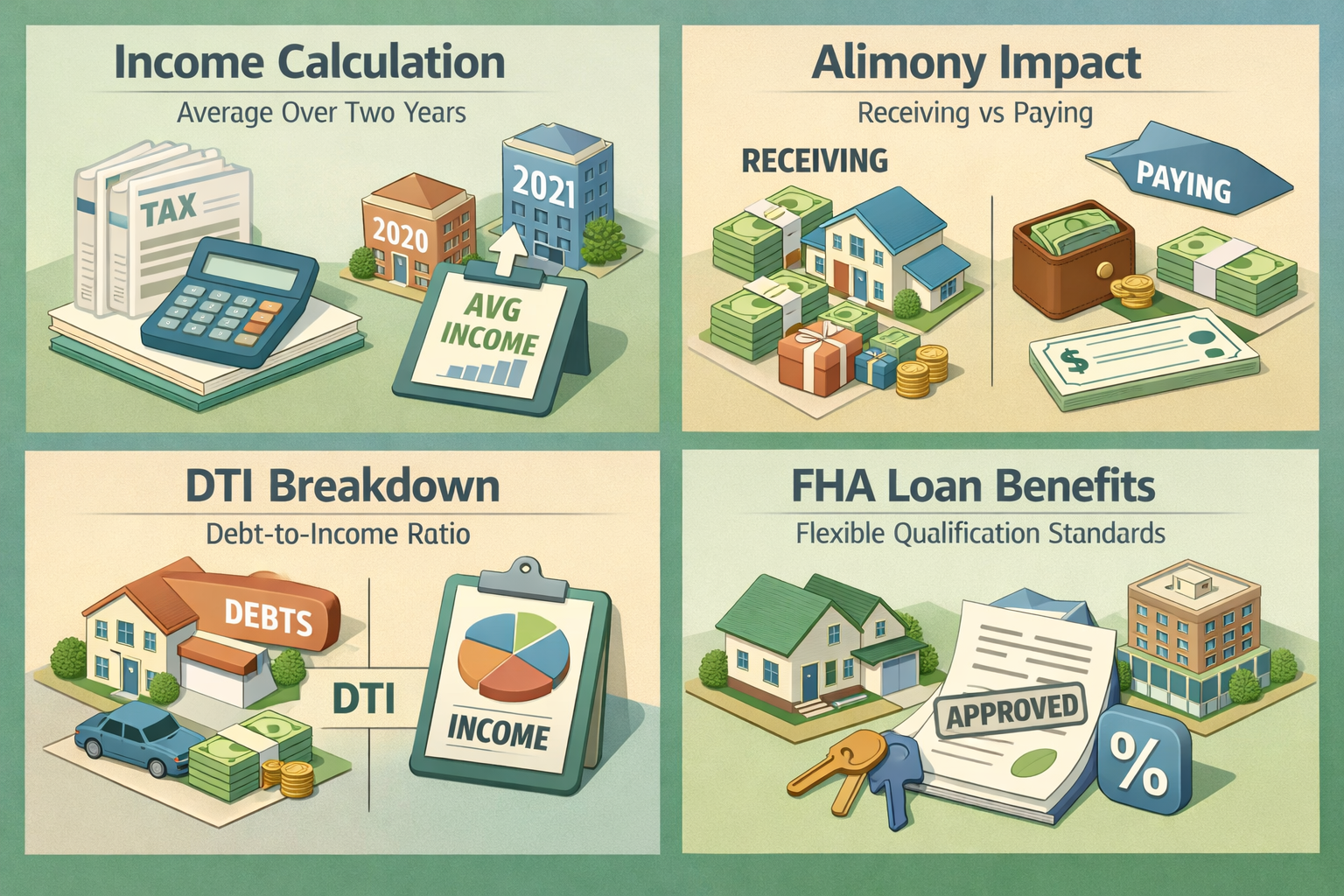
When you apply for a mortgage as a 1099 freelancer, lenders will typically request two years of federal tax returns, along with your 1099 forms and possibly profit and loss statements. They use this documentation to determine your average qualifying income over a two-year period.
Here's a simplified example of how that calculation might work:
- Year 1 net self-employment income: $60,000
- Year 2 net self-employment income: $72,000
- Two-year average: $66,000 per year, or $5,500 per month
Keep in mind that lenders use the net figure from your Schedule C or Schedule SE — not the total 1099 amounts you received. They'll then add back certain non-cash deductions, like depreciation, which can slightly increase your qualifying income. This process is known as income analysis, and it's something a skilled mortgage professional can help you navigate.
It's also worth noting that if your income is declining year over year, lenders may use the lower figure or question the stability of your earnings. Ideally, you want to show consistent or growing income over the two-year window before applying.
Factoring Alimony Into Your Mortgage Affordability Calculation
Alimony can play a meaningful role in your mortgage qualification — but the rules vary depending on whether you're receiving it or paying it.
If You're Receiving Alimony
Many lenders will count alimony as qualifying income, provided you can show that the payments are documented in a divorce decree or separation agreement and are likely to continue for at least three years from the time of your mortgage application. You may need to provide bank statements showing consistent deposits to support this claim.
For example, if you receive $1,200 per month in alimony and earn an average of $4,300 per month from freelance work, a lender might count your total qualifying income as $5,500 per month. That combined figure is then used to assess how much mortgage affordability you can demonstrate.
If You're Paying Alimony
If alimony payments are coming out of your pocket each month, lenders will typically treat them as a monthly debt obligation. This reduces the income available to cover a mortgage payment. For instance, if your qualifying income is $5,500 per month but you pay $800 in alimony, your effective income for debt-to-income purposes may be reduced accordingly.
Understanding which side of the alimony equation you're on is essential when learning how to calculate mortgage affordability with 1099 freelance income and alimony.
Understanding Debt-to-Income Ratio for Freelancers With Alimony
Your debt-to-income ratio (DTI) is one of the most important numbers in the mortgage qualification process. It measures how much of your gross monthly income goes toward debt payments, including your proposed mortgage payment.
Most conventional lenders prefer a DTI at or below 43%, though some programs may allow higher ratios with compensating factors. FHA loans may be more flexible in certain scenarios. Here's a basic breakdown of how DTI works in practice:
- Gross monthly qualifying income: $5,500
- Monthly debts (car loan, student loans, credit cards, alimony paid): $800
- Proposed monthly mortgage payment (PITI): $1,400
- Total monthly obligations: $2,200
- DTI: $2,200 ÷ $5,500 = 40%
In this example, a 40% DTI might be acceptable to many lenders. However, if your business deductions have significantly reduced your qualifying income, your DTI could climb much higher — making it harder to qualify for the loan amount you need.
One practical strategy is to reduce high-interest debt before applying. Paying off a credit card or small personal loan could lower your monthly obligations and bring your DTI into a more favorable range.
FHA Loan Options for 1099 Income Earners and Alimony Recipients
For many freelancers and non-traditional income borrowers, an FHA loan with 1099 income and alimony payments may offer a more accessible path to homeownership. FHA loans are backed by the Federal Housing Administration and are known for their more flexible qualification standards compared to conventional mortgages.
Here are some features that make FHA loans attractive for this type of borrower:
- Lower credit score requirements: FHA loans may allow credit scores as low as 580 with a 3.5% down payment, or as low as 500 with a 10% down payment, though individual lenders may set higher minimums.
- More flexibility on DTI: FHA guidelines may allow higher debt-to-income ratios under certain circumstances, particularly when strong compensating factors — like significant cash reserves — are present.
- Acceptance of self-employment income: FHA lenders still require two years of self-employment history and tax returns, but the program is designed with varied income situations in mind.
- Alimony as qualifying income: FHA guidelines allow alimony to be counted as income when it meets the continuance and documentation requirements.
It's important to work with a lender who has experience processing FHA loan with 1099 income and alimony payments applications. Not all lenders are equally experienced with these layered income scenarios, and choosing the right loan officer can make a significant difference in your outcome.
Steps to Strengthen Your Mortgage Application as a Freelancer
Whether you're pursuing an FHA loan or a conventional mortgage, there are several proactive steps you can take to improve your chances of approval and maximize your improve your buying power.
Build and Document a Consistent Income History
Lenders want to see stability. If you've been freelancing for less than two years, you may face additional scrutiny. The longer your track record, the better. Keep detailed records of all income received, contracts with clients, and any recurring revenue streams that demonstrate reliability.
Minimize Business Write-Offs Strategically
While tax deductions are beneficial for reducing your tax bill, they also reduce the income lenders use to qualify you. Consider speaking with both a tax professional and a mortgage advisor before filing your taxes to understand the trade-offs between maximizing deductions and maximizing your qualifying income.
Maintain a Strong Credit Profile
A healthy credit score can open doors to better loan programs and lower interest rates. Pay bills on time, keep credit card balances low, and avoid opening new lines of credit in the months before applying for a mortgage.
Build Cash Reserves
Lenders often feel more confident about approving borrowers who have several months' worth of mortgage payments saved in a liquid account. Reserves can serve as a compensating factor when other aspects of your file — like variable income — may raise questions.
Gather Your Documentation Early
Self-employed borrowers typically need to provide more paperwork than W-2 earners. Collect your last two years of federal tax returns, profit and loss statements, 1099 forms, bank statements, and your divorce or separation agreement if alimony is involved. Having these ready before you apply can speed up the process significantly.
Working With the Right Lender Makes All the Difference
Not every lender is equally equipped to handle complex income scenarios. Some mortgage professionals work extensively with self-employed borrowers and understand how to present your file in the most favorable light. Others may not be familiar with the nuances of 1099 income analysis or how alimony should be factored into a qualification.
When you're ready to explore your options, look for a lender or mortgage broker who:
- Has demonstrable experience with self-employed and non-QM loan programs
- Can clearly explain how they'll calculate your qualifying income
- Is transparent about which loan programs fit your financial situation
- Is willing to take the time to review your full financial picture before pre-qualifying you
Asking the right questions upfront can save you from surprises later in the process. A good lender will walk you through how to calculate mortgage affordability with 1099 freelance income and alimony in a way that's specific to your numbers and goals — not just a generic estimate.
Remember, even if one lender declines your application, another may see your situation differently. The mortgage market includes a wide range of programs — from FHA and conventional to bank statement loans and other alternative documentation options — that may be a better fit for your unique circumstances.
●Conclusion
Calculating mortgage affordability as a freelancer with alimony income involves more moving parts than a typical W-2 application, but it's far from impossible. By understanding how lenders evaluate your 1099 earnings, how alimony is treated on both sides of the equation, and how your debt-to-income ratio comes together, you can approach the homebuying process with confidence. Whether an FHA loan or a conventional program is the right fit, preparation and the right lending partner are your two greatest assets. Take the time to organize your documentation, review your financial profile honestly, and connect with a mortgage professional who truly understands your situation. Your path to homeownership may take a few extra steps — but it's very much within reach.