
If you're shopping for a home in an expensive city or metro area, you've probably noticed that home prices can stretch well beyond what you'd find in rural or mid-tier markets. That's where understanding FHA loan limits for single-family homes in high-cost areas becomes essential. The Federal Housing Administration sets specific borrowing caps that reflect local real estate conditions — and in pricier markets, those caps are significantly higher. Whether you're a first-time homebuyer trying to break into a competitive market or a seasoned homeowner looking to refinance, knowing how these limits work could make or break your financing strategy.
What Are FHA Loan Limits and Why Do They Exist?
FHA loans are government-backed mortgages insured by the Federal Housing Administration. Because they carry federal insurance, lenders are willing to extend credit to borrowers with lower credit scores and smaller down payments. However, to manage risk and keep the program focused on moderate-income homebuyers, the FHA sets maximum loan amounts — commonly called loan limits — that cap how much you can borrow.
These limits aren't one-size-fits-all. The FHA uses a formula tied to conforming loan limits set by the Federal Housing Finance Agency (FHFA). Each year, the Department of Housing and Urban Development (HUD) reviews and updates these limits to reflect changes in local home values. The result is a tiered system where borrowers in high-cost counties can access much larger loan amounts than those in lower-cost regions.
The purpose is straightforward: a flat national cap would shut out buyers in expensive markets, while a universally high cap would expose the program to unnecessary risk in affordable areas. The geographic adjustment is meant to strike a balance that keeps FHA loans accessible without overextending the insurance fund.
How the FHA Defines a High-Cost Area for Single-Family Homes
Not every county with above-average home prices qualifies as a high-cost area under FHA guidelines. The designation is based on median home sale prices relative to the national baseline. When local home values exceed a certain percentage of the national conforming loan limit, the FHA raises its ceiling for that area accordingly.
In practical terms, the FHA sets a floor — the minimum loan limit that applies to most lower-cost counties — and a ceiling — the maximum limit available in the highest-priced markets. For high-cost areas, the limit typically falls closer to that ceiling. Metropolitan statistical areas in states like California, New York, Hawaii, and parts of the Pacific Northwest and Mid-Atlantic corridor often qualify for elevated limits because local home prices consistently run well above the national median.
Alaska, Hawaii, Guam, and the U.S. Virgin Islands receive special consideration under FHA rules. These areas may have even higher limits to account for construction costs and geographic isolation that drive up property values. It's worth checking HUD's official loan limit lookup tool for your specific county before assuming which tier applies to your location.
The Numbers Behind FHA Loan Limits in High-Cost Markets
Each year, HUD publishes updated loan limits that reflect current market conditions. While specific figures change annually and can vary widely by county, the structure remains consistent: FHA loan limits for high-cost areas single-family properties are set at a percentage of the area's median home price, capped at the FHA ceiling for that calendar year.
For a single-family home specifically, the high-cost ceiling tends to be significantly higher than the national floor. This gap can amount to several hundred thousand dollars depending on the year and the market. In some of the most expensive counties in the country, the FHA ceiling allows buyers to finance homes that might otherwise require a jumbo loan — which typically comes with stricter credit and income requirements.
It's important to note that FHA limits apply to the loan amount, not the purchase price. If a home is priced above the FHA limit for your area, you may still be able to purchase it by making a larger down payment to bring the financed portion within the allowable range. This flexibility is worth discussing with a qualified mortgage professional to understand how it might work for your specific situation.
Why High-Cost FHA Limits Matter for Homebuyers and Refinancers
For buyers entering a high-cost market, FHA financing can be a meaningful entry point that conventional loans or jumbo products might not offer as readily. FHA loans typically allow down payments as low as 3.5% for borrowers with qualifying credit scores, and credit score thresholds tend to be more accessible than what's required for many conventional programs. In expensive markets where a 20% down payment could represent hundreds of thousands of dollars, this flexibility is significant.
Homeowners looking to refinance may also benefit from elevated FHA limits. If you originally purchased with a conventional loan and now want to switch to an FHA product — perhaps to access the FHA Streamline Refinance program or tap into equity more efficiently — knowing your area's FHA loan ceiling helps you determine whether your current balance qualifies.
Real estate investors should note that FHA loans are intended for owner-occupied primary residences. While FHA products can apply to multi-unit properties (up to four units), the borrower must occupy one of the units. Limits for two-, three-, and four-unit properties are set higher than those for single-family homes, which could open additional opportunities for house-hacking strategies in high-cost cities.
How FHA Limits Compare to Conventional and Jumbo Thresholds
Understanding how FHA limits stack up against other loan types helps you make a more informed borrowing decision. Conventional conforming loans also have loan limits set by the FHFA, and in many high-cost areas, the FHA ceiling mirrors or closely tracks the high-balance conforming limit. This overlap means that in some markets, borrowers may qualify for either an FHA or a high-balance conventional loan and should compare costs carefully.
One important distinction is mortgage insurance. FHA loans require both an upfront mortgage insurance premium and an annual premium for the life of the loan in most cases. Conventional loans, on the other hand, allow borrowers to cancel private mortgage insurance once they've built sufficient equity. In a high-cost market where loan amounts are larger, this difference in long-term mortgage insurance costs could be substantial over the life of a 30-year loan.
Jumbo loans — which exceed conforming limits — typically require higher credit scores, larger down payments, and more extensive income documentation. For buyers who might not meet those stricter thresholds but are purchasing in a high-cost area, an FHA loan at the high-cost ceiling may offer a more accessible path to homeownership. That said, every borrower's financial picture is different, and it's worth modeling total costs across loan types before committing.
Steps to Find Out the FHA Limit in Your County or Metro Area
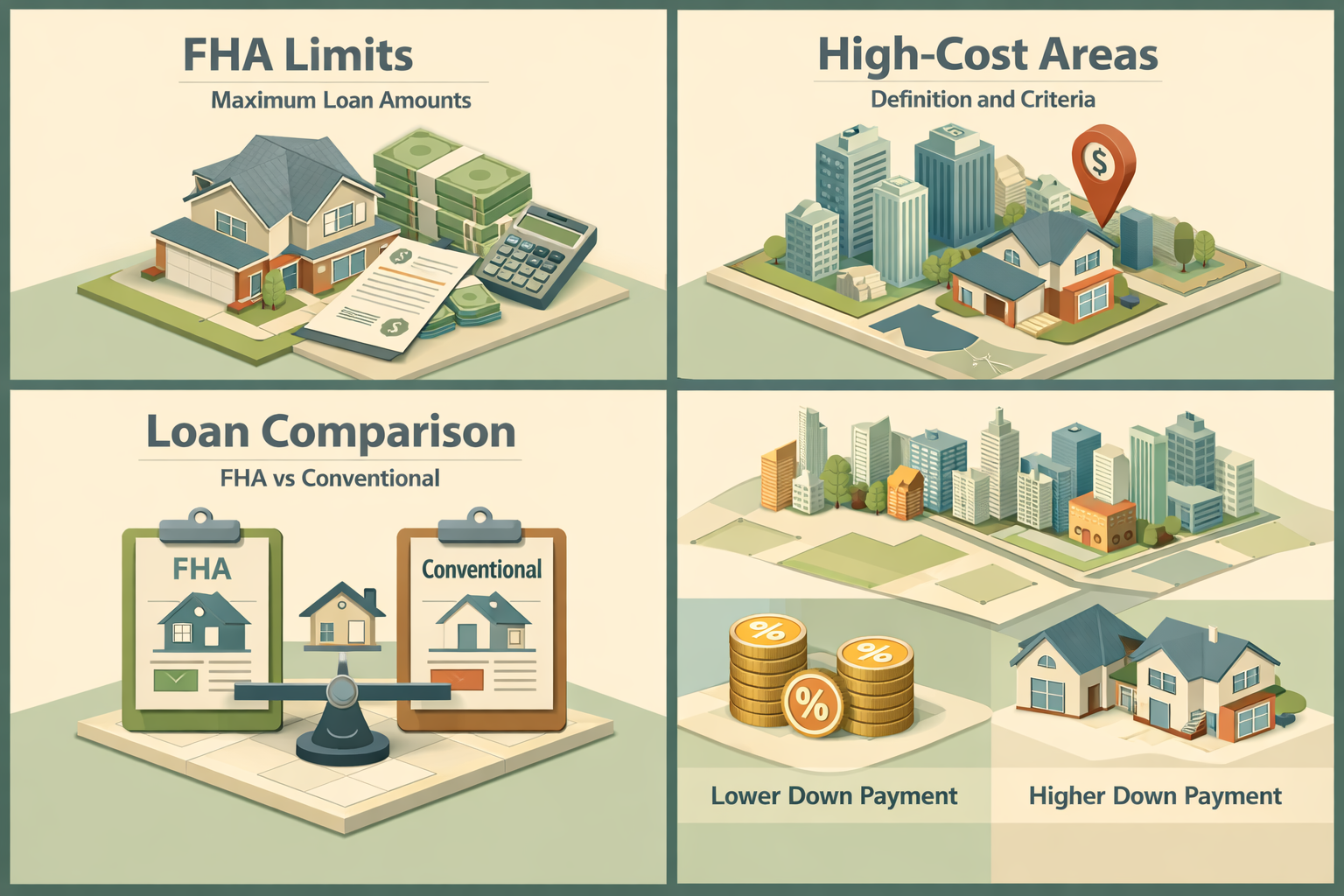
Finding your area's current FHA loan limit is easier than many borrowers expect. HUD maintains an online tool that allows you to look up limits by state, county, or metropolitan statistical area. The results show limits for single-family, two-unit, three-unit, and four-unit properties separately — so you can see exactly what applies to the home type you're considering.
- Visit HUD's official loan limit lookup tool and select the current program year to see the most up-to-date figures.
- Search by county rather than just city, since FHA limits are set at the county level and boundaries don't always follow city lines.
- Note whether your county is designated as a high-cost area — this will tell you whether you're working with the floor, the ceiling, or somewhere in between.
- Compare the limit to your target purchase price to understand how much you'd need to bring as a down payment if the home price exceeds the limit.
- Speak with an FHA-approved lender who can confirm current limits, walk you through qualification requirements, and help you understand how your debt-to-income ratio and credit score position you for approval.
Limits are updated annually and typically take effect in January. If you're planning a purchase that straddles a calendar year, it's wise to confirm which year's limits apply to your home purchase at the time of closing.
●Conclusion
Understanding FHA loan limits for single-family homes in high-cost areas is one of the most practical steps a homebuyer or refinancer can take before beginning the mortgage process. These limits determine how much you can borrow under FHA guidelines, and in competitive, high-price markets, they could meaningfully expand your purchasing power compared to what a flat national limit would allow. The key is knowing your county's specific threshold, comparing FHA options against conventional and jumbo alternatives, and working with a knowledgeable lender who understands both the program rules and the local market. With the right information in hand, FHA financing in a high-cost area can be a smart, accessible route to the home you're looking for. Ready to explore your options? Connect with a LoanWise mortgage specialist today to find out how FHA loan limits in your area could work in your favor.