
Figuring out how much home you can afford is already a big task — but when your income comes from two 1099 sources instead of a traditional paycheck, the process gets a little more involved. Lenders don't just look at what you earned; they look at how you earned it, how consistent it's been, and how much of it remains after business expenses. If you're a freelancer, independent contractor, or gig worker juggling two separate income streams, understanding how to calculate mortgage affordability with 1099 income from two jobs could be the key to unlocking homeownership. This guide walks you through the process step by step, so you can approach a lender with confidence.
Why 1099 Income Is Treated Differently by Mortgage Lenders
When you receive a W-2, your employer withholds taxes and reports a straightforward gross income figure. With 1099 income, you're responsible for your own taxes, and your actual take-home pay depends on your business expenses. This distinction matters enormously in the mortgage world.
Lenders typically classify 1099 earners as self-employed borrowers, which means they apply a different set of income verification rules. Rather than accepting your total 1099 earnings at face value, most lenders — especially those offering conventional or government-backed loans — will look at your net income after deductions as reported on your federal tax returns. The more deductions you claim, the lower your qualifying income may appear, even if your bank account tells a different story.
This is why the same gross income that looks strong on paper might result in a smaller loan approval than you'd expect. Understanding this framework is the first step toward accurately estimating what you can afford.
How Lenders Calculate Qualifying Income from Two 1099 Sources
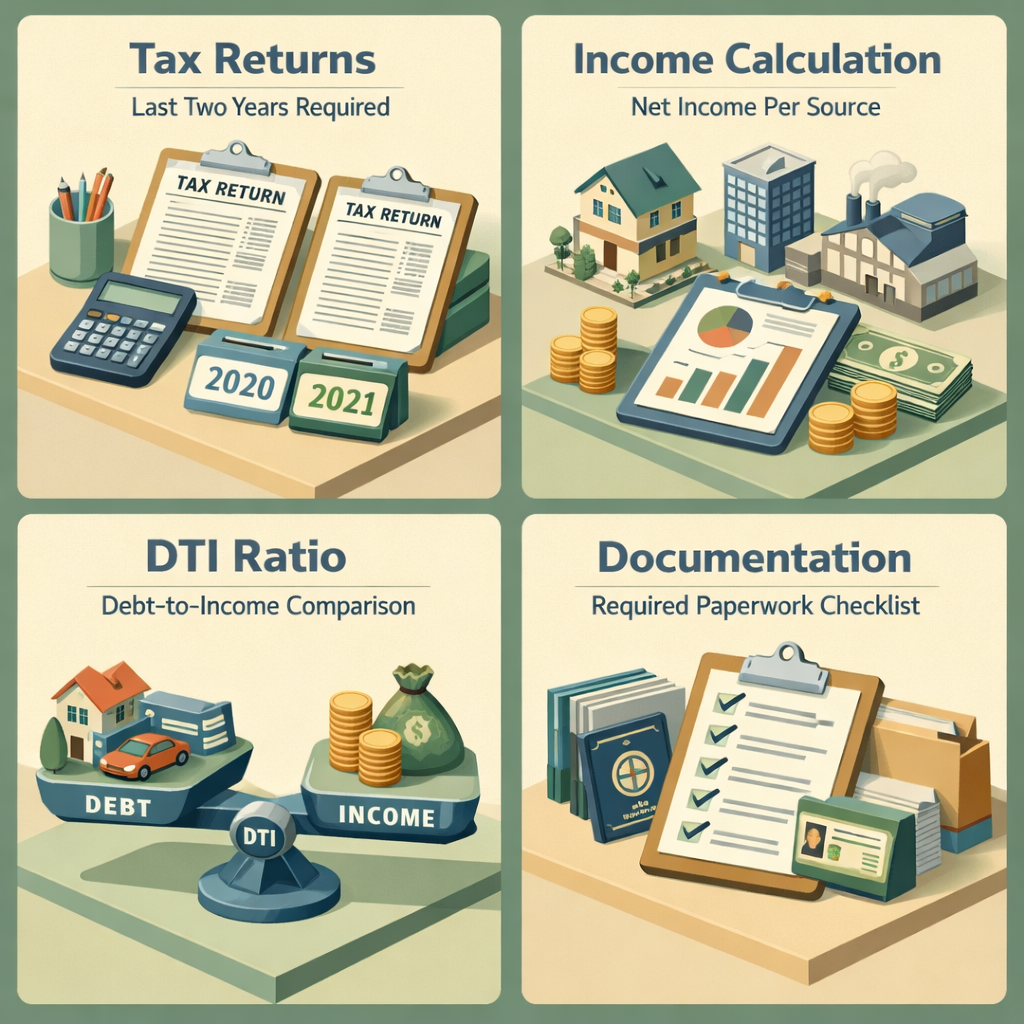
When you have 1099 income from two separate jobs or clients, lenders will generally want to see a two-year history for both income streams. Here's how the calculation typically works:
- Step 1 — Gather your tax returns: Lenders usually request your last two years of federal tax returns, including all schedules. Schedule C is especially important if you operate as a sole proprietor, as it shows both your gross revenue and your deductible business expenses.
- Step 2 — Calculate net income per source: For each 1099 income stream, the lender subtracts allowable business expenses from gross income to arrive at net self-employment income. Depreciation and certain non-cash deductions may be added back in some cases.
- Step 3 — Average the income over two years: Lenders commonly average the net income from both years across both sources. If your income has been increasing, some lenders may use just the most recent year; if it's been declining, they may use the lower figure or the average — whichever is less favorable.
- Step 4 — Apply the debt-to-income (DTI) ratio: Once your monthly qualifying income is established, lenders compare your total monthly debt obligations — including the projected mortgage payment — to that income. A DTI of 43% or below is commonly cited as a standard benchmark, though some loan programs may allow higher ratios with compensating factors.
Having two 1099 income sources can actually strengthen your application if both streams are well-documented and show consistency. Lenders generally appreciate income diversification, as it may reduce the risk of a complete income loss.
Using a Self-Employed Mortgage Calculator for 1099 Earners
A self-employed mortgage calculator 1099 is a tool designed to help independent contractors and freelancers estimate their qualifying income and potential loan amount before formally applying. While every lender has its own underwriting guidelines, these calculators offer a useful starting point.
Here's how to get the most out of one:
- Input your net income, not gross: Since lenders use your after-expense income from Schedule C or equivalent, enter the figure that reflects your actual reported net profit — not your total 1099 earnings.
- Account for both income streams separately: If a calculator allows for multiple income sources, enter each 1099 job individually. If it doesn't, manually add the two net income figures together before entering the combined total.
- Enter your existing monthly debts: Include car payments, student loans, credit card minimums, and any other recurring obligations. This helps the calculator estimate your DTI ratio more accurately.
- Adjust for the two-year average: If your income has varied between years, average your net income from both tax years before plugging in the number. This gives you a more realistic picture of what a lender might use.
These calculators can help you set a realistic home price target before you start shopping. That said, they're estimates — a licensed mortgage affordability professional can give you a more precise figure based on your actual documents.
Documentation You'll Need to Support Your Application
Mortgage lenders ask for more paperwork from 1099 earners than from salaried borrowers. Being organized ahead of time can speed up the process considerably. Here's what you'll likely need:
- Two years of federal tax returns (personal and business, if applicable)
- All 1099 forms from both income sources for the past two years
- Year-to-date profit and loss statement — especially important if you're applying mid-year and want lenders to consider current earnings
- Bank statements (typically two to three months) to verify cash flow and reserves
- Business license or client contracts to confirm the legitimacy and longevity of your income sources
- CPA letter verifying your self-employment status (some lenders require this)
Having two 1099 income streams means you'll want documentation for each one separately. Lenders may scrutinize whether both income sources are likely to continue, so any contracts, ongoing agreements, or evidence of repeat clients can work in your favor.
Strategies to Strengthen Your Mortgage Eligibility as a Dual 1099 Earner
Knowing how to calculate mortgage affordability with 1099 income from two jobs is only part of the puzzle. The other part is positioning your application as strongly as possible. Here are several practical strategies:
- Minimize tax deductions in the year before applying: This is a delicate balance — claiming fewer deductions means paying more in taxes, but it also raises your reported net income and potentially your qualifying loan amount. Speak with a tax advisor before making this decision.
- Improve your credit score: A higher credit score can offset some of the perceived risk associated with variable income. Paying down revolving balances and avoiding new credit inquiries in the months before applying can help.
- Make a larger down payment: A bigger down payment reduces your loan-to-value ratio, which may make lenders more comfortable approving a self-employed borrower. It also lowers your monthly payment, helping with DTI calculations.
- Build up reserves: Lenders feel more confident when borrowers have several months of mortgage payments sitting in savings or investments. This acts as a buffer in case one income stream slows down.
- Consider non-QM loan options: If traditional loans don't work for your situation, non-qualified mortgage products — such as bank statement loans — may allow lenders to use 12 to 24 months of bank deposits rather than tax returns to verify income. These products are designed specifically for self-employed borrowers with complex income situations, particularly when determining how much home you can afford.
Understanding Debt-to-Income Ratios for 1099 Borrowers with Multiple Jobs
Your debt-to-income (DTI) ratio is one of the most critical numbers in your mortgage application. It tells the lender what percentage of your gross monthly income goes toward paying debts. For 1099 earners, this calculation works a bit differently than for W-2 employees.
Your front-end DTI compares just your proposed housing costs — including principal, interest, taxes, and insurance — to your monthly income. Your back-end DTI includes all monthly debt payments. Most lenders pay close attention to the back-end figure.
For self-employed borrowers, the monthly income figure used in this ratio is based on your averaged net income from tax returns, divided by 24 months (or 12 months if only one year is used). If your combined net income from both 1099 jobs averages to, say, $6,000 per month after expenses, a lender targeting a 43% back-end DTI would generally want your total monthly debts — including your new mortgage — to stay at or below approximately $2,580.
If your current debts are already consuming a significant portion of that limit, you may want to pay down some balances before applying, or look for a lower-priced home to keep the mortgage payment within range. Running these numbers through a self-employed mortgage calculator 1099 can help you visualize different scenarios.
●Conclusion
Calculating mortgage affordability when you earn 1099 income from two jobs takes more planning than a standard W-2 application, but it's entirely achievable with the right preparation. Lenders want to see consistent, documented income — and with two income streams, you may actually have more financial stability than a single-job earner. The key is understanding how your income is calculated, gathering the right paperwork, and positioning your finances to reflect your true earning power. Whether you use a self-employed mortgage calculator 1099 to run initial estimates or work directly with a mortgage advisor, taking the time to understand how to calculate mortgage affordability with 1099 income from two jobs puts you firmly in the driver's seat on your path to homeownership. Ready to take the next step? Connect with a LoanWise mortgage specialist who understands the unique needs of independent earners.