
If you run a seasonal business, you already know the pressure that comes with preparing for your busiest time of year. Whether you're a retailer gearing up for the holidays, a landscaping company preparing for spring, or a tourism operator getting ready for summer, one challenge is almost universal: you need inventory and supplies before the revenue rolls in. That gap between spending and earning is exactly where smart financing can make a real difference. Understanding how to get a business line of credit for seasonal inventory could be the key to keeping your shelves stocked, your staff paid, and your business positioned to capitalize on peak demand — without draining your reserves or missing out on sales.
Why Seasonal Businesses Face Unique Cash Flow Challenges
Most businesses deal with some degree of cash flow variation throughout the year. But for seasonal businesses, those swings can be dramatic. You might generate the majority of your annual revenue in just a few months, while still incurring operating costs year-round. This pattern creates a fundamental tension: you need capital to buy inventory before the sales happen, but your cash reserves may be at their lowest just when you need them most.
This is particularly true for retail businesses, gift shops, garden centers, outdoor equipment dealers, and holiday-focused service providers. Financing retail inventory fluctuations is a common need in these industries, and lenders are increasingly aware of it. The good news is that there are financing products specifically designed to help businesses manage these predictable but demanding cycles.
Without access to adequate working capital, a seasonal business might under-stock inventory, miss sales opportunities, or take on expensive last-minute financing at unfavorable terms. Planning ahead and understanding your options is the smarter approach.
What Is a Business Line of Credit and How Does It Work
A business line of credit is a flexible, revolving financing tool that gives you access to a set amount of funds. Unlike a traditional term loan where you receive a lump sum upfront, a line of credit lets you draw funds as needed, repay them, and draw again — much like a credit card but typically with higher limits and lower interest rates.
This revolving structure makes it especially well-suited for seasonal inventory needs. You can draw funds to purchase stock ahead of your peak season, then repay the balance as sales come in. You only pay interest on the amount you actually use, which can help keep borrowing costs manageable.
- Revolving access: Funds become available again as you repay, giving you ongoing flexibility.
- Interest on usage: You're typically charged interest only on the amount drawn, not the full credit limit.
- Scalable draws: You can borrow in increments as inventory needs arise, rather than taking on more debt than necessary.
- Reusable tool: Once established, many lines of credit can be used across multiple seasons without reapplying.
For small business owners who experience predictable seasonal demand, a business line of credit may offer more control and cost-efficiency than a lump-sum loan product.
Types of Seasonal Working Capital Loans and Financing Options
While a business line of credit is often the go-to solution, it's not the only option available. Depending on your business's financial profile, credit history, and the size of your inventory needs, other seasonal working capital loans may also be worth exploring.
Unsecured Business Lines of Credit
These lines don't require collateral, making them accessible to businesses that may not have significant physical assets. They're typically based on creditworthiness, time in business, and annual revenue. Approval amounts may be lower than secured options, but they offer speed and simplicity.
Secured Business Lines of Credit
If your business owns equipment, real estate, or inventory that can serve as collateral, a secured line of credit may come with higher borrowing limits and potentially more favorable terms. This could be a good fit for established businesses with valuable assets.
SBA Seasonal Lines of Credit
The U.S. Small Business Administration offers programs that may support seasonal financing needs. The SBA's CAPLines program, for example, includes a seasonal line of credit specifically designed to help businesses manage cash flow during peak periods. These programs often come with competitive terms, though the application process may be more involved.
Short-Term Loans for Seasonal Stock
Short-term loans for seasonal stock offer a lump-sum disbursement with a fixed repayment schedule, often over 6 to 18 months. They can be a practical alternative when a business needs a specific, predictable amount of capital and prefers the structure of set payments over revolving credit.
Merchant Cash Advances
For businesses with strong credit card sales volume, a merchant cash advance provides upfront capital in exchange for a percentage of future sales. This option tends to carry higher costs and should be evaluated carefully before proceeding.
How to Qualify: Key Requirements Lenders Look For
Understanding how to get a business line of credit for seasonal inventory starts with knowing what lenders typically evaluate. While requirements vary by lender and product type, most financial institutions will look at several core factors when assessing your application.
Time in Business
Most traditional lenders prefer to see at least one to two years of operating history. This gives them confidence that your business is established and that your seasonal patterns are predictable. Some online lenders may accept businesses with shorter operating histories, though terms may differ.
Credit Profile
Both your personal credit score and your business credit profile may be reviewed. A stronger credit history generally improves your chances of approval and may result in better interest rates. If your credit needs work, addressing it before applying could strengthen your application.
Revenue and Cash Flow Documentation
Lenders want to see that your business generates enough revenue to service the debt. They'll likely ask for bank statements, tax returns, and profit-and-loss statements. Demonstrating a clear seasonal pattern — with documented peak revenue periods — can actually work in your favor, as it shows the lender your repayment capacity is real and predictable.
Debt Service Coverage
Lenders often calculate your debt service coverage ratio (DSCR) to ensure your income is sufficient to cover existing and new debt obligations. A ratio above 1.25 is commonly considered healthy, though requirements vary by lender.
Collateral (for Secured Products)
If you're applying for a secured line of credit, you'll need to identify eligible collateral. Inventory itself may sometimes serve as collateral, though lenders typically discount its value since liquidating inventory isn't always straightforward.
Step-by-Step Guide to Applying for Business Loans for Peak Season Inventory
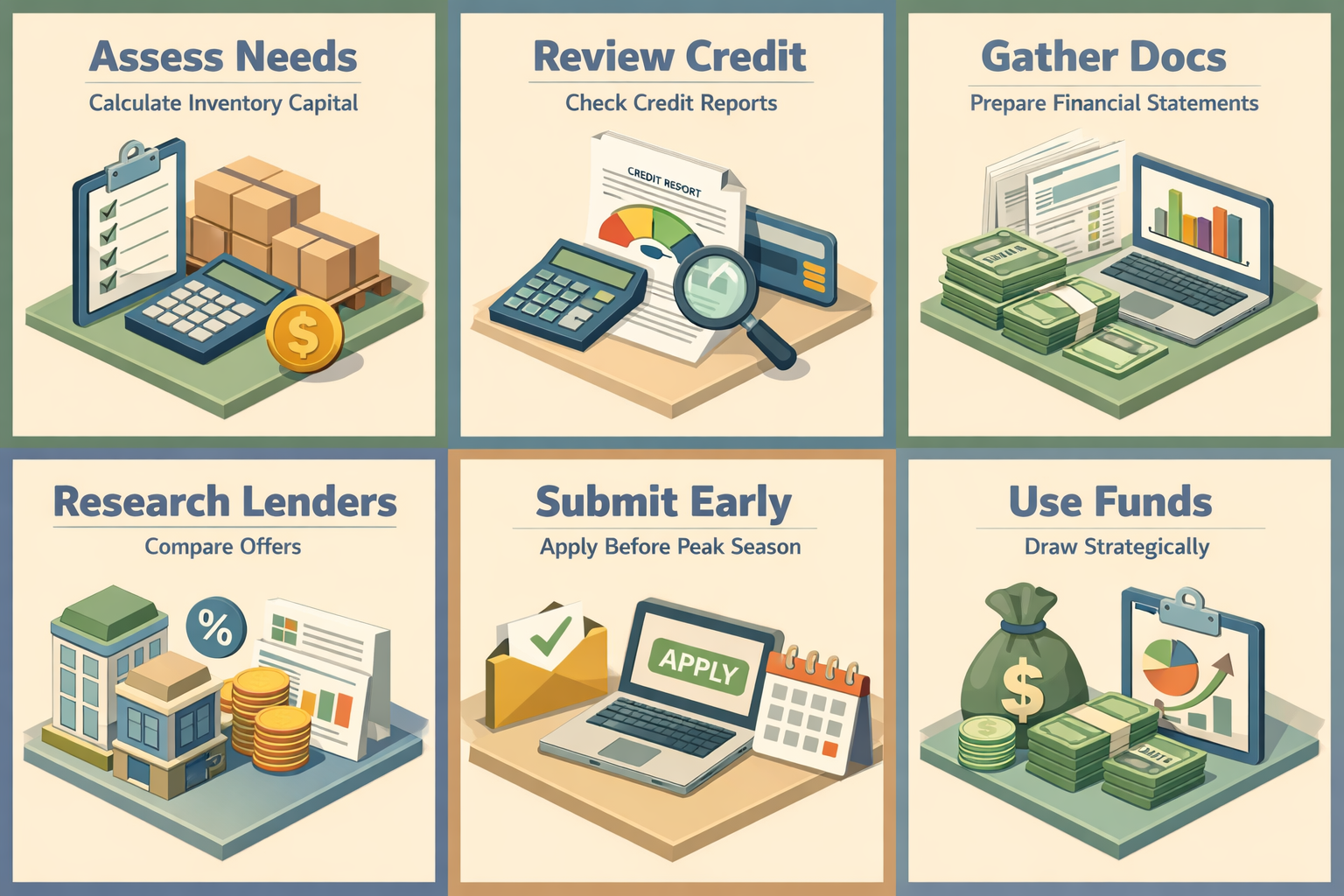
Applying for business loans for peak season inventory doesn't have to feel overwhelming. Breaking the process into clear steps can help you move efficiently and improve your chances of approval.
Step 1: Assess Your Inventory Financing Needs
Before approaching any lender, calculate how much inventory capital you'll actually need. Review your sales data from prior peak seasons, estimate your cost of goods, and identify your lead time for ordering stock. Having a clear, documented number shows lenders that you've done your homework.
Step 2: Review Your Business and Personal Credit
Pull your business credit reports and check your personal credit score. Identify any inaccuracies and address them before applying. Even minor improvements to your credit profile could make a meaningful difference in the terms you're offered.
Step 3: Gather Your Financial Documentation
Most lenders will require: business bank statements (typically 3 to 6 months), recent business tax returns, a profit-and-loss statement, and possibly a business plan or cash flow projection. Having these ready in advance speeds up the process significantly.
Step 4: Research Lenders and Compare Offers
Don't settle for the first offer you receive. Compare options from traditional banks, credit unions, online lenders, and SBA-approved lenders. Pay close attention to interest rates, fees, repayment terms, and draw flexibility. The lowest rate isn't always the best deal if the terms don't match your seasonal cash flow pattern.
Step 5: Submit Your Application Early
This is one of the most important tips for seasonal businesses: apply well before your peak season begins. Lender processing times can range from a few days to several weeks. Waiting until you urgently need funds limits your options and increases the risk of settling for less favorable terms.
Step 6: Use Funds Strategically
Once approved, use your line of credit or loan proceeds with discipline. Draw only what you need, track your inventory turns carefully, and prioritize repaying the balance as sales revenue comes in. This approach keeps your borrowing costs low and keeps your credit line available for future seasons.
Tips for Managing Financing Retail Inventory Fluctuations Year After Year
Getting approved for financing once is a great start — but building a sustainable strategy for financing retail inventory fluctuations over the long term is what separates resilient businesses from ones that constantly scramble for capital.
- Build a relationship with your lender: Lenders often offer better terms and faster approvals to businesses they know well. Consistent borrowing and repayment behavior builds trust over time.
- Maintain a business credit profile: Actively building your business credit — through trade accounts, business credit cards, and on-time payments — can expand your financing options as your business grows.
- Keep detailed seasonal records: Document your inventory purchases, sales velocity, and cash flow patterns each season. This data becomes powerful evidence when negotiating with lenders.
- Avoid overborrowing: It might be tempting to draw the full amount of your credit line, but borrowing only what you need keeps interest costs down and preserves your available credit for unexpected needs.
- Plan for repayment timing: Structure your repayment schedule to align with your post-peak revenue period. If your peak season runs October through December, plan to repay the bulk of your balance in January and February.
- Consider a standing line of credit: Rather than applying for new financing each year, maintaining a standing business line of credit that you use and repay seasonally can save time and reduce the risk of being declined when you need capital most.
●Conclusion
Seasonal businesses are built on opportunity — and opportunity rewards preparation. Knowing how to get a business line of credit for seasonal inventory gives you the financial foundation to stock up confidently, serve your customers at peak demand, and grow your business year after year. Whether you explore a revolving line of credit, an SBA seasonal program, or short-term loans for seasonal stock, the right financing tool could make the difference between a good season and a great one. At LoanWise, we're here to help small business owners and entrepreneurs find lending solutions that align with their real-world cash flow needs. Connect with a lending specialist today to explore your options and get ahead of your next peak season.