
Short-term rental investing has grown significantly over the past decade, and many real estate investors now rely on Airbnb income as a meaningful part of their financial picture. But when it comes time to apply for a new mortgage, that income doesn't always translate cleanly onto a loan application. Lenders follow specific rules about what counts, how much they'll credit, and what documentation they need. If you're trying to figure out how to calculate mortgage affordability with rental income from multiple Airbnb properties, you're navigating one of the more nuanced areas of real estate financing. This guide walks you through the key concepts, lender expectations, and practical steps to strengthen your application.
Why Airbnb Income Is Treated Differently Than Traditional Rental Income
Traditional long-term rental income — the kind tied to a 12-month lease — has a relatively straightforward path to mortgage qualification. Lenders can verify it through lease agreements and bank statements, and many loan programs allow a portion of that income to offset the property's monthly obligations.
Short-term rental income from platforms like Airbnb is a different story. Because it's variable, seasonal, and dependent on guest bookings, lenders tend to view it with more caution. There's no lease guaranteeing monthly payments, and the income can fluctuate significantly based on travel trends, local competition, or platform policy changes.
This doesn't mean Airbnb income is worthless on a mortgage application — it means lenders require stronger documentation and may apply conservative calculations when determining how much of that income to count. Understanding this distinction is the first step in learning how to calculate mortgage affordability with rental income from multiple Airbnb properties.
How Lenders Typically Evaluate Short-Term Rental Income for Qualification
Most conventional lenders — including those following Fannie Mae and Freddie Mac guidelines — have historically required that rental income come from properties with documented lease agreements. However, guidelines have evolved to address the growth of platforms like Airbnb, and some lenders now have pathways for qualifying borrowers who earn short-term rental income.
Here's how lenders generally approach the evaluation:
- Tax returns are the primary source: Lenders typically want to see at least two years of federal tax returns, specifically Schedule E, which reports rental income and expenses. The net rental income — after allowable deductions — is what usually gets factored into your qualifying income.
- Averaging is standard practice: Rather than using a single year of income, lenders often average the last two years to smooth out fluctuations. If your income increased year over year, some lenders may use a shorter average; if it declined, they may use the lower figure or require explanation.
- Vacancy and expense factors may apply: Some lenders apply a vacancy factor — typically reducing gross rental income by a set percentage — to account for periods when the property isn't booked. Expenses like cleaning fees, platform commissions, and maintenance shown on your tax return will also reduce the countable income.
- Platform statements as supplemental documentation: Airbnb provides income summaries through its host dashboard. While these aren't always accepted as primary documentation, they can support your tax return figures and provide context for seasonal trends.
It's worth noting that lender guidelines vary widely. Some lenders, particularly those offering non-QM (non-qualified mortgage) products, may be more flexible in how they count short-term rental income and may even use bank statement programs or DSCR (Debt Service Coverage Ratio) loans as an alternative path to qualification.
Understanding Investment Property DTI Calculation When You Own Multiple Properties
Your debt-to-income ratio (DTI) is one of the most important numbers in any mortgage application. It compares your total monthly debt obligations to your gross monthly income. For real estate investors with multiple Airbnb properties, the investment property DTI calculation can get complicated quickly.
Here's why: each investment property you own contributes to both sides of the DTI equation. The mortgage payment, property taxes, insurance, and HOA fees on each property are counted as monthly obligations. At the same time, the rental income those properties generate may be counted as income — but typically only a portion of it.
Let's walk through a simplified example:
- You own three Airbnb properties, each with a monthly mortgage payment of $1,500.
- Each property generates an average of $2,500 per month in gross rental income.
- Your lender applies a 25% vacancy and expense factor, leaving $1,875 of countable income per property.
- The net income after subtracting the $1,500 mortgage is $375 per property, or $1,125 across all three.
- This positive net rental income may then be added to your qualifying income, helping your DTI.
If the properties are operating at a net loss after lender adjustments, those losses would instead be added to your monthly debt obligations, which could hurt your DTI significantly. This is why it's so important to run the numbers carefully before applying.
For most conventional loans, lenders typically look for a back-end DTI of 45% or below, though some loan programs allow higher ratios with compensating factors like strong credit or significant reserves. Non-QM lenders may evaluate your portfolio differently, sometimes using a property-level DSCR — which compares rental income to the property's total debt — rather than a traditional DTI framework.
Step-by-Step Guide to Calculating Your Rental Income Mortgage Affordability
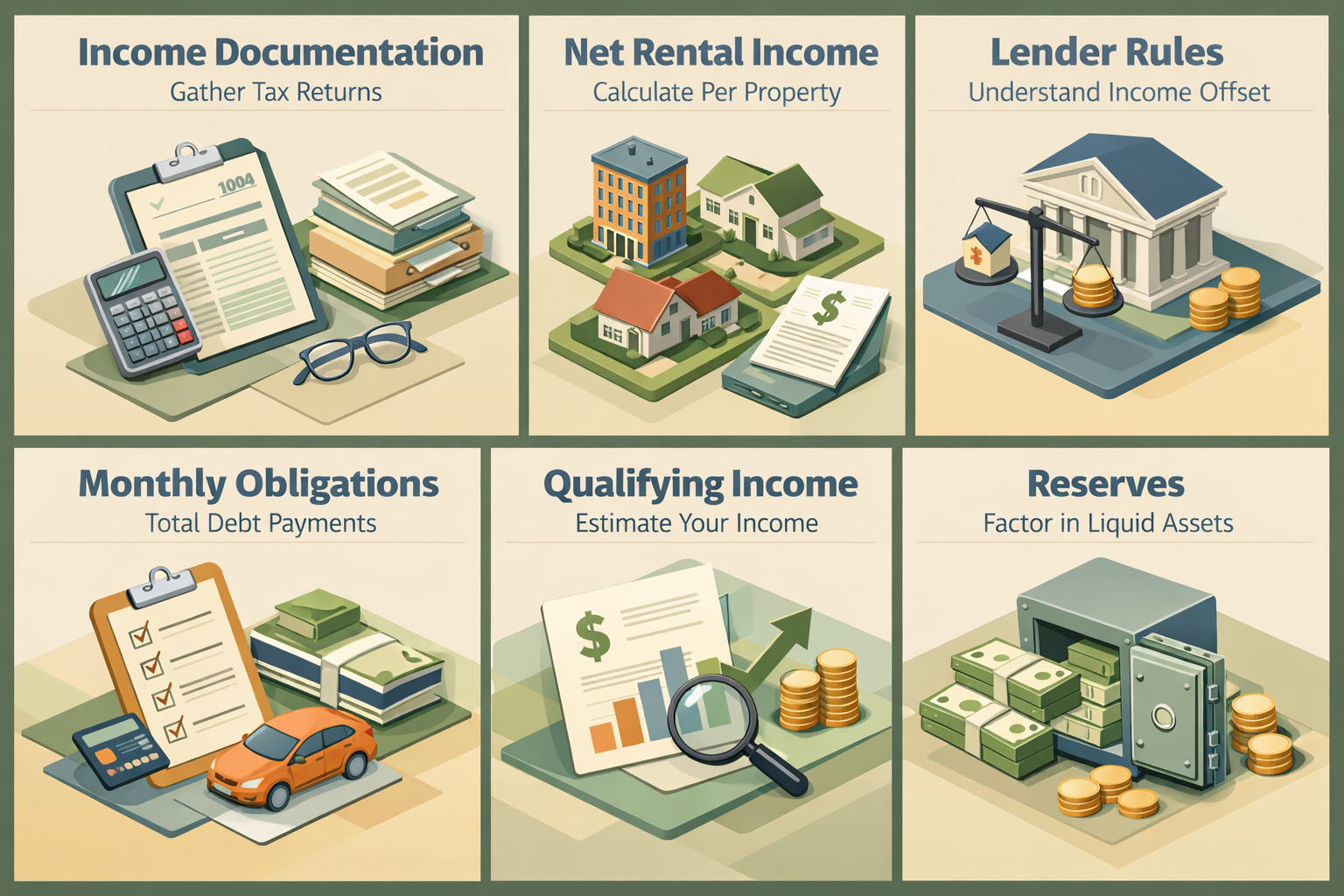
Understanding how to calculate mortgage affordability with rental income from multiple Airbnb properties requires pulling together several data points. Here's a practical framework to estimate where you stand before approaching a lender:
Step 1: Gather Your Income Documentation
Pull your last two years of federal tax returns, focusing on Schedule E for each rental property. Note the gross rents received and the total expenses listed. The net rental income figure on Schedule E is typically your starting point. Also collect your Airbnb income summaries and bank statements to corroborate the figures.
Step 2: Calculate Net Rental Income Per Property
For each Airbnb property, take the gross annual rental income from your tax return and subtract allowable expenses. Divide the result by 12 to get a monthly net income figure. If a property shows a net loss, that loss will likely count against your qualifying income.
Step 3: Apply the Lender's Income Offset Rules
Some lenders allow you to use net rental income to offset the property's monthly payment. Others require that the income exceed the full PITI (principal, interest, taxes, and insurance) payment before any positive income is counted. Check with your lender on their specific guidelines, as this step varies considerably.
Step 4: Total Your Monthly Obligations
Add up all monthly debt payments — including mortgages on your primary residence and each investment property, car loans, student loans, credit card minimum payments, and any other recurring obligations. This is your total monthly debt load for DTI purposes.
Step 5: Estimate Your Qualifying Income
Add together your base income (salary, self-employment income, etc.) and any net rental income mortgage affordability your lender will count. Divide your total monthly debt by your qualifying income to get your DTI ratio. If the result is below your lender's threshold, you're likely in a strong position to qualify.
Step 6: Factor In Reserves
Lenders often require that investors hold several months of mortgage payments in reserve for each financed property. The more Airbnb properties you own, the higher your reserve requirement may be. Make sure liquid assets are sufficient to meet these requirements alongside your down payment.
Documentation Strategies That Help Airbnb Investors Qualify More Easily
One of the biggest hurdles for Airbnb investors applying for a mortgage is documentation. Because short-term rental income is irregular and platform-based, presenting it clearly and compellingly to a lender takes preparation. Here are some strategies that may improve your chances:
- Keep your tax returns consistent and complete: Lenders rely heavily on tax filings. Ensure your rental income is accurately reported on Schedule E each year, and that all properties are listed. Unreported income — even if it was earned — won't help you qualify.
- Maintain detailed records: Create a property-by-property income and expense log that aligns with your tax return. This helps underwriters follow the numbers without confusion, which can speed up approval.
- Provide Airbnb income summaries: Download annual income reports from your Airbnb host dashboard and include them in your application package. While these may be supplemental, they help validate your tax return figures.
- Consider a letter of explanation: If your income dropped in a particular year due to travel restrictions, seasonal slowdowns, or property renovations, a brief explanation letter can prevent an underwriter from viewing the decline as a red flag.
- Work with a lender experienced in short-term rental income: Not all loan officers are familiar with Airbnb income nuances. Partnering with a lender who regularly works with real estate investors can make a meaningful difference in how smoothly your application is handled.
Alternative Lending Options for Airbnb Property Investors
If traditional mortgage qualification feels out of reach due to income complexity, there are several alternative lending products worth exploring. These options may be particularly relevant if you're self-employed, if your tax return shows significant deductions that reduce net income, or if your Airbnb portfolio is growing faster than your conventional income history can support.
DSCR Loans
Debt Service Coverage Ratio loans are designed specifically for investment properties. Instead of evaluating your personal income, lenders assess whether the property's rental income is sufficient to cover its debt obligations. A DSCR of 1.0 means income equals the debt payment; most lenders prefer a ratio of 1.1 or higher. This type of loan can be a strong fit for investors with multiple Airbnb property mortgages who have substantial portfolio cash flow but complex personal tax situations.
Bank Statement Loans
Non-QM bank statement programs allow lenders to calculate income based on 12 to 24 months of bank deposits rather than tax returns. For Airbnb investors who take many business deductions, this approach could reflect a higher qualifying income than Schedule E would show.
Portfolio Loans
Some local banks and credit unions offer portfolio loans — mortgages they hold in-house rather than selling to the secondary market. These lenders may have more flexibility in how they evaluate short-term rental income, making them worth a conversation if traditional lenders are hesitant.
Each of these options comes with trade-offs, including potentially higher interest rates, larger down payment requirements, or stricter reserve standards. It's important to compare the total cost of each option before committing.
●Conclusion
Calculating mortgage affordability when you earn income from multiple Airbnb properties isn't as simple as adding up your deposits and plugging them into a calculator. Lenders apply specific documentation standards, income averaging methods, and DTI frameworks that can significantly affect how much borrowing power you actually have. The good news is that with careful preparation — organized tax returns, detailed property records, and a clear understanding of how lenders view rental income mortgage affordability — many short-term rental investors are able to qualify for financing that supports their growth. Whether you pursue a conventional loan, a DSCR product, or a bank statement program, working with a knowledgeable lender who understands your income structure is one of the most valuable steps you can take. If you're ready to explore your options, connecting with a lending specialist who works regularly with investment property borrowers can help you map out a clear path forward.