
If you earn income from freelancing, sales commissions, or alimony, you might already know that applying for a mortgage feels a little different than it does for a salaried employee. Lenders look at your finances through a very specific lens, and income that varies from month to month — or that comes from multiple sources — requires extra documentation and careful calculation. The good news is that knowing how to calculate mortgage affordability with freelance commission income and alimony puts you in a much stronger position before you ever walk into a lender's office. This article walks you through the key concepts, the math lenders use, and the practical steps you can take to move closer to homeownership with confidence.
Why Non-Traditional Income Makes Mortgage Qualification More Complex
Most mortgage underwriting guidelines are built around predictable, consistent income — think a W-2 employee who receives the same paycheck every two weeks. When your income comes from commissions, freelance contracts, or court-ordered support payments like alimony, lenders have to work a little harder to determine how stable and reliable that income actually is.
This doesn't mean you can't qualify for a mortgage. It simply means the process involves more documentation and a deeper review of your income history. Lenders are generally looking for income that is stable, consistent, and likely to continue for at least three years. Each of your income types — freelance earnings, commissions, and alimony — may be evaluated using different methods, and understanding those methods is the first step toward building a solid application.
For self-employed borrowers and commission earners especially, the challenge is that your taxable income — what actually appears on your tax returns after deductions — may be significantly lower than what you actually earn. This is a critical point that many first-time buyers overlook when using a self-employed mortgage calculator or estimating their own buying power.
How Lenders Calculate Freelance and Self-Employment Income for a Mortgage
When you're self-employed or earn freelance income, most conventional lenders will typically require at least two years of self-employment history. They'll usually average your net income across those two years after reviewing your federal tax returns, including any business returns if applicable. Some lenders may use a shorter history if your income has been growing steadily, but this can vary by lender and loan program.
Here's a simplified version of how the math often works for freelancers:
- Start with your net profit from your Schedule C (or your share of business income from a partnership or S-corp).
- Add back certain deductions that don't represent actual cash outflows, such as depreciation or depletion allowances.
- Average the adjusted figures across your two most recent tax years to arrive at a monthly qualifying income.
For example, if your adjusted net income was $60,000 in year one and $72,000 in year two, a lender might calculate your qualifying monthly income at approximately $5,500 — the average of both years divided by 12. Keep in mind that if your income declined significantly in the second year, some lenders may use the lower figure rather than the average. This conservative approach is designed to protect both the lender and the borrower from overextending.
Using a self-employed mortgage calculator can help you estimate your qualifying income before you apply, but it's always worth confirming the exact calculation method with your loan officer, since guidelines can vary between lenders and loan types.
How Commission Income Is Evaluated by Mortgage Underwriters
Commission-based earners — such as real estate agents, financial advisors, or sales professionals — face a similar documentation challenge. Even if you receive a W-2 from your employer, if more than a certain portion of your income comes from commissions, lenders will typically treat you more like a self-employed borrower than a standard salaried employee.
As a general rule, if commission income makes up a significant share of your total earnings — often cited as 25% or more — lenders will usually want to see a two-year history of that income and will average it over that period. You'll likely need to provide:
- Two years of W-2 forms and federal tax returns
- Recent pay stubs showing year-to-date earnings
- A written verification of employment from your employer
The key concern for lenders is whether your commission income is likely to continue. If you recently changed industries or employers, or if your commission structure has changed significantly, that could raise questions about income continuity. Commission earners with a long, consistent track record in the same field tend to have an easier time qualifying.
When thinking about DTI for commission earners, remember that lenders use your averaged qualifying income — not your best month or your highest year — to calculate how much of your gross monthly income goes toward debt payments. We'll cover debt-to-income ratio in more detail in the next section.
Using Alimony as Qualifying Income: What Lenders Look For
Alimony, also sometimes called spousal support or maintenance, can often be counted as qualifying income for a mortgage — but only under certain conditions. Lenders will generally require proof that the payments are stable and that they're likely to continue for a meaningful period after the mortgage closes, typically at least three years.
To use alimony as qualifying income, you'll usually need to provide:
- A copy of your divorce decree or separation agreement that clearly outlines the payment amount and duration
- Documentation showing that payments have been received consistently, such as bank statements covering the past 12 months
- Proof that the paying party has a history of making payments on time
It's worth noting that you are generally not required to disclose alimony income if you'd prefer not to use it for qualification purposes. However, if you need it to meet income thresholds, it can be a powerful addition to your mortgage application — especially for borrowers whose other income sources fall slightly short of what's needed to qualify for the home they want.
One important detail: lenders may be cautious if the alimony agreement is set to expire within a few years of the loan closing. If the payments are scheduled to end soon, the lender may not be able to count that income at all. Be transparent with your loan officer about the terms of your agreement so they can guide you accordingly.
How to Calculate Mortgage Affordability With Freelance Commission Income and Alimony Combined
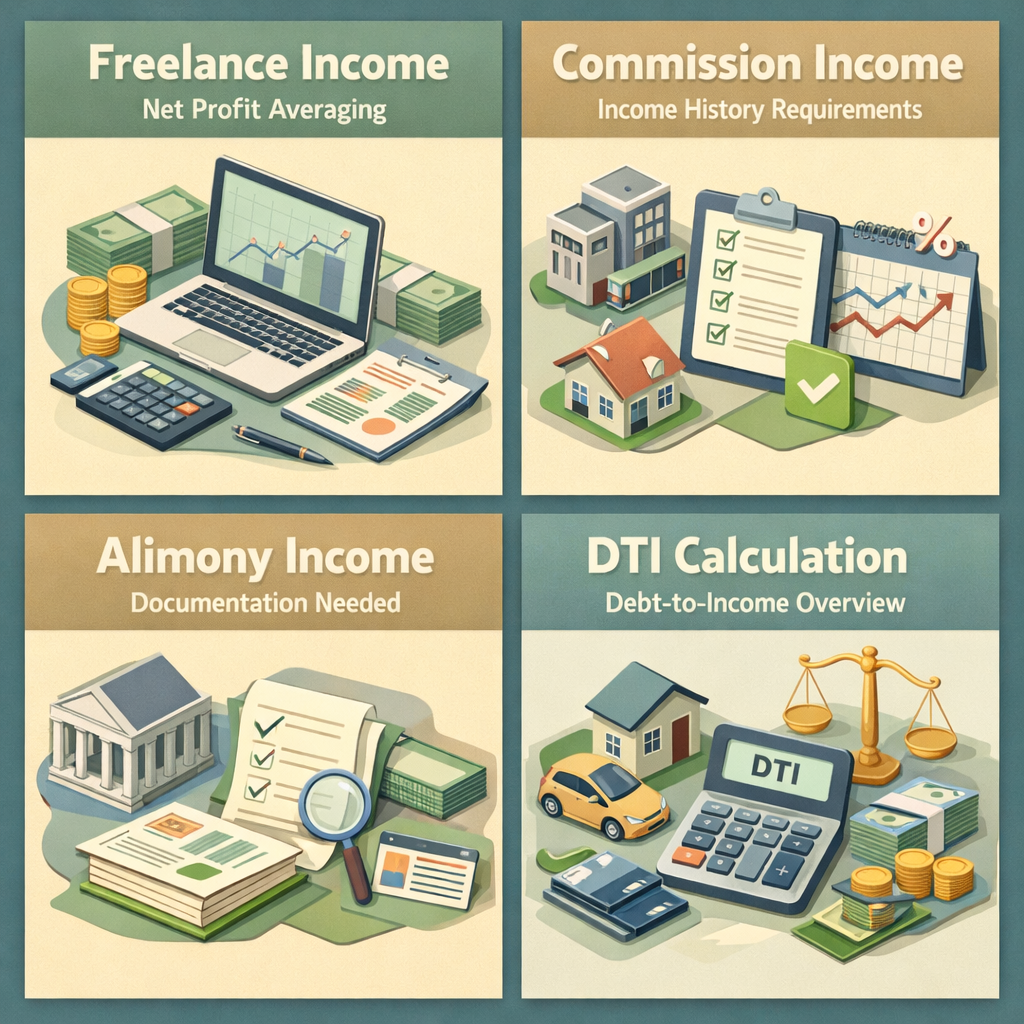
So how do you actually put this all together? How to calculate mortgage affordability with freelance commission income and alimony comes down to one central concept: your debt-to-income ratio, commonly called DTI.
Your DTI measures how much of your gross monthly income goes toward monthly debt obligations. Lenders typically look at two versions:
- Front-end DTI: Your proposed monthly housing payment (including principal, interest, taxes, insurance, and any HOA fees) divided by your gross monthly income.
- Back-end DTI: All monthly debt payments — including housing, car loans, student loans, credit cards, and other obligations — divided by your gross monthly income.
For most conventional loans, lenders often prefer a back-end DTI of 43% or below, though some programs may allow higher ratios with compensating factors like strong credit or significant reserves. FHA loans may allow somewhat higher DTI ratios depending on other qualifying factors.
Here's a simplified example of how the math works when you're combining income sources:
- Averaged freelance net income: $4,200 per month
- Averaged commission income: $1,800 per month
- Qualifying alimony income: $1,000 per month
- Total gross qualifying income: $7,000 per month
If your total monthly debt payments — including your target mortgage — come to $2,800, your back-end DTI would be approximately 40%, which could fall within an acceptable range for many loan programs. Using a loan officer's guidance or a reliable self-employed mortgage calculator to model these numbers before you apply can help you set a realistic target home price and avoid surprises during underwriting.
Documentation Tips to Strengthen Your Application as a Non-Traditional Earner
One of the most important things you can do when applying for a mortgage affordability review with variable or non-traditional income sources is to be organized and proactive with your paperwork. Lenders dealing with commission earners, freelancers, and alimony recipients often spend more time in the review process, and delays are usually caused by missing or incomplete documentation.
Here are some practical steps to prepare:
- File your taxes on time and accurately. Your tax returns are the foundation of your income verification. Unfiled returns or returns with large discrepancies can create major roadblocks.
- Keep clean records of all income. Bank statements, 1099 forms, invoices, and payment histories all help paint a clear picture of your earning patterns.
- Avoid large deductions in the year before applying. While tax deductions reduce your tax liability, they also reduce your qualifying income. Consider discussing this with a tax advisor and your loan officer before the tax year in which you plan to apply.
- Maintain a strong credit profile. For non-traditional earners, a high credit score can serve as a powerful compensating factor that may give lenders more flexibility on DTI or documentation requirements.
- Build up reserves. Having several months' worth of mortgage payments saved in a bank or investment account signals financial stability and may improve your odds of approval.
If your documentation situation is complicated, you might also want to explore non-QM loan programs — sometimes called non-qualified mortgage loans — which are designed specifically for borrowers whose income doesn't fit the standard mold. These programs may use bank statements, asset depletion, or other alternative income documentation methods.
●Conclusion
Navigating a mortgage application with freelance income, commission earnings, and alimony doesn't have to be overwhelming. The key is understanding how lenders view each income source, gathering the right documentation, and doing the math on your DTI for commission earners and other income streams before you apply. Knowing how to calculate mortgage affordability with freelance commission income and alimony gives you a realistic picture of your buying power — and a clear path forward. Whether you're a first-time homebuyer or a seasoned homeowner looking to refinance, working with an experienced loan officer who understands non-traditional income can make all the difference. At LoanWise, we're here to help you find the right path to homeownership, no matter how your income is structured. Reach out today to explore your options.