
Buying a high-value home is an exciting goal, but financing it with a jumbo mortgage requires careful planning — especially when part of your income comes from overtime. Many homebuyers assume that because they earn strong gross wages, qualifying for a large loan should be straightforward. The reality is a bit more nuanced. Lenders scrutinize every dollar of income when underwriting a jumbo loan, and variable earnings like overtime are evaluated differently than a steady base salary. If you're trying to figure out how to calculate jumbo mortgage affordability with overtime pay, this guide will walk you through the process step by step, so you can approach the application process with confidence.
What Makes Jumbo Mortgages Different From Conventional Loans
A jumbo mortgage is a home loan that exceeds the conforming loan limits set each year by the Federal Housing Finance Agency (FHFA). Because these loans are too large to be purchased by Fannie Mae or Freddie Mac, lenders take on the full risk themselves. That shift in risk is exactly why jumbo underwriting standards tend to be stricter than those for conventional loans.
For borrowers, this means more scrutiny across several key areas: credit scores, cash reserves, debt-to-income ratios, and — critically — how income is verified and calculated. While a conventional loan might follow standardized guidelines for variable income, jumbo lenders often apply their own overlays, meaning the rules can vary from one lender to the next.
Understanding this landscape is the first step toward knowing how to calculate jumbo mortgage affordability with overtime pay accurately. The good news is that overtime income can be used to qualify — but it typically needs to meet certain criteria before lenders will count it toward your borrowing power.
How Lenders View Overtime Income for Jumbo Loan Qualification
Most jumbo lenders treat overtime pay as variable income, meaning it's not guaranteed month to month. Because of this, underwriters generally won't count overtime at face value the way they would a base salary. Instead, they look for a consistent pattern over time before including it in your qualifying income.
Lenders' views on overtime for jumbo loans typically center on two major factors: history and continuity. Here's what that usually means in practice:
- Two-year history: Most lenders want to see at least 24 months of documented overtime earnings on your tax returns and pay stubs before they'll count it as stable income.
- Likelihood of continuation: Underwriters may ask your employer to confirm that overtime opportunities are expected to continue. A letter of employment or a verbal verification of employment (VVOE) is sometimes requested.
- Consistency of hours: Sporadic or declining overtime may raise red flags. Lenders typically prefer to see overtime that is steady or increasing over the two-year period.
- Averaging method: Rather than using your most recent pay stub amount, lenders generally average your overtime earnings over 24 months to arrive at a monthly figure.
It's worth noting that some portfolio lenders — those who hold jumbo loans on their own books — may have more flexible approaches to variable income. Shopping around and working with a knowledgeable mortgage broker can make a real difference in how much of your overtime income ultimately gets counted.
Step-by-Step: Using a Jumbo Mortgage Calculator With Overtime Income
Using a jumbo mortgage calculator overtime income approach means you need to first establish your accurate qualifying monthly income before plugging numbers into any tool. Here's how to work through that process:
Step 1 — Calculate Your Average Monthly Overtime
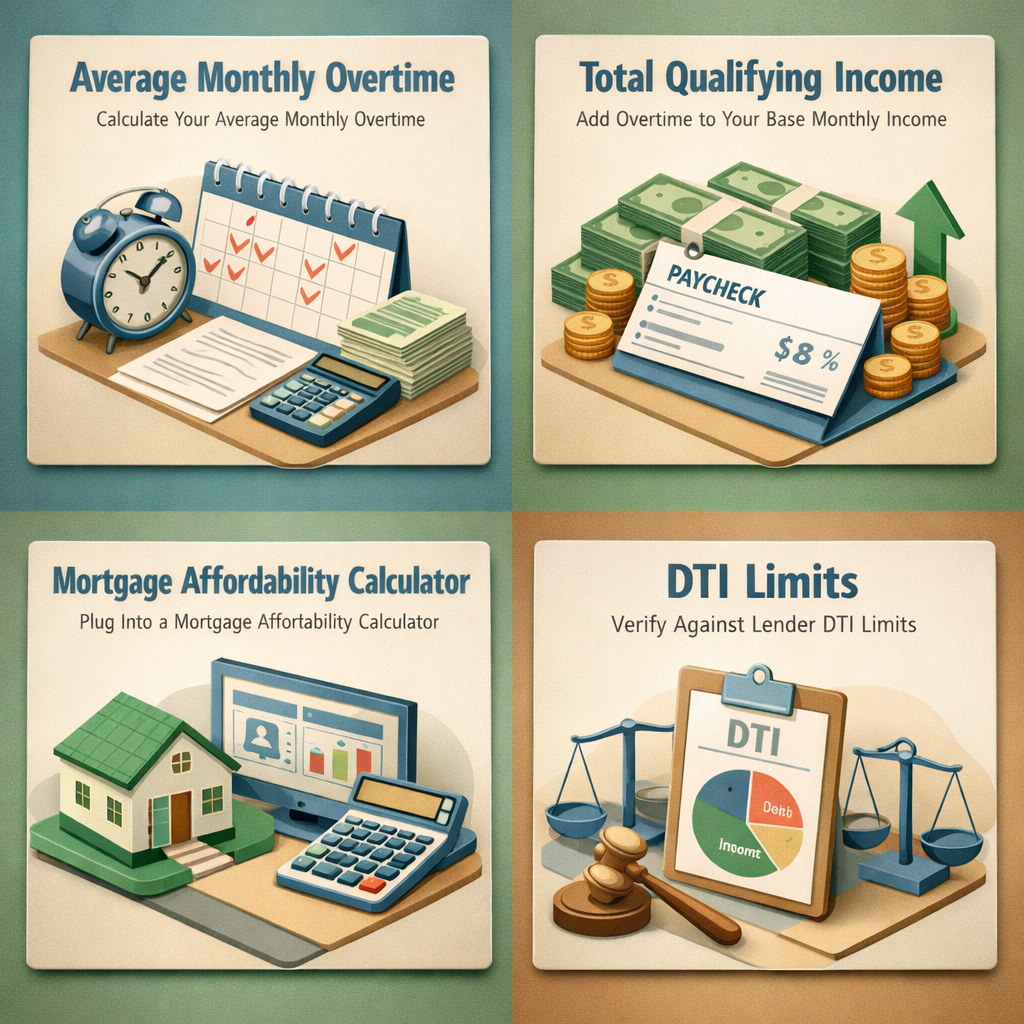
Pull your W-2 forms or tax returns from the past two years and identify the total overtime you received in each year. Add those two figures together and divide by 24 to get your average monthly overtime income. For example, if you earned $18,000 in overtime in Year 1 and $22,000 in Year 2, your total is $40,000. Divided by 24 months, that gives you approximately $1,667 per month in qualifying overtime income.
Step 2 — Add Overtime to Your Base Monthly Income
Once you have your average monthly overtime figure, add it to your gross monthly base salary. This combined figure is what lenders will typically use as your total qualifying monthly income. If your base salary is $8,500 per month and your qualifying overtime averages $1,667 per month, your total qualifying income is approximately $10,167 per month.
Step 3 — Plug Into a Mortgage Affordability Calculator
With your qualifying income established, you can now use a jumbo mortgage affordability calculator. Enter your total qualifying monthly income, your estimated monthly debts (credit cards, car payments, student loans), expected property taxes, homeowner's insurance, and any HOA fees. The calculator will estimate the maximum loan amount you may qualify for based on your debt-to-income ratio.
Step 4 — Verify Against Lender DTI Limits
Keep in mind that jumbo lenders often set tighter DTI thresholds than conventional loan programs. While some conventional loans may allow a back-end DTI up to 45% or even 50% in some cases, many jumbo lenders prefer to see a back-end DTI at or below 43%. Some may go lower, particularly for very large loan amounts. Always confirm the specific DTI limits with your lender before relying solely on a calculator result.
DTI Calculation for Jumbo Loans With Variable Overtime Pay
The DTI calculation for jumbo overtime income follows the same foundational formula used in all mortgage underwriting, but the inputs require extra care when variable pay is involved. Your debt-to-income ratio is expressed as a percentage and is calculated as follows:
DTI = Total Monthly Debt Obligations ÷ Gross Monthly Qualifying Income × 100
There are two types of DTI that lenders evaluate:
- Front-end DTI: This includes only your proposed housing costs — principal, interest, taxes, insurance, and HOA fees if applicable — divided by your gross monthly income. Many jumbo lenders prefer a front-end DTI below 28% to 31%.
- Back-end DTI: This includes all monthly debt obligations, including the proposed housing payment plus credit cards, auto loans, student loans, and other recurring debts. Jumbo lenders commonly look for a back-end DTI under 43%, though this can vary.
Here's a practical example. Suppose your qualifying monthly income — after properly averaging your overtime — is $10,167. Your proposed jumbo mortgage payment is $4,200 per month, and your other monthly debts total $800. Your back-end DTI would be ($4,200 + $800) ÷ $10,167, which equals approximately 49%. That would likely be too high for most jumbo lenders.
To bring your DTI into an acceptable range, you might consider paying down existing debts before applying, making a larger down payment to reduce the loan amount, or demonstrating additional qualifying income if available. Understanding this math before you apply helps you set realistic expectations and avoid surprises during underwriting.
Documentation You'll Need to Verify Overtime Income
Jumbo lenders are thorough when it comes to income documentation, and variable income like overtime requires a particularly organized paper trail. Before you apply, it's smart to gather the following:
- Two years of W-2 forms: These provide a clear record of all income earned, including overtime, separated from your base wages.
- Most recent 30 days of pay stubs: Pay stubs should clearly show year-to-date overtime earnings, which lenders use to confirm the income pattern is continuing.
- Federal tax returns (1040s): Lenders typically request two years of complete personal tax returns to cross-reference against your W-2s and confirm consistent income reporting.
- Employment verification letter: Some jumbo lenders may ask your employer to confirm your position, base salary, and whether overtime is expected to continue.
- 12 to 24 months of bank statements: Portfolio lenders in particular may request bank statements to verify that overtime deposits align with what's shown on your pay stubs and tax returns.
Being proactive about organizing these documents can speed up the underwriting process considerably. Gaps or inconsistencies in your income history — such as a year where overtime dropped significantly — may prompt additional questions from underwriters, so it's wise to be prepared to explain any fluctuations in writing.
Tips for Strengthening Your Jumbo Loan Application With Overtime Pay
Qualifying for jumbo loan with variable income is absolutely achievable, but a few strategic steps can meaningfully improve your chances of approval and help you qualify for the loan amount you need.
Build a Robust Cash Reserve
Jumbo lenders typically require larger cash reserves than conventional lenders — often 12 months or more of mortgage payments held in liquid accounts after closing. Strong reserves signal financial stability and can partially offset concerns about variable income.
Maintain an Excellent Credit Profile
Most jumbo lenders look for a credit score of at least 700, and many prefer scores of 720 or higher. A strong credit history demonstrates reliability and may give you access to better interest rates and more flexible underwriting terms.
Consider a Larger Down Payment
A down payment of 20% or more is generally expected for jumbo loans, though some lenders may accept slightly less with strong compensating factors. A larger down payment reduces the loan-to-value ratio, which lowers the lender's risk and may make them more receptive to qualifying variable income like overtime.
Work With a Jumbo-Experienced Lender
Not all lenders have the same appetite for jumbo lending or the same approach to variable income. A lender or broker with specific experience in jumbo mortgage underwriting may know which portfolio lenders are more flexible when it comes to averaging overtime pay or accepting income from multiple sources.
●Conclusion
Knowing how to calculate jumbo mortgage affordability with overtime pay puts you in a much stronger position when you're ready to finance a high-value home. The key is understanding that overtime income can count — but it needs to be documented carefully, averaged appropriately, and evaluated against your full debt picture. By organizing your income history, calculating your qualifying DTI with realistic numbers, and working with a lender who understands jumbo underwriting, you can make a compelling case for the loan you need. If you're ready to explore your options, the team at LoanWise is here to help you navigate the process with clarity and confidence.