
Buying a home is one of the most meaningful financial decisions you can make — and disability income shouldn't stand in the way of that goal. Whether you receive Social Security Disability Insurance (SSDI), Supplemental Security Income (SSI), or long-term disability payments through a private insurer, many lenders may count these income sources when evaluating your mortgage application. Understanding how to calculate mortgage affordability with disability income is the first step toward turning your homeownership goals into reality. This guide walks you through the key concepts, the math lenders use, and the programs that could help you qualify.
Why Disability Income Counts Toward Mortgage Qualification
Many homebuyers assume that disability income qualifies for a mortgage won't hold up under mortgage scrutiny. That's often not the case. Lenders are generally required under the Fair Housing Act and the Equal Credit Opportunity Act to consider all legal, verifiable income sources — including disability benefits — when making lending decisions. Refusing to count disability income without a legitimate underwriting reason could be considered discriminatory.
That said, lenders do apply specific standards when verifying disability income. They'll typically want to confirm that the income is stable, ongoing, and likely to continue for at least the next three years. If you can demonstrate that your benefits are not set for review or termination in the near term, most lenders will treat your disability income similarly to wage-based income.
Common types of disability income that may be accepted include:
- Social Security Disability Insurance (SSDI) — federally funded benefits for workers who have paid into Social Security and can no longer work due to disability
- Supplemental Security Income (SSI) — needs-based income support for disabled individuals with limited resources
- Long-term disability (LTD) insurance — employer-sponsored or privately purchased disability coverage
- Veterans disability compensation — monthly payments from the VA for service-connected disabilities
- Workers' compensation — may be considered depending on whether it's ongoing or temporary
Each income type may come with its own documentation requirements and continuity standards, so it's worth checking with your lender about what they'll need upfront.
How to Calculate Mortgage Affordability With Disability Income
The core of any mortgage qualification is your debt-to-income ratio (DTI) — a simple comparison of your monthly debt obligations to your gross monthly income. Knowing how to calculate what you can afford with disability income means understanding this ratio inside and out.
Here's how it generally works:
- Step 1 — Add up your gross monthly income: Include all verified, ongoing disability income. If your SSDI benefit letter states a monthly payment amount, that's your starting figure. If any of your disability income is non-taxable (which SSDI often is for lower-income recipients), some lenders may gross it up — meaning they increase the stated amount by a factor of 15–25% to reflect its higher net value compared to taxable wages.
- Step 2 — Calculate your total monthly debt payments: Include minimum payments on credit cards, auto loans, student loans, and any other recurring obligations.
- Step 3 — Add your estimated housing costs: This includes your projected mortgage principal and interest, property taxes, homeowners insurance, and any HOA fees or mortgage insurance premiums.
- Step 4 — Divide total debts by gross income: The result is your DTI ratio, expressed as a percentage.
Most conventional lenders prefer a DTI at or below 43–45%, though some programs may allow slightly higher ratios with compensating factors such as strong credit or a larger down payment. FHA loans may accommodate DTIs up to 50% in some cases.
Example: If your total monthly disability income (after grossing up if applicable) is $3,200, and your existing monthly debts are $400, you may have room for a housing payment of approximately $1,000–$1,200 before hitting a 45% DTI threshold. That translates to a mortgage amount that could range considerably depending on interest rates and loan term — which is why using an online mortgage calculator alongside these figures can help you model different scenarios.
Disability Income Mortgage Requirements Lenders Typically Look For
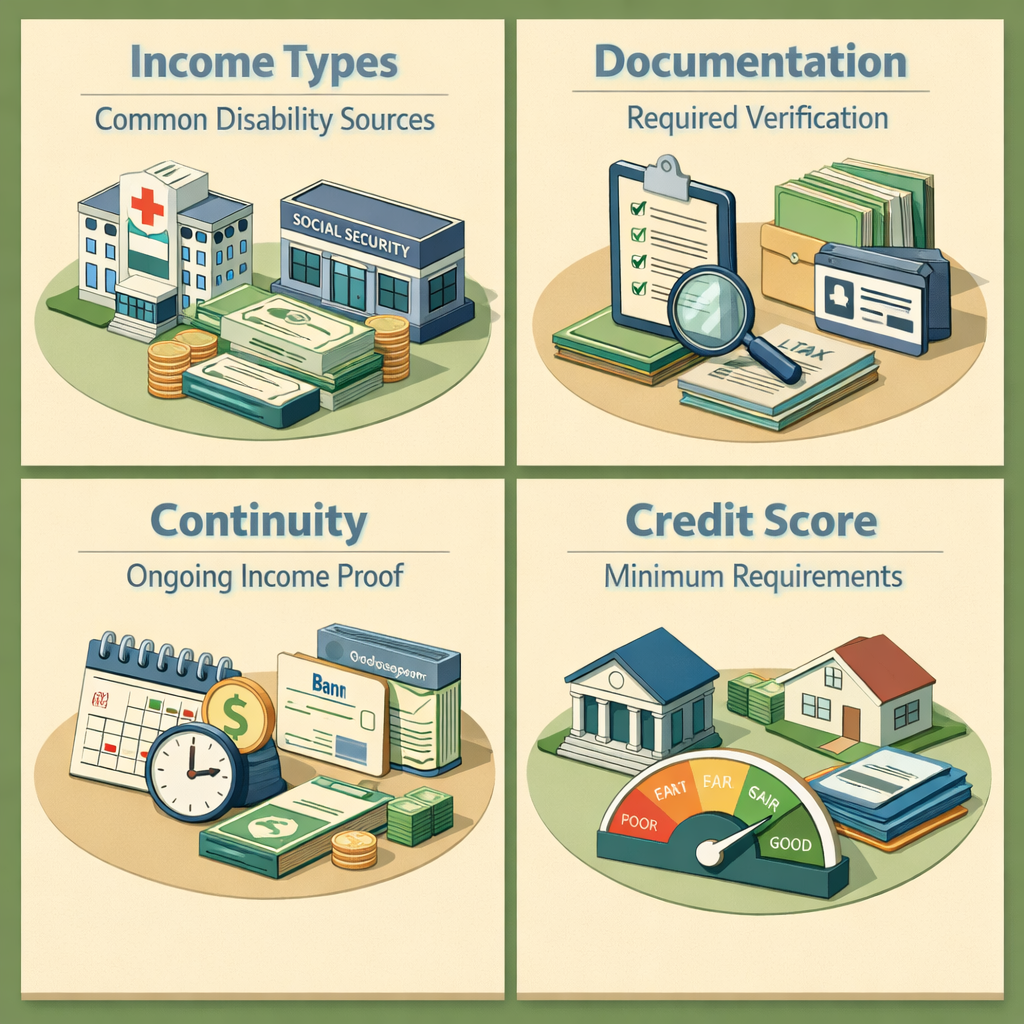
Understanding disability income mortgage requirements is essential before you start shopping for a home loan. While requirements can vary by lender and loan type, there are common standards that most underwriters will apply when evaluating disability income.
Documentation You May Need
Lenders will generally ask for one or more of the following documents to verify your disability income:
- A Social Security award letter or benefit verification letter dated within the past 12 months
- A bank statement history showing consistent monthly deposits that match the award letter
- For LTD income, a current policy document or employer letter confirming the benefit amount and expected duration
- For VA disability income, a letter from the Department of Veterans Affairs confirming the payment amount and entitlement
Continuity and Stability Requirements
One of the most important disability income mortgage requirements is continuity. Lenders typically want to see evidence that your income will continue for at least 36 months from the closing date. For SSDI recipients who are not subject to a scheduled review in the near future, this standard is often easier to meet. SSI and other benefit types may require more documentation to confirm ongoing eligibility.
Credit Score Considerations
Your credit score still plays a significant role in mortgage approval. Depending on the loan program, you may need a minimum score of 580–620 for government-backed loans or 620–640 for conventional options. If your credit history has been affected by medical debt or past financial hardship related to your disability, it may be worth taking time to address inaccuracies on your credit report before applying.
Loan Programs That May Work Well for Disabled Homebuyers
Several mortgage programs are particularly well-suited to borrowers relying on disability income. Exploring these options can help you find out which loan programs may work best for your situation.
FHA Loans
FHA loans, backed by the Federal Housing Administration, are often a strong choice for disabled homebuyers. They may accept lower credit scores, allow higher DTI ratios, and require a down payment as low as 3.5%. FHA guidelines explicitly allow SSDI and SSI as qualifying income, provided continuity requirements are met.
VA Loans
If you're a veteran receiving VA disability compensation, you may qualify for a VA home loan — one of the most favorable mortgage products available. VA loans typically require no down payment and no private mortgage insurance. Veterans with a service-connected disability rating of 10% or higher may also be exempt from the VA funding fee, which can save thousands of dollars at closing.
USDA Loans
For buyers interested in rural or suburban properties, USDA loans backed by the U.S. Department of Agriculture offer zero-down financing with competitive rates. USDA guidelines allow disability income to count toward qualification as long as it meets continuity and documentation standards.
Conventional Loans with Fannie Mae or Freddie Mac Guidelines
Both Fannie Mae and Freddie Mac have guidelines that permit Social Security disability income to be used for qualifying purposes. Fannie Mae's HomeReady program and Freddie Mac's Home Possible program offer reduced mortgage insurance premiums and flexible income guidelines that may benefit lower-income disabled homebuyers.
State and Local Housing Assistance Programs
Many states offer down payment assistance grants, low-interest second mortgages, or housing vouchers specifically for buyers with disabilities. The HUD website and your state housing finance agency are good starting points for discovering what might be available in your area.
The "Gross-Up" Strategy and How It Can Boost Your Buying Power
One often-overlooked advantage of disability income is the potential for income grossing up. Because certain forms of disability income — particularly SSDI — may be received tax-free, lenders are often permitted to increase the stated income amount when calculating your qualifying income. This practice is sometimes called "grossing up" the income.
The logic is straightforward: a tax-free dollar is worth more than a taxable dollar of the same amount. A borrower earning $2,500 per month in tax-free SSDI may have the same purchasing power as someone earning $2,900–$3,125 in taxable wages, depending on their tax bracket.
Lenders typically apply a gross-up factor of around 15–25%, though specific guidelines vary by loan program. For example:
- Fannie Mae and Freddie Mac generally allow non-taxable income to be grossed up by up to 25%
- FHA guidelines have historically allowed a similar adjustment, though borrowers should confirm current guidelines with their lender
- VA loan guidelines may also permit grossing up non-taxable disability compensation
This strategy could meaningfully increase the loan amount you qualify for. If you're receiving non-taxable disability income, make sure your lender or loan officer knows to apply this adjustment — not all lenders will do so automatically.
Common Challenges and How to Work Around Them
While the path to homeownership with disability income is genuinely accessible, it's not without hurdles. Being aware of potential challenges ahead of time can help you prepare more effectively.
Inconsistent Benefit Amounts
Some disability benefits are subject to periodic cost-of-living adjustments or reviews that may temporarily create inconsistency in your payment history. Lenders may look at a 12–24 month average of deposits to establish a reliable income baseline. Keeping your bank statements organized and up to date can simplify this process.
Limited Credit History
Some disabled individuals, particularly those who became disabled early in life, may have a thin credit file. Building credit through a secured credit card or becoming an authorized user on a family member's account can help establish a stronger profile over time.
Lender Awareness
Not all loan officers are equally familiar with how to handle disability income. Working with a lender who has direct experience with government-backed loans and non-traditional income types can make a significant difference. Don't hesitate to ask potential lenders how they've handled disability income applications in the past.
Property Accessibility Needs
For some disabled homebuyers, finding a property that meets accessibility requirements adds another layer of complexity. It's worth noting that HUD's Section 504 Rehab Loan program and some state programs may offer grants or low-interest loans to fund accessibility modifications — which could reduce the immediate cost burden and expand your property options.
●Conclusion
Homeownership is well within reach for many individuals living with disabilities. By understanding how to calculate mortgage affordability with disability income, knowing what documentation lenders require, and exploring programs designed to support your situation, you can approach the mortgage process with confidence. The key is to work with knowledgeable lending professionals, gather your documentation early, and take advantage of every qualifying tool available — including income grossing up and down payment assistance programs. At LoanWise, we're here to help you navigate each step of the journey. Connect with one of our mortgage specialists today to get started on a path toward the home you deserve.