
If you've recently received a year-end bonus or performance incentive, you might be wondering whether that extra income could help you qualify for a larger mortgage. The good news is that lenders can consider bonus pay when evaluating your application — but there are specific rules about how it's counted. Understanding how to calculate mortgage affordability with recent bonus income could be the difference between qualifying for the home you want and falling just short. This guide walks you through how lenders treat bonus pay, what documentation you'll need, and how to make the most of your variable income when shopping for a home loan.
What Counts as Bonus Income in a Mortgage Application
Not all income is treated equally when you apply for a mortgage. Lenders typically divide income into two broad categories: base income and variable income. Bonus pay falls firmly in the variable category, alongside overtime, commission, and self-employment earnings.
Variable income is considered less predictable than a fixed salary, so lenders apply additional scrutiny before including it in your qualifying figures. That said, bonus income can absolutely be used — it just needs to meet certain conditions to be counted reliably.
Generally speaking, lenders look for the following before accepting bonus income as part of your qualifying earnings:
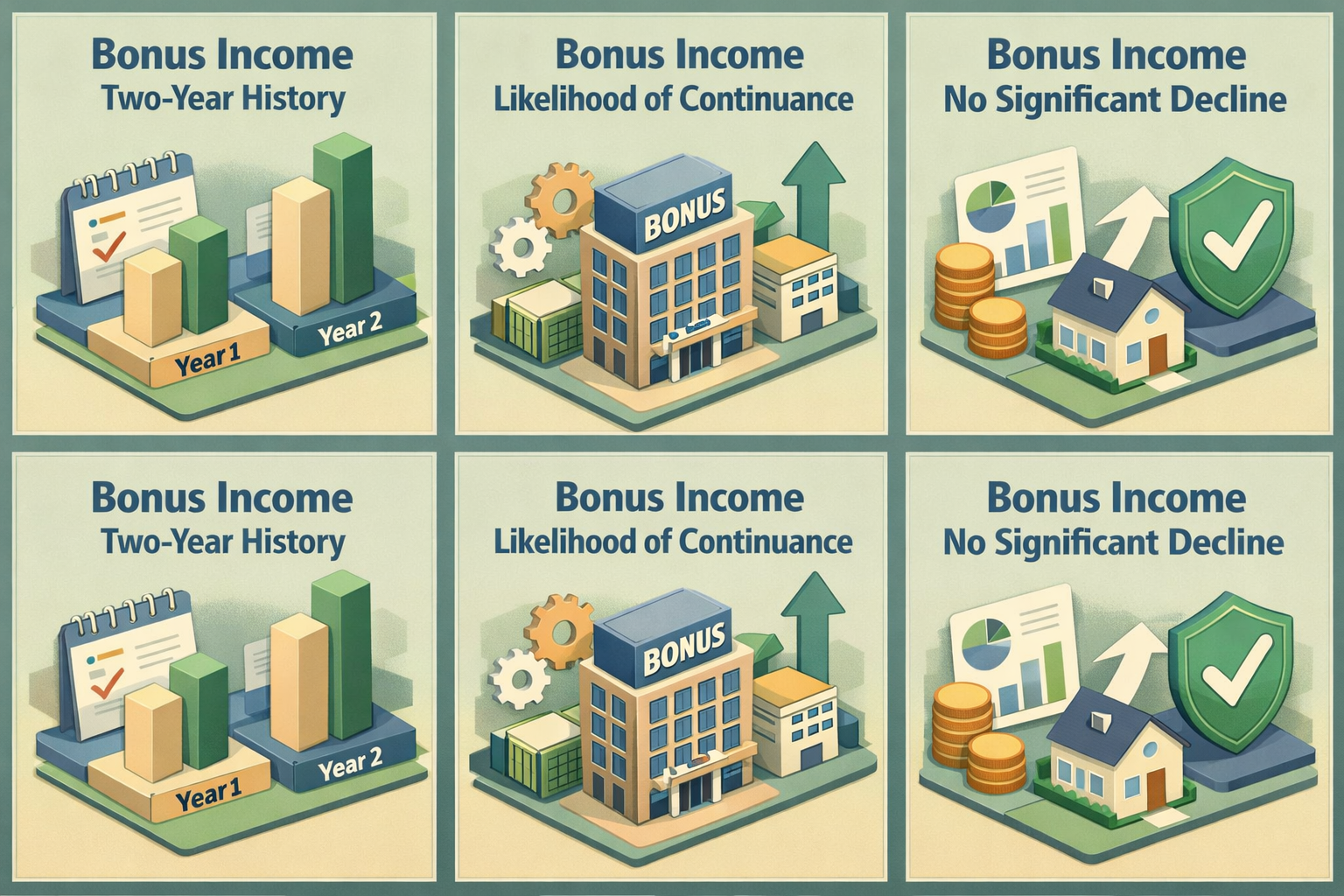
- Two-year history: Most lenders want to see that you've received bonus pay consistently for at least two years. This is often verified through W-2 forms and tax returns.
- Likelihood of continuance: The lender may ask your employer to confirm that your bonus structure is expected to continue. A verification of employment letter or written confirmation from your employer can help here.
- No significant decline: If your bonus income has dropped sharply from one year to the next, lenders may discount it or exclude it entirely.
It's worth noting that a single bonus — especially one received recently for the first time — may not be usable at all until a track record is established. If you're in that situation, it's still worth discussing your options with a loan officer, as some lenders may have more flexible guidelines than others.
How Lenders Calculate Average Bonus Pay for Qualifying Purposes
Once a lender determines that your bonus income is eligible, they'll typically average it over a specific period to arrive at a monthly qualifying figure. Here's how that process generally works:
A lender will add up your total bonus earnings over the past 24 months and divide by 24 to get a monthly average. For example, if you received a $10,000 bonus in year one and a $12,000 bonus in year two, your total bonus income over two years is $22,000. Divided by 24 months, that gives you approximately $916 per month in qualifying bonus income.
This monthly figure is then added to your base salary to determine your total gross monthly income, which is used to calculate your debt-to-income (DTI) ratio — one of the most critical factors in mortgage affordability.
It's important to understand that lenders may use the lower of the two-year average or the most recent year's income if there's a downward trend. Conversely, some loan programs may allow the most recent year to be used if it's higher and can be properly documented. This is why working directly with an experienced mortgage professional can be so valuable — program rules vary by loan type and lender.
Understanding Debt-to-Income Ratio With Bonus Pay Included
Your DTI ratio compares your total monthly debt obligations to your gross monthly income. Most conventional loan programs prefer a DTI at or below 43%, though some programs may allow higher ratios with compensating factors. When bonus income is properly documented and included, it can meaningfully reduce your DTI and help you qualify for a higher loan amount.
Using a Mortgage Affordability Calculator With Bonus Pay
A mortgage affordability calculator bonus pay feature allows you to input not just your base salary but also variable income sources like bonuses. These tools can give you a useful starting estimate of how much home you might be able to afford — before you ever speak to a lender.
When using an online mortgage affordability calculator, here's how to incorporate your bonus income accurately:
- Use your averaged monthly bonus figure: Rather than entering your full annual bonus as a lump sum, divide it by 12 and add it to your monthly income field. For example, a $12,000 annual bonus becomes $1,000 per month.
- Be conservative if income varies: If your bonus has fluctuated year to year, consider using the lower annual figure to get a more cautious estimate.
- Include all monthly debts: Credit cards, auto loans, student loans, and other recurring obligations should all be factored in to get an accurate DTI estimate.
- Factor in down payment and rate assumptions: Most calculators will ask for an estimated interest rate and down payment amount. Use current market rates as a guide, and remember that a larger down payment can improve your affordability range.
Keep in mind that online calculators are helpful planning tools, but they can't replicate the full underwriting process. They won't account for your credit score, the specific loan program you're using, or individual lender guidelines. Treat them as a directional estimate, not a guaranteed approval figure.
When to Speak With a Loan Officer Instead of Relying on a Calculator
If your income picture is complex — such as a mix of salary, bonuses, commissions, and possibly self-employment income — a mortgage affordability calculator may not give you the full picture. In these cases, a pre-qualification or pre-approval conversation with a licensed loan officer is likely to be more informative and more accurate.
Documentation You'll Need to Verify Bonus Income
One of the most important steps in the mortgage process is gathering the right paperwork. When it comes to bonus income, lenders typically require more documentation than they would for a straightforward salaried position. Being prepared can help speed up your approval and reduce the chance of surprises during underwriting.
Here's what you'll likely need to provide:
- Two years of W-2 forms: These show your total annual earnings, including any bonuses paid through your employer's payroll system.
- Two years of federal tax returns: Lenders use these to cross-reference your reported income and identify any deductions that might affect your qualifying figures.
- Recent pay stubs (usually 30 days): Pay stubs help confirm your current earnings and may show year-to-date bonus payments if you've already received one in the current year.
- Employer verification letter: Some lenders may request a letter from your employer confirming that your bonus structure is ongoing and the amounts received are accurate.
- Bank statements: These can serve as additional evidence that bonus payments were actually deposited, particularly if the amounts are large.
If you've recently changed jobs but still receive a bonus, documentation requirements may be more stringent. Lenders generally want to see stability, so a job change within the past year or two could complicate how your bonus income is treated — though it doesn't necessarily disqualify it.
How Different Loan Programs Treat Bonus Income
The way bonus income is evaluated can differ depending on which mortgage program you're applying for. Here's a general overview of how some common loan types approach variable income:
Conventional Loans
Conventional loans backed by Fannie Mae or Freddie Mac typically follow guidelines that require a two-year history of bonus income and documentation supporting its continuance. These programs are often the most straightforward when it comes to using bonus pay, as the guidelines are well-established and widely understood by lenders.
FHA Loans
FHA loans, insured by the Federal Housing Administration, also generally require a two-year history for variable income. However, FHA guidelines may offer some flexibility in how that income is averaged or weighted, which could be beneficial depending on your situation. Speaking with an FHA-approved lender can help clarify what's possible.
VA Loans
VA loans, available to eligible veterans and service members, also consider bonus income when it can be documented and shown to be stable. VA lenders typically follow residual income analysis in addition to DTI, which can sometimes work in borrowers' favor when income sources are diverse.
Jumbo Loans
Jumbo loans — those exceeding conforming loan limits — are issued by individual lenders without government backing, which means guidelines can vary significantly. Some jumbo lenders may be more or less flexible with bonus income, and documentation requirements can be more thorough. If your bonus income is a major factor in qualifying for a jumbo mortgage, it's worth shopping multiple lenders.
Practical Tips to Strengthen Your Application When Relying on Bonus Income
If bonus pay is a meaningful part of your income, there are several steps you can take to give yourself the best possible chance of a smooth mortgage approval.
- Apply after receiving your bonus: If your bonus is paid annually and you can time your application, applying shortly after receiving and depositing your bonus can strengthen your documentation and reduce any gaps in your paper trail.
- Keep your credit in good shape: A strong credit score can help compensate for any uncertainty around variable income. Lenders are often more flexible with borrowers who present a lower overall risk profile.
- Reduce existing debts before applying: Paying down credit card balances or other loans before applying can improve your DTI ratio, which may offset any bonus income that's discounted or excluded.
- Save a larger down payment: A higher down payment reduces the loan amount you need, which lowers the income required to qualify. This can be especially useful if your bonus history is shorter than lenders would ideally like.
- Work with a lender experienced in variable income: Not all loan officers handle complex income situations equally well. Choosing a lender with experience in variable and bonus income can make a real difference in both the accuracy of your pre-approval and the smoothness of your underwriting process.
Knowing how to calculate mortgage affordability with recent bonus income isn't just a technical exercise — it's a practical step toward making smarter homebuying decisions. The more clarity you have going in, the more confidently you can strengthen your application and shop for a home within your true financial reach.
●Conclusion
Bonus income can be a powerful asset in your mortgage application — but only if it's properly documented, consistently received, and carefully presented to the right lender. Whether you're using a mortgage affordability calculator with bonus pay to do initial research or working through the details with a loan officer, taking the time to understand how variable income is evaluated puts you in a much stronger position. At LoanWise, we understand that income comes in many forms, and we're here to help you navigate the path to homeownership with confidence. Ready to find out how much home you can afford? Connect with a LoanWise mortgage specialist today and let's run the numbers together.