
For homebuyers, real estate investors, and self-employed borrowers, the mortgage qualification process can feel like navigating a maze. One of the most important numbers lenders look at is your debt-to-income ratio, or DTI. But when your income comes from rental properties or freelance 1099 work rather than a traditional paycheck, the calculation isn't always straightforward. Understanding how to calculate DTI with rental property income and freelance 1099 work could be the key to unlocking your next home loan or investment property purchase. This guide walks you through the process step by step.
What Is DTI and Why Does It Matter for Mortgage Approval
Your debt-to-income ratio is a simple but powerful metric. It compares your total monthly debt obligations to your gross monthly income. Lenders use it to gauge whether you can comfortably manage a new mortgage payment on top of your existing financial commitments.
The basic formula looks like this:
- DTI = Total Monthly Debt Payments ÷ Gross Monthly Income × 100
For example, if your total monthly debts equal $2,500 and your gross monthly income is $8,000, your DTI would be approximately 31.25%. Most conventional loan programs prefer a DTI at or below 43%, though some lenders may allow higher ratios with compensating factors like strong credit scores or significant reserves.
Where things get more nuanced is when your income doesn't come from a single employer. Rental property cash flow and freelance earnings are treated differently than W-2 wages, and understanding those differences is essential for anyone who earns income from multiple non-traditional sources.
How Lenders View Freelance and 1099 Self-Employment Income
Freelancers and independent contractors typically receive 1099 forms rather than W-2s. From a lender's perspective, this type of income requires extra scrutiny because it can fluctuate month to month. Most lenders will not simply take your most recent paycheck or invoice total as proof of income.
Instead, mortgage underwriters typically average your net self-employment income over the most recent two years using your federal tax returns. This means they look at your adjusted gross income after business deductions — not your gross revenue. If you wrote off significant expenses, your qualifying income may be lower than you expect.
Here's how it generally works:
- Lenders review your Schedule C (Profit and Loss for Sole Proprietors) or Schedule K-1 if you operate through a partnership or S-corporation.
- They add back certain non-cash deductions, such as depreciation, to arrive at a more accurate income figure.
- The two-year average is then divided by 24 to calculate a monthly qualifying income amount.
If your freelance income has been increasing year over year, some lenders may use the most recent year only, though policies vary by lender and loan program. It's worth discussing your specific situation with a mortgage professional who has experience with self-employed borrowers.
Breaking Down Rental Property Income in the DTI Calculation
Rental property income adds another layer of complexity to the DTI equation. Whether you own one rental property or several, lenders have specific methods for determining how much of that income can count toward your qualifying total — and how the associated debts are treated.
Using Rental Income as Qualifying Income
To use rental income in a mortgage application, lenders typically require documentation such as signed lease agreements, current rent rolls, and federal tax returns showing Schedule E (Supplemental Income and Loss). Similar to freelance income, lenders usually average rental income over two years from your tax returns.
One important detail: lenders often apply a vacancy factor, typically discounting reported rental income by around 25%, to account for periods when a unit might be unoccupied or expenses arise. So if your rental property generates $2,000 per month in gross rent, a lender might only credit $1,500 toward your qualifying income.
How Rental Property Mortgage Debt Is Counted
If your rental property carries a mortgage, that monthly payment will typically be included in your total monthly debt obligations — even if the rental income more than covers it. However, if you can demonstrate through tax returns that the property generates a net positive cash flow, some loan programs may allow the lender to offset the mortgage payment with rental income rather than stacking both into your debt side.
If the property shows a net rental loss on your tax returns, that loss may actually be added to your monthly debt obligations, increasing your DTI. This is why tax strategy matters deeply for real estate investors applying for mortgages.
Step-by-Step Guide: How to Calculate DTI With Rental Property Income and Freelance 1099 Work
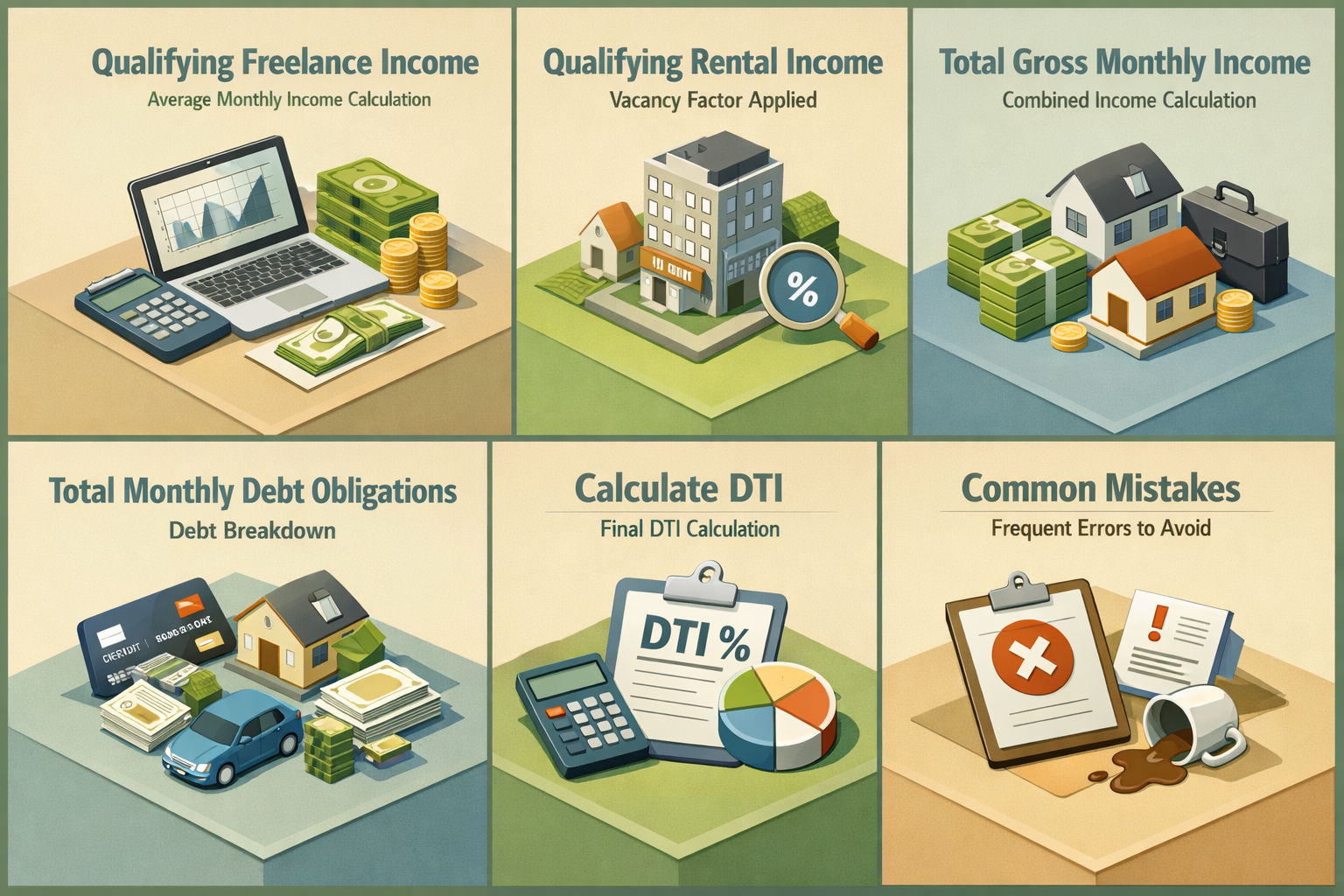
Let's walk through a practical example that combines both income streams. This will help illustrate the debt-to-income ratio calculation for landlords and self-employed borrowers in a clear, concrete way.
Step 1 — Calculate Your Qualifying Freelance Income
- Year 1 net self-employment income (after deductions): $52,000
- Year 2 net self-employment income (after deductions): $60,000
- Two-year average: $56,000 ÷ 12 = $4,667 per month
Step 2 — Calculate Your Qualifying Rental Income
- Gross monthly rent collected: $2,000
- Apply 25% vacancy/expense factor: $2,000 × 0.75 = $1,500 per month
- Alternatively, use two-year average from Schedule E if available
Step 3 — Total Gross Monthly Income
- Freelance income: $4,667
- Rental income: $1,500
- Total: $6,167 per month
Step 4 — Total Monthly Debt Obligations
- Proposed new mortgage payment (PITI): $1,800
- Rental property mortgage: $900 (if not offset by rental income)
- Auto loan: $400
- Minimum credit card payments: $150
- Total monthly debts: $3,250
Step 5 — Calculate DTI
- $3,250 ÷ $6,167 = approximately 52.7% DTI
In this example, the DTI exceeds the conventional preferred threshold. However, if the rental property qualifies for income offsetting — reducing the rental mortgage payment from the debt side — the DTI could drop significantly. This is where working with a knowledgeable lender becomes critical.
Common DTI Mistakes Landlords and Freelancers Make When Applying for a Mortgage
Even well-prepared borrowers sometimes stumble during the underwriting process. Here are some of the most frequent errors that could affect your approval:
- Assuming gross income counts: Lenders look at net income after deductions, not your top-line revenue. Overestimating your qualifying income is one of the most common mistakes self-employed borrowers make.
- Ignoring rental property losses: If your rental property shows a loss on your tax return due to deductions like depreciation, that loss can hurt your DTI rather than help it.
- Not having two years of history: Most conventional lenders want to see at least two years of self-employment or landlord history. If you started freelancing or renting recently, your income may not yet be considered stable enough to use.
- Missing documentation: Lease agreements, 1099 forms, Schedule C and Schedule E filings, and business bank statements are typically all required. Incomplete paperwork can delay or derail the process.
- Excessive write-offs: While tax deductions reduce your tax burden, they also reduce your qualifying income. Finding the right balance between tax efficiency and mortgage qualification is something many self-employed borrowers need to think through carefully.
Loan Program Options That May Work Better for Non-Traditional Income Borrowers
If conventional loan DTI requirements feel out of reach given the way your income is structured, there may be alternative mortgage programs worth exploring.
Bank Statement Loans
Some lenders offer bank statement mortgage programs designed specifically for self-employed borrowers and freelancers. Instead of relying on tax returns, these programs use 12 to 24 months of personal or business bank statements to calculate qualifying income. This can significantly increase the amount of income a lender will recognize, especially if your revenue is strong but your taxable income is reduced by deductions.
Debt Service Coverage Ratio (DSCR) Loans
For real estate investors, DSCR loans are a popular option. Rather than calculating DTI based on your personal income, these loans evaluate whether the rental property itself generates enough income to cover its own mortgage payment. This can be a powerful tool for landlords who own multiple properties or whose personal income structure makes traditional qualification challenging.
Asset Depletion Loans
Some borrowers with significant liquid assets but irregular income may qualify through asset depletion programs, where a lender converts a portion of your investment or savings account balance into a monthly income figure. Policies vary widely, so it's worth asking lenders whether this option applies to your situation.
Exploring non-QM (non-qualified mortgage) programs through a lender experienced in debt-to-income ratio calculation for landlords and self-employed borrowers may open doors that traditional underwriting keeps closed.
Tips to Improve Your DTI Before Applying for a Mortgage
If your current DTI is higher than lenders prefer, there are several strategies that might help you improve your position before submitting a mortgage application.
- Pay down existing debts: Reducing balances on credit cards or paying off smaller loans can lower your monthly debt obligations, which directly improves your DTI.
- Increase documented income: If possible, consider reducing excessive deductions on your tax return in the year or two before applying. While this may increase your tax bill, it could also raise your qualifying income significantly.
- Build a rental income track record: If you're new to being a landlord, give yourself time to build a documented two-year history before applying for a new mortgage using that income.
- Work with a CPA and a mortgage advisor together: Having both professionals collaborate on your financial picture can help you strike the right balance between tax efficiency and loan qualification.
- Consider a larger down payment: A larger down payment reduces your loan amount, which lowers your proposed monthly mortgage payment and improves your front-end DTI ratio.
Planning ahead — ideally 12 to 24 months before you intend to purchase or refinance — gives you the most flexibility to optimize your financial profile for lender review.
●Conclusion
Understanding how to calculate DTI with rental property income and freelance 1099 work is genuinely one of the more complex areas of mortgage lending. The rules can vary by loan program, lender, and even the specific way your income is documented. But with the right preparation, the right documentation, and guidance from a lender experienced in non-traditional income scenarios, qualifying for a mortgage as a landlord or self-employed borrower is absolutely achievable. At LoanWise, we specialize in helping borrowers with complex income profiles find the financing solutions that fit their unique situations. Reach out today to speak with a mortgage professional who understands your world.