
Real estate investors often face unique challenges when seeking traditional mortgage financing, particularly when their personal income doesn't reflect their investment property's cash flow potential. DSCR loans, or Debt Service Coverage Ratio loans, have emerged as a game-changing solution for property investors who need financing based on rental income rather than personal income verification. This comprehensive guide explores how these innovative loan products work and why they're becoming increasingly popular among savvy real estate investors.
Understanding DSCR Loans and How They Work
DSCR loans represent a fundamental shift in how lenders evaluate investment property financing applications. Unlike traditional mortgages that heavily scrutinize personal income through tax returns and pay stubs, these loans focus primarily on the property's ability to generate sufficient rental income to cover mortgage payments.
The debt service coverage ratio itself is calculated by dividing the property's net operating income by its total debt service. For example, if a rental property generates $2,400 monthly in net rental income and the mortgage payment is $2,000, the DSCR would be 1.2. This ratio demonstrates that the property generates 20% more income than needed to cover the mortgage payment, providing a cushion for the lender.
Most lenders typically require a DSCR of at least 1.0, though many prefer ratios of 1.25 or higher. This requirement ensures that rental income alone can sustain the mortgage payments, reducing the lender's risk while providing investors with more predictable cash flow management.
Key Benefits for Real Estate Investors
DSCR loans offer numerous advantages that make them particularly attractive to real estate investors. Perhaps most significantly, these loans don't require extensive personal income documentation, making them ideal for self-employed investors, those with complex tax situations, or individuals whose personal income doesn't accurately reflect their financial capacity.
The streamlined qualification process often results in faster approvals and closings, which can be crucial in competitive real estate markets. Investors can move quickly on promising opportunities without waiting for lengthy income verification processes that might cause them to lose out to cash buyers or faster-moving competitors.
Additionally, DSCR loans typically allow investors to finance multiple properties more easily. Since each property is evaluated based on its own income-generating potential rather than the borrower's cumulative debt-to-income ratio, investors can build larger portfolios without being constrained by traditional lending limitations. This scalability makes DSCR financing particularly valuable for investors focused on portfolio growth and expansion.
Qualification Requirements and Eligibility Criteria
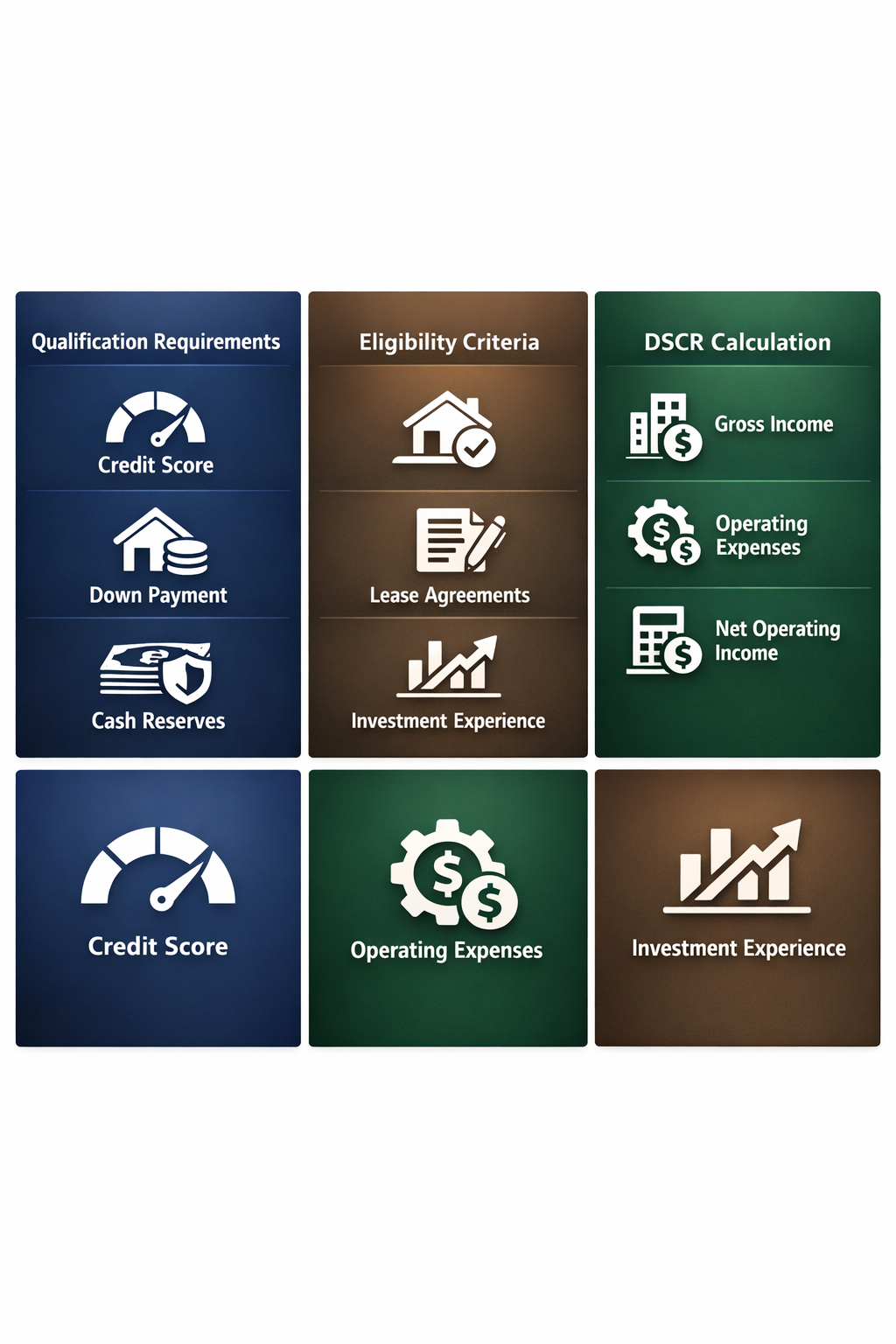
While DSCR loans offer more flexibility than traditional mortgages, they still maintain specific qualification requirements that borrowers must meet. Credit score requirements typically range from 640 to 680 minimum, though some lenders may accept lower scores with compensating factors such as larger down payments or higher cash reserves.
Down payment requirements for DSCR loans often range from 20% to 25% for single-family rental properties, with some lenders requiring higher amounts for multi-unit properties or commercial investments. Cash reserves are another important consideration, with most lenders requiring borrowers to maintain several months of mortgage payments in liquid assets as a safety buffer.
The property itself must meet certain criteria as well. It should be in rentable condition and located in areas with stable rental markets. Some lenders may require current lease agreements or rent rolls to verify income potential, while others might use market rent analysis to determine the property's income-generating capacity. Investment experience, while not always mandatory, can strengthen an application and potentially lead to better terms.
DSCR Calculation Methods and Requirements
Understanding how lenders calculate debt service coverage ratios is crucial for investors evaluating potential properties. The calculation begins with determining the property's gross rental income, typically based on current leases, market rent analysis, or appraisal rent schedules. From this gross income, lenders subtract vacancy allowances, usually ranging from 5% to 10%, and operating expenses.
Operating expenses might include property taxes, insurance, property management fees, and maintenance reserves, though the specific inclusions can vary between lenders. Some lenders use a simplified approach, applying a standard percentage for operating expenses, while others require detailed expense breakdowns based on actual property operating statements.
The resulting net operating income is then divided by the total debt service, including principal, interest, taxes, and insurance. Different lenders may have varying approaches to calculating this ratio, and some might consider additional factors such as homeowners association fees or special assessments. Understanding these calculation nuances helps investors better evaluate properties and anticipate loan approval likelihood before making purchase decisions.
Comparing DSCR Loans to Traditional Investment Property Financing
The differences between DSCR loans and conventional investment property mortgages extend beyond just income verification requirements. Interest rates for DSCR loans are often slightly higher than traditional mortgages, reflecting the increased flexibility and reduced documentation requirements. However, this rate difference might be offset by the speed and certainty of approval that DSCR loans provide.
Traditional investment property loans typically require extensive documentation including tax returns, bank statements, employment verification, and detailed debt-to-income calculations. This process can be time-consuming and may disqualify investors whose personal income doesn't adequately reflect their investment capabilities or those with complex financial situations.
DSCR loans also offer more flexibility in terms of borrower employment status and income sources. While traditional lenders might struggle to evaluate income from multiple rental properties, business ownership, or seasonal employment, DSCR lenders focus primarily on the subject property's income potential. This approach can be particularly beneficial for experienced investors who understand property cash flow but may not fit traditional lending criteria.
Property Types and Investment Strategies
DSCR loans can be used for various property types, though single-family rental properties remain the most common application. Many lenders also offer DSCR financing for small multi-family properties, typically up to four units, making these loans suitable for investors interested in duplex, triplex, or quadplex investments that can provide multiple income streams from a single property.
These loans work particularly well for buy-and-hold investment strategies where investors purchase properties with the intention of generating long-term rental income. The focus on rental income sustainability aligns perfectly with this investment approach, ensuring that properties can support themselves financially without requiring ongoing personal contributions from the investor.
Some DSCR lenders also accommodate fix-and-flip strategies, though the application might be more complex since rental income projections are based on future rather than current cash flows. In these cases, lenders might require detailed renovation plans, contractor estimates, and after-repair value appraisals to assess the property's income potential upon completion of improvements.
Application Process and Documentation Requirements
The DSCR loan application process is typically more streamlined than traditional mortgage applications, though it still requires specific documentation. Borrowers usually need to provide basic personal information, credit authorization, and proof of assets for down payment and reserves. Some lenders may request limited income documentation, particularly for initial qualification purposes.
Property-related documentation forms the core of DSCR loan applications. This might include purchase contracts, current lease agreements, rent rolls for multi-unit properties, and property management statements if applicable. For vacant properties, lenders often rely on market rent analysis provided by licensed appraisers to determine income potential.
The approval timeline for DSCR loans can be significantly shorter than traditional mortgages, often ranging from two to four weeks depending on property complexity and documentation completeness. This expedited process makes DSCR loans particularly attractive in competitive markets where quick closings can mean the difference between securing a property and losing it to other buyers. Working with experienced lenders who specialize in DSCR products can further streamline the process and improve approval odds.
●Conclusion
DSCR loans represent a significant advancement in real estate investment financing, offering investors the flexibility to build portfolios based on property performance rather than personal income constraints. While these loans require careful consideration of property cash flows and may carry slightly higher interest rates, they provide unmatched speed and accessibility for qualified investors. As the rental property market continues to evolve, DSCR financing is likely to become an increasingly important tool for serious real estate investors looking to scale their portfolios efficiently and effectively.