Buying a home is one of the most exciting financial steps you can take — but if your down payment is less than 20%, there's a good chance you'll encounter private mortgage insurance, commonly known as PMI. For many homebuyers, this added cost can feel like an obstacle. But understanding the cost of PMI for conventional loan with low down payment scenarios can help you plan smarter, budget accurately, and make confident decisions about your purchase. In this article, we'll walk through what PMI is, how much it typically costs, what factors influence your rate, and how you can eventually get rid of it.
What Is Private Mortgage Insurance and Why Do Lenders Require It
Private mortgage insurance is a type of insurance policy that protects the lender — not the borrower — in the event that the borrower defaults on the loan. It's typically required on conventional loans when the homebuyer puts down less than 20% of the home's purchase price.
From a lender's perspective, a smaller down payment means more financial exposure. If a borrower only puts down 3% or 5%, the lender is financing a larger share of the home's value, which increases their risk. PMI serves as a financial safety net for that added risk.
It's worth noting that PMI is specific to conventional loans. Government-backed loans like FHA, VA, and USDA have their own forms of mortgage insurance or funding fees, which work differently. If you're using a conventional loan program — backed by Fannie Mae or Freddie Mac — and your down payment is below 20%, PMI will almost certainly be part of your monthly housing costs.
The good news is that PMI is not permanent. Unlike FHA mortgage insurance premiums, which can last the life of the loan under certain conditions, conventional PMI can be removed once you've built sufficient equity in your home. We'll cover how that works in more detail later in this article.
How Much Does PMI Cost on a Conventional Loan — Breaking Down the Numbers
So, how much is PMI on a conventional loan? The short answer is: it varies. PMI rates on conventional loans typically range from around 0.2% to 2% of your original loan amount per year, though most borrowers fall somewhere in the middle of that range. The exact rate you'll pay depends on several factors, which we'll explore in the next section.
To put that into practical terms, consider a homebuyer who purchases a $350,000 home with a 5% down payment. Their loan amount would be $332,500. If their PMI rate is approximately 0.8% annually, that works out to roughly $2,660 per year — or about $222 per month added to their mortgage payment.
For a buyer putting down 10% on that same home, the loan amount drops to $315,000. At a similar PMI rate, the annual cost could be closer to $2,520, or about $210 per month. As you can see, even modest increases in your down payment can have a measurable impact on what you pay for PMI each month.
These figures are illustrative estimates. Your actual PMI cost will depend on your credit score, loan-to-value ratio, loan term, and the specific insurer your lender works with. That's why using a private mortgage insurance calculator conventional tool can be especially helpful when you're comparing loan scenarios during the homebuying process.
Key Factors That Influence Your PMI Rate on a Low Down Payment Mortgage
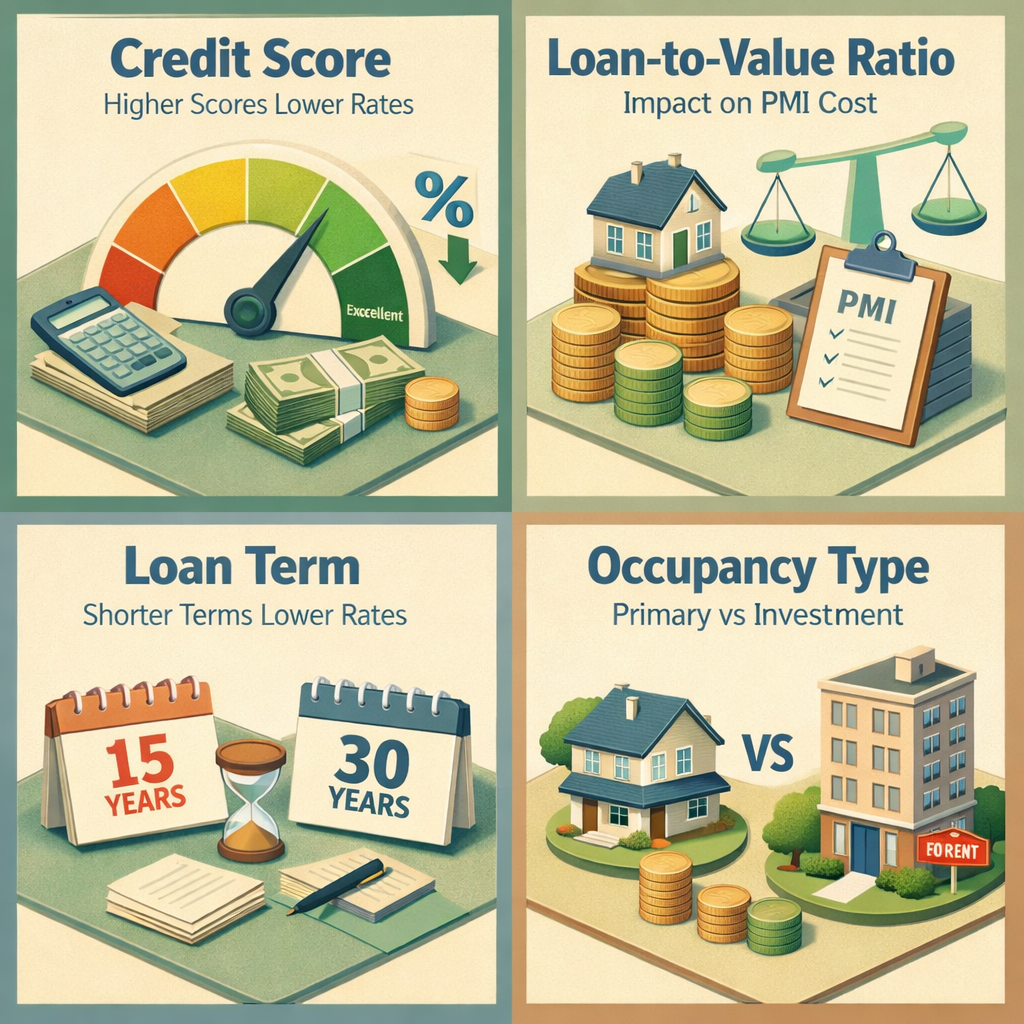
Not every borrower pays the same PMI rates on a low down payment mortgage. Lenders and private mortgage insurers consider several variables when determining your specific rate. Understanding these factors can help you prepare — and potentially save money.
- Credit Score: This is one of the most significant drivers of your PMI rate. Borrowers with higher credit scores are generally considered lower risk and may qualify for lower PMI rates. Conversely, if your credit score is on the lower end, you could end up paying more for mortgage insurance. Improving your credit before applying for a mortgage may help reduce this cost.
- Loan-to-Value (LTV) Ratio: Your LTV ratio compares your loan amount to the home's appraised value. The higher the LTV — meaning the smaller your down payment — the higher your PMI rate tends to be. A 3% low down payment results in a 97% LTV, which typically carries a higher PMI cost than a 10% down payment with a 90% LTV.
- Loan Term: The length of your mortgage can also affect PMI costs. Shorter loan terms may sometimes carry lower PMI rates because the lender's risk exposure decreases more quickly over time.
- Occupancy Type: Primary residences generally receive more favorable PMI rates compared to investment properties or second homes, which are seen as higher risk.
- Fixed vs. Adjustable Rate: Adjustable-rate mortgages (ARMs) may carry different PMI pricing than fixed-rate loans, depending on the insurer and market conditions.
Because so many variables are at play, shopping around and using a private mortgage insurance calculator conventional tool — often available through lenders and mortgage comparison websites — can give you a clearer picture of your potential monthly costs before you commit to a loan.
Different Ways PMI Can Be Structured and Paid
One thing many homebuyers don't realize is that PMI doesn't always have to be paid as a monthly add-on to your mortgage payment. There are a few different structures lenders may offer, and each has its own trade-offs.
Monthly PMI
This is the most common approach. Your PMI premium is divided into 12 equal payments and added to your monthly mortgage bill. It's predictable and straightforward, and it disappears once you reach the required equity threshold. Most borrowers opt for this structure because it requires no large upfront payment.
Single-Premium PMI
With this option, you pay the entire PMI cost upfront at closing as a lump sum. This eliminates the monthly PMI charge, which can lower your ongoing housing payment. However, it requires more cash at closing, and if you sell or refinance in the near term, you may not recoup that full upfront cost.
Lender-Paid PMI (LPMI)
Some lenders offer to cover the PMI cost in exchange for a slightly higher interest rate on your loan. While this eliminates the separate PMI line item from your monthly payment, it's worth doing the math carefully. A higher interest rate affects your payment for the life of the loan, whereas standard PMI can be removed once you build enough equity. Lender-paid PMI may cost you more over the long run, depending on how long you stay in the home.
Split-Premium PMI
This is a hybrid approach where you pay part of the PMI cost upfront and the rest monthly. It can be a good middle ground for borrowers who have some extra cash at closing but don't want to fully exhaust their savings.
Understanding these options can help you have a more informed conversation with your lender about structuring your loan in a way that aligns with your financial goals.
How to Use a Private Mortgage Insurance Calculator for Conventional Loans
If you're trying to estimate your total monthly housing costs before making an offer on a home, a private mortgage insurance calculator conventional loan tool can be incredibly useful. These calculators are designed to give you a reasonable estimate of your PMI costs based on the loan details you enter.
Here's what you'll typically need to have on hand when using one of these tools:
- Home purchase price — the total price of the property you're buying
- Down payment amount or percentage — how much you're putting down upfront
- Loan amount — generally the purchase price minus your down payment
- Credit score range — many calculators ask for a general range rather than an exact number
- Loan term — typically 15 or 30 years for conventional mortgages
- Loan type — fixed-rate vs. adjustable-rate
Once you enter this information, the calculator will provide an estimated monthly PMI cost and may also show you how that cost changes as your down payment increases. This is particularly helpful for buyers who are deciding between putting down 5%, 10%, or 15% — letting you weigh the trade-off between a larger upfront payment and a lower ongoing PMI cost.
Keep in mind that online calculators provide estimates, not guarantees. Your actual PMI rate will be determined by the private mortgage insurer your lender partners with, and rates can vary from one insurer to another. Use private mortgage insurance calculator conventional tools as a planning tool, and confirm your actual costs with your lender once you're further along in the process.
Eliminating PMI on a Conventional Loan — Your Path to a Lower Payment
One of the most important advantages of conventional PMI over FHA mortgage insurance is that it's removable. Eliminating PMI on a conventional loan is a realistic and achievable goal for most homeowners, and knowing the rules can help you plan accordingly.
Automatic Cancellation Under the Homeowners Protection Act
Under federal law — specifically the Homeowners Protection Act (HPA) — lenders are required to automatically cancel PMI once your loan balance reaches 78% of the original purchase price, provided your payments are current. This happens based on the original amortization schedule, so you don't have to take any action. It's built into the loan timeline.
Requesting Cancellation at 80% LTV
You don't have to wait for automatic cancellation. Once your loan-to-value ratio drops to 80% — meaning you've built up 20% equity — you have the right to request that your lender cancel PMI. You'll typically need to submit a written request, have a good payment history, and in some cases, provide a new appraisal to confirm the current value of your home.
Accelerating Equity Through Extra Payments
If you want to reach the 20% equity mark faster, making additional principal payments can help. Even small extra payments each month can shorten your timeline and save you money on PMI costs over the long run.
Home Value Appreciation
If your home's market value has increased significantly since you purchased it, you may reach 20% equity sooner than your amortization schedule suggests. In this case, you could request a new appraisal and ask your lender to cancel PMI based on the updated value. Policies vary by lender, so it's worth asking about the specific requirements.
Refinancing Your Mortgage
Refinancing into a new conventional loan when you have at least 20% equity is another way to eliminating PMI on conventional loan. While this involves closing costs and a new loan application, it may make sense if interest rates have also dropped since you originally purchased your home.
●Conclusion
The cost of PMI for conventional loan with low down payment purchases is a real and important factor to account for in your homebuying budget. While it does add to your monthly expenses, PMI is also what makes it possible for many buyers to purchase a home without waiting years to save a 20% down payment. Understanding how PMI rates are determined, how different payment structures work, and how to eventually eliminate it puts you in a much stronger position as a borrower.
If you're ready to explore your mortgage options or want a personalized estimate of what PMI might look like for your specific situation, the team at LoanWise is here to help. Connect with one of our mortgage specialists today to review your loan scenarios and take the next step toward homeownership with confidence.