
Life doesn't always follow a predictable path — and neither does your income. If you're navigating a career transition, you might find yourself holding a severance package, a portfolio of vested stock options, or both, while also sitting on an adjustable-rate mortgage that's becoming harder to predict. The good news is that refinancing in this situation is possible, though it does require careful planning and a clear understanding of how lenders evaluate unconventional income sources. This guide walks through the best options for refinancing ARM mortgage with severance package and stock options, so you can make an informed decision that protects your home and your financial future.
Why ARM Holders Often Seek Refinancing During Life Transitions
An adjustable-rate mortgage, or ARM, starts with a fixed interest rate for an initial period — commonly five, seven, or ten years — and then adjusts periodically based on a market index. When rates are rising or your employment situation has changed, that upcoming adjustment can feel especially risky.
Homeowners facing a job loss or career shift often worry that a rate adjustment could push their monthly payment beyond what their current income can comfortably support. This concern is entirely valid. Refinancing from an ARM into a fixed-rate mortgage may offer more predictable monthly payments, making it easier to budget during a period of financial uncertainty.
That said, timing matters. Lenders will look closely at your income stability when you apply to refinance. If your salary has recently ended and you're living on severance or investment proceeds, you'll need to document those sources carefully. The refinancing process may be more involved than a standard application, but it's far from impossible.
How Lenders Evaluate Severance Income During a Mortgage Application
When you apply to refinance, lenders want to confirm that you have the ability to repay the loan — not just today, but well into the future. Severance pay complicates this picture because it's temporary by nature. Most conventional lenders, including those following Fannie Mae and Freddie Mac guidelines, may view severance income differently depending on how it's structured.
If your severance is paid out as a lump sum, lenders may not count it as ongoing qualifying income at all. However, if your severance is disbursed in regular installments over a defined period, some lenders may count it as income — provided there's documentation showing the payment schedule and the total duration.
- Written severance agreement: A formal letter from your former employer outlining the payment amount, frequency, and duration is typically required.
- Bank statements: Deposits confirming you've already received severance payments can strengthen your application.
- Asset documentation: Some lenders may consider large liquid asset reserves as a compensating factor, even when income appears limited.
It's also worth noting that if you have a new job offer in hand — even if you haven't started yet — many lenders will consider that as qualifying income with the right documentation, such as an offer letter showing a start date and salary.
Using Stock Options as Income When Refinancing Your Home Loan
Stock options can be a meaningful part of your compensation, but lenders don't treat them the same way they treat a salary. Whether your stock options help or hinder your refinance application depends on several factors, including the type of options, their vesting status, and how recently you've exercised them.
For the stock options mortgage qualification process, most lenders follow guidelines that require a documented two-year history of receiving income from stock options before they'll count it toward your qualifying income. This history is typically verified using two years of federal tax returns, which should reflect the proceeds from exercised options.
Here's what lenders generally look for:
- Vested vs. unvested options: Only vested options that have been exercised and resulted in taxable income are typically counted. Unvested options are generally not considered qualifying income.
- Consistency of income: If your stock option income has varied significantly from year to year, lenders may average the two-year total or use the lower of the two years.
- Employer verification: Lenders may request a letter from your employer — or former employer — confirming that the option grants are ongoing or that additional grants are expected.
- Market volatility risk: Because stock-based compensation is tied to market performance, lenders may apply additional scrutiny compared to salaried income.
If you've recently exercised a large block of options and have proceeds sitting in a brokerage or bank account, those funds may still help your application — particularly as asset reserves rather than income. Lenders often look at reserves to assess financial resilience, and substantial liquid assets could act as a compensating factor.
Best Options for Refinancing ARM Mortgage with Severance Package and Stock Options
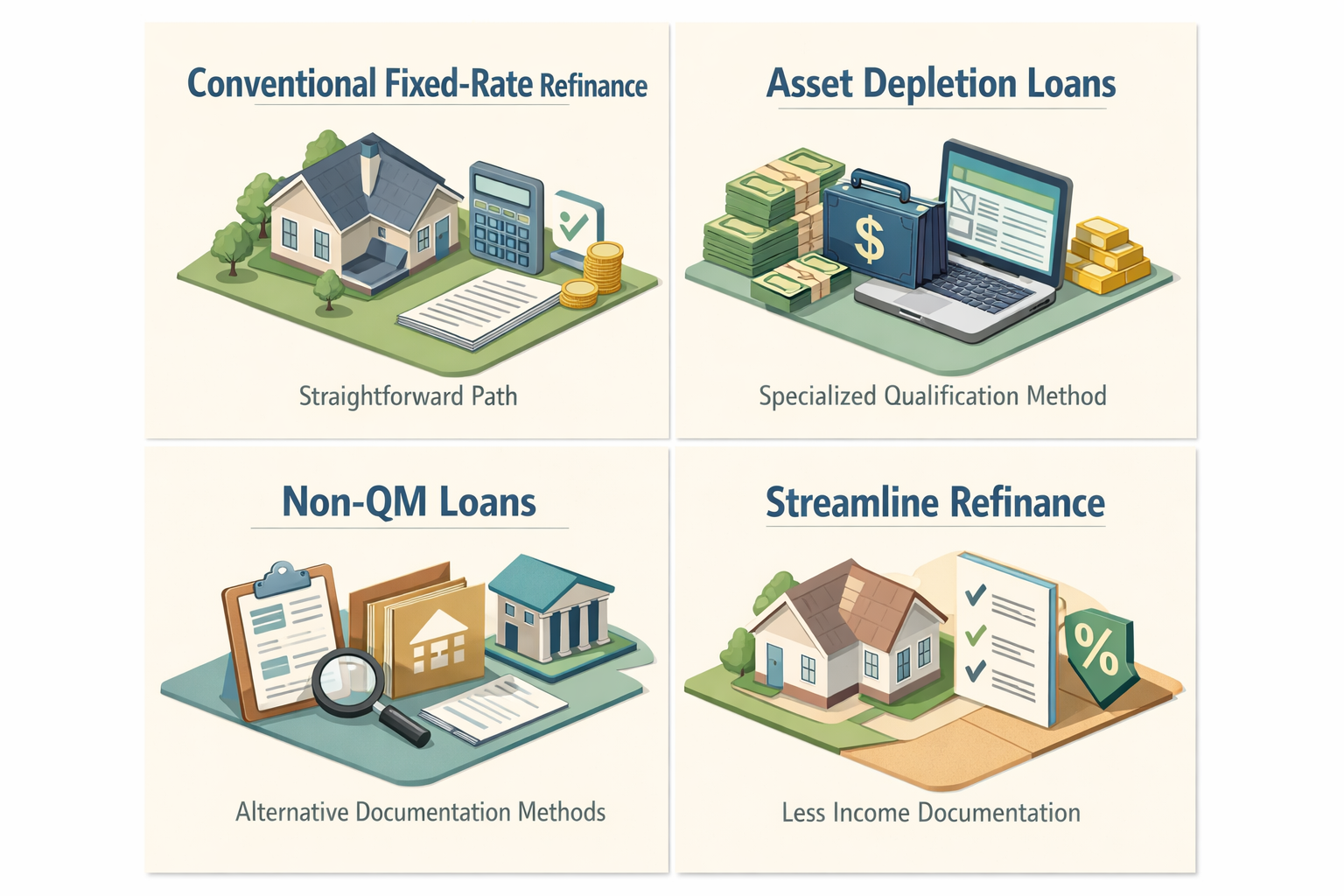
Now that we've covered how lenders view severance and stock-based income, let's explore the actual refinancing pathways that may be available to you. The best options for refinancing ARM mortgage with severance package and stock options typically fall into a few broad categories depending on your financial profile.
Conventional Fixed-Rate Refinance
If your documented income — including qualifying severance installments and a two-year history of stock option income — meets standard debt-to-income requirements, a conventional fixed-rate refinance may be the most straightforward path. This option typically comes with competitive interest rates and broad lender availability.
Asset Depletion or Asset Dissipation Loans
Some lenders offer a specialized qualification method called asset depletion (sometimes called asset dissipation), where your total liquid assets are divided over a set number of months to calculate a monthly qualifying income. For example, if you have significant proceeds from exercised stock options sitting in a brokerage account, a lender might divide that balance by 60 or 84 months to arrive at a monthly income figure. This approach can be particularly useful for borrowers who have wealth but limited traditional income documentation.
Non-QM (Non-Qualified Mortgage) Loans
Non-QM loans are designed for borrowers who don't fit neatly into standard agency guidelines. These loans may accept bank statement income, asset-based qualification, or other alternative documentation methods. While non-QM loans can open doors for borrowers with complex financial profiles, they often come with higher interest rates than conventional products. It's important to weigh the cost against the benefit.
Streamline Refinance Options
If your current ARM is backed by a government program such as the FHA or VA, you may be eligible for a streamline refinance. These programs generally require less income documentation and may be more accessible during a period of income transition. However, they typically require that you remain in the same loan program rather than switching to a conventional fixed-rate product.
Strengthening Your Application Before You Apply
Whether you're pursuing a conventional refinance or a non-QM alternative, there are several steps you can take to improve your chances of approval before submitting your application.
- Build your documentation file early: Gather your severance agreement, two years of tax returns, recent bank and brokerage statements, and any employer letters related to stock option grants. The more organized and complete your file, the smoother the process tends to go.
- Check your credit score: A strong credit history can offset other risk factors in your application. Review your credit reports for errors and address any outstanding issues before applying.
- Lower your debt-to-income ratio: Paying down credit card balances or other debts before applying may help bring your DTI into a range that lenders find comfortable, especially when your income documentation is non-traditional.
- Maintain liquid reserves: Avoid spending down your severance or stock option proceeds before closing. Lenders typically verify asset balances close to the closing date, and substantial reserves can serve as a meaningful compensating factor.
- Work with an experienced mortgage professional: A loan officer who has experience with complex income scenarios — including refinance ARM severance situations — can help you identify which loan programs you're most likely to qualify for and how to present your income most effectively.
Timing Your Refinance Strategically During a Career Transition
Timing can make a significant difference in how your refinance application is received. If you're still within your severance period and have not yet found new employment, your application may face more scrutiny than if you wait until you've secured a new position.
That said, waiting too long could also work against you. If your ARM is approaching a rate adjustment date, delaying the refinancing ARM mortgage could expose you to higher monthly payments before you're able to lock in a stable rate. It's a balancing act — and one that's worth discussing in detail with a mortgage professional who understands your specific situation.
Consider the following timing factors:
- ARM adjustment date: Know when your rate is scheduled to adjust and work backward from that date to allow enough time for underwriting and closing.
- Employment timeline: If you expect to start a new job within 60 to 90 days, some lenders may accept an offer letter as income documentation, which could open more refinancing options.
- Interest rate environment: Monitor prevailing mortgage rates to determine whether refinancing now versus later is likely to yield a meaningfully better or worse rate.
- Stock option exercise schedule: If you have options vesting soon, understanding how and when you'll realize that income may affect how your application is structured.
●Conclusion
Refinancing an adjustable-rate mortgage while managing severance income and stock options is genuinely more complex than a standard refinance — but it's a challenge that many homeowners have navigated successfully with the right preparation and guidance. The key is understanding how lenders view each income source, gathering thorough documentation, and exploring the full range of loan programs available to you. Whether a conventional fixed-rate refinance, an asset depletion loan, or a non-QM product turns out to be your best fit, taking action before your ARM adjusts can help you protect your budget and your home. At LoanWise, we're here to help you explore the best options for refinancing ARM mortgage with severance package and stock options so that your next chapter starts on solid financial footing. Reach out to one of our experienced loan specialists today to discuss your unique situation.