
Life moves fast — and sometimes a new job opportunity means packing up and starting over in a new city. If you took out an adjustable-rate mortgage (ARM) when you first bought your home and you've since relocated for work, you may be wondering what your next move should be. The good news is that refinancing doesn't have to be out of reach, even with a recent job change and variable income like bonuses. Understanding the best options for refinancing ARM mortgage with recent job relocation and bonus income is the first step toward locking in long-term financial stability. This guide walks you through what lenders look for, how to position your income, and which loan programs may work best for your situation.
Why ARM Refinancing Becomes a Priority After Relocation
An adjustable-rate mortgage can feel comfortable during stable times — rates are often lower in the early years, and the predictability of a fixed period offers short-term savings. But once that initial fixed window closes, your rate can shift with market conditions, leaving your monthly payment unpredictable.
When you've also relocated for a new job, your financial picture adds another layer of complexity. You may be earning more, spending more during the transition, and working to re-establish routine expenses in a new market. In this environment, carrying an ARM can feel like an added risk you didn't sign up for.
Refinancing your ARM into a fixed-rate mortgage could provide the payment stability you need while you're settling into a new role and a new location. Rather than waiting for your rate to adjust — potentially upward — many homeowners in this situation choose to act before the ARM's rate cap kicks in. Timing matters here, and understanding your loan's adjustment schedule is a smart first step.
How Lenders View Employment Changes During a Refinance
One of the most common concerns for people exploring a refinance ARM after relocation is how a job change affects their eligibility. Lenders do place significant weight on employment history, and a recent job change — even a beneficial one — can raise questions during underwriting.
Generally speaking, most conventional loan programs prefer to see at least two years of consistent employment history. However, a job change doesn't automatically disqualify you. What lenders often look for is continuity of income in the same field or a clear upward career trajectory. If you moved to a higher-paying position in the same industry, that transition may actually work in your favor.
Here's what lenders typically evaluate when reviewing a refinancing ARM mortgage with recent job relocation application:
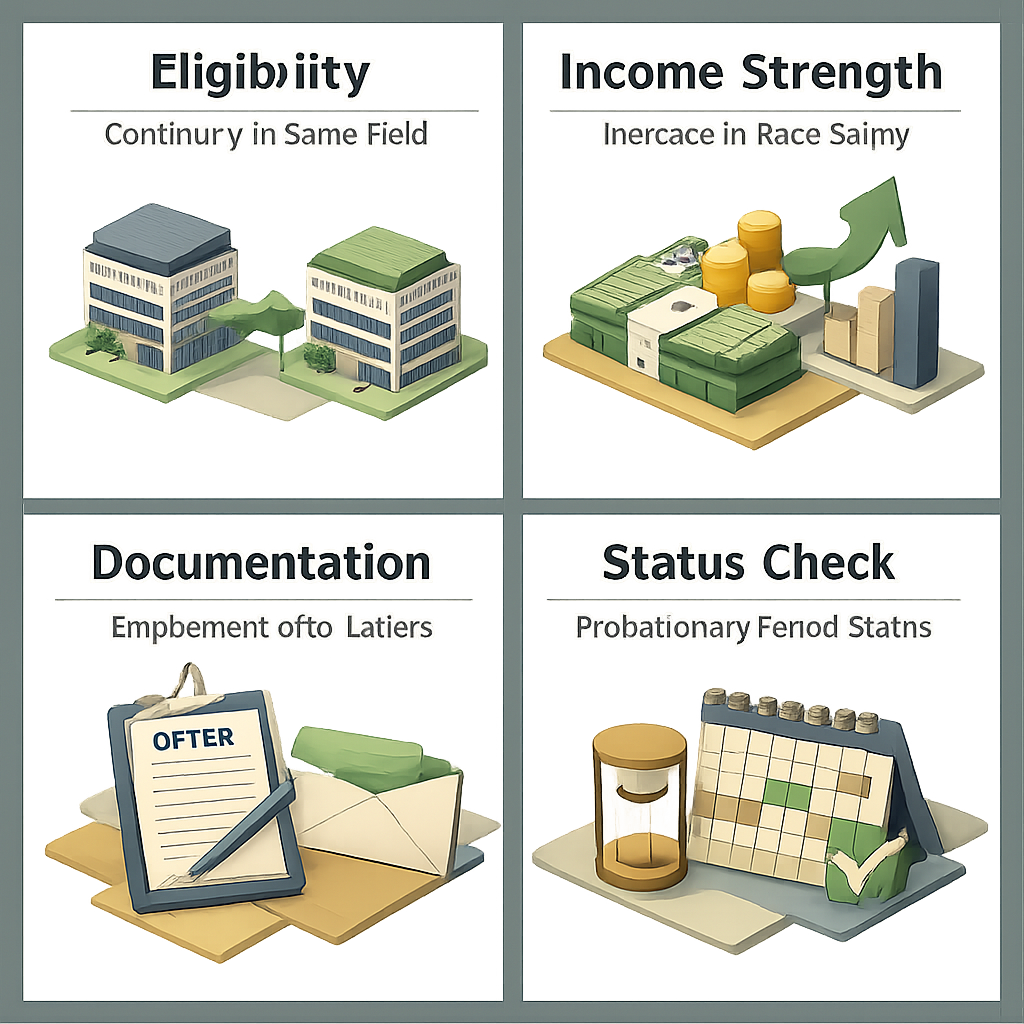
- Continuity in the same field: Switching employers within the same industry is generally viewed more favorably than a complete career change.
- Increase in base salary: A higher guaranteed income in your new role strengthens your debt-to-income (DTI) ratio.
- Employment offer letters: If you recently started, lenders may accept an offer letter along with pay stubs to verify income.
- Probationary period status: Some underwriters will want confirmation that you're not in a probationary employment period, or they may simply document the circumstances.
Being transparent with your loan officer about your employment situation is key. An experienced mortgage professional can help you frame your job change in the most favorable light possible and identify programs that are more flexible with employment timelines.
Using Bonus Income to Strengthen Your Refinance Application
Bonus income can be a significant financial asset — but lenders don't treat it the same way they treat a base salary. Understanding how to document and present bonus income properly could make a meaningful difference in your refinance approval and loan terms.
For most conventional loan programs, lenders typically require a two-year history of receiving bonus income before they'll count it as qualifying income. They may average your bonus earnings over those two years and use that figure in your income calculation. If your bonus income is recent or tied to a new role, it may be harder to use immediately, though some lenders are more flexible than others.
That said, there are strategies that may help:
- Provide W-2s and tax returns: Two years of documented bonus income from a prior employer may still count, even if your current role hasn't yet paid out a bonus.
- Letter from employer: If your new employer guarantees a bonus in writing, some lenders may consider a portion of that income — especially if it's a contractual, not discretionary, bonus.
- Higher base salary offset: If your new job comes with a substantially higher base pay, your bonus income may be less critical to qualifying for the loan amount you need.
- Non-QM loan options: For borrowers with strong assets and income that doesn't fit traditional documentation molds, non-qualified mortgage programs may offer alternative paths to approval.
Working with a lender who specializes in complex income scenarios — including those involving relocation and variable pay — can help you navigate these requirements more confidently.
Loan Programs Worth Exploring for Relocated Borrowers
Not all mortgage programs handle relocation and employment changes the same way. Depending on your credit profile, down payment position, and income documentation, certain loan types may offer more flexibility than others.
Conventional Fixed-Rate Loans
Converting your ARM into a conventional 30-year or 15-year fixed-rate loan is one of the most straightforward refinance strategies. If your credit score is solid and your DTI is within acceptable limits, a conventional loan could lock in a stable rate without requiring private mortgage insurance if you have sufficient equity.
FHA Streamline Refinance
If your current mortgage is FHA-backed, an FHA Streamline Refinance could simplify the process significantly. This program often requires less documentation and may be more lenient with income verification — though it does carry mortgage insurance premiums. It's worth asking your lender whether your current ARM qualifies.
VA Interest Rate Reduction Refinance Loan (IRRRL)
If you're an eligible veteran or active-duty service member, the VA IRRRL — sometimes called a VA Streamline — allows you to refinance from an ARM to a fixed-rate VA loan with minimal paperwork. Income verification requirements are often reduced, which could be advantageous if your job transition is recent.
Non-QM and Bank Statement Programs
For borrowers whose income doesn't fit neatly into traditional underwriting boxes — such as those with heavy bonus or commission-based earnings — non-QM programs may provide an alternative route. These programs typically come with slightly higher rates but offer greater documentation flexibility.
Timing Your Refinance Around Rate Adjustments and Market Conditions
The timing of your refinance can be just as important as the loan program you choose. With an ARM, you're working against a built-in clock — your rate will adjust at a predetermined interval, and depending on where interest rates stand at that time, the change could be significant.
Most ARMs have an initial fixed period — commonly five, seven, or ten years — followed by annual adjustments based on a benchmark index plus a margin. Before your rate adjusts for the first time, or before another scheduled adjustment, is often a smart window to refinance.
Consider these timing factors:
- Review your loan note: Your mortgage documents will outline exactly when your rate can change and by how much. Understanding your caps — periodic and lifetime — helps you assess your maximum exposure.
- Monitor market rates: If current fixed rates are favorable relative to your ARM's potential ceiling, refinancing ARM mortgage sooner may lock in long-term savings.
- Account for closing costs: Refinancing isn't free. Factor in lender fees, title costs, and other closing expenses when calculating whether refinancing makes financial sense right now.
- Break-even analysis: Calculate how long it'll take for your monthly savings to offset the cost of refinancing. If you plan to stay in the home for several years, the math often favors locking in a fixed rate.
If you're uncertain about timing, a mortgage calculator or a conversation with a knowledgeable loan officer can help you model different scenarios based on your specific loan terms and goals.
Practical Steps to Prepare Your Application After a Relocation
Preparation is everything when you're refinancing with a complex financial profile. The more organized and thorough your documentation, the smoother the underwriting process tends to be. Here's a practical checklist to help you get ready:
- Gather income documentation: This includes recent pay stubs, your last two years of W-2s or tax returns, and any offer letters from your new employer. If you earn bonuses, collect documentation of those payments as well.
- Update your address records: Make sure your credit report, bank statements, and employer records all reflect your current address. Inconsistencies can slow down processing.
- Check your credit report: Request a free copy of your credit report and review it for any errors that could be dragging down your score. Dispute inaccuracies before applying.
- Assess your home equity: A lender will order an appraisal to determine your home's current value. If your property has appreciated, you may have more equity than you think — which can improve your loan terms.
- Write a letter of explanation: If your job change or relocation is recent, prepare a clear, professional letter explaining the transition and highlighting the career benefits. Underwriters often appreciate context.
- Compare lenders: Don't settle for the first offer. Shopping multiple lenders — including banks, credit unions, and mortgage brokers — can surface the best options for refinancing ARM mortgage and more flexible program options for your situation.
●Conclusion
Navigating the best options for refinancing ARM mortgage with recent job relocation and bonus income takes a bit more preparation than a standard refinance — but it's absolutely achievable. By understanding how lenders evaluate job changes, how to document bonus income effectively, and which loan programs may offer the most flexibility, you can move from an unpredictable adjustable rate into the stability of a fixed mortgage. Whether you're a few months into your new role or still settling into your new city, the right lender and the right strategy can make all the difference. At LoanWise, we're here to help you find a path that fits your real life — not just a textbook borrower profile. Reach out today to explore your refinancing options and take the next step with confidence.