
Life has a way of throwing curveballs just when you least expect them. A corporate layoff, a career transition, or a company buyout can leave you holding a severance package and vested stock options — while still carrying an adjustable-rate mortgage that may be about to reset. If that sounds familiar, you're not alone. Many homeowners find themselves exploring the best options for refinancing ARM mortgage with recent severance package and stock options, wondering whether their unconventional income situation will work against them. The good news is that lenders have more flexibility than most people realize, and with the right strategy, refinancing into a stable fixed-rate loan may be well within reach.
Understanding Why Homeowners Want to Refinance Out of an ARM
An adjustable-rate mortgage, or ARM, starts with a fixed interest rate for an initial period — commonly five, seven, or ten years — and then adjusts periodically based on a market index. When rates were historically low, ARMs were an attractive option for many buyers. But as interest rates shift, those adjustment periods can bring payment increases that feel unsettling, especially if your income situation has recently changed.
For homeowners navigating a job transition, refinancing an ARM into a fixed-rate mortgage could provide the payment stability they need. A fixed rate means your principal and interest payment stays the same for the life of the loan, making budgeting far more predictable. This stability can be especially valuable when your monthly cash flow depends partly on variable sources like severance disbursements or investment income from stock liquidations.
It's also worth noting that refinancing isn't just about chasing a lower rate. For many homeowners, it's about locking in certainty during a period of personal or financial transition. Converting from an ARM to a fixed mortgage can be a smart defensive move — even if the new rate is slightly higher than your current introductory ARM rate.
How Lenders View Severance Income When You Apply to Refinance
One of the biggest concerns homeowners have after receiving a severance package is whether lenders will count that money as qualifying income. The honest answer is: it depends on the lender and the loan program. Most conventional lenders following Fannie Mae or Freddie Mac guidelines require borrowers to demonstrate stable, ongoing income — typically with a two-year history and a reasonable expectation that the income will continue.
Severance payments, by definition, are temporary. They're designed to bridge the gap between employment periods. Because of this, a lump-sum severance payment typically cannot be counted as regular qualifying income by most traditional lenders. However, there are important nuances to understand:
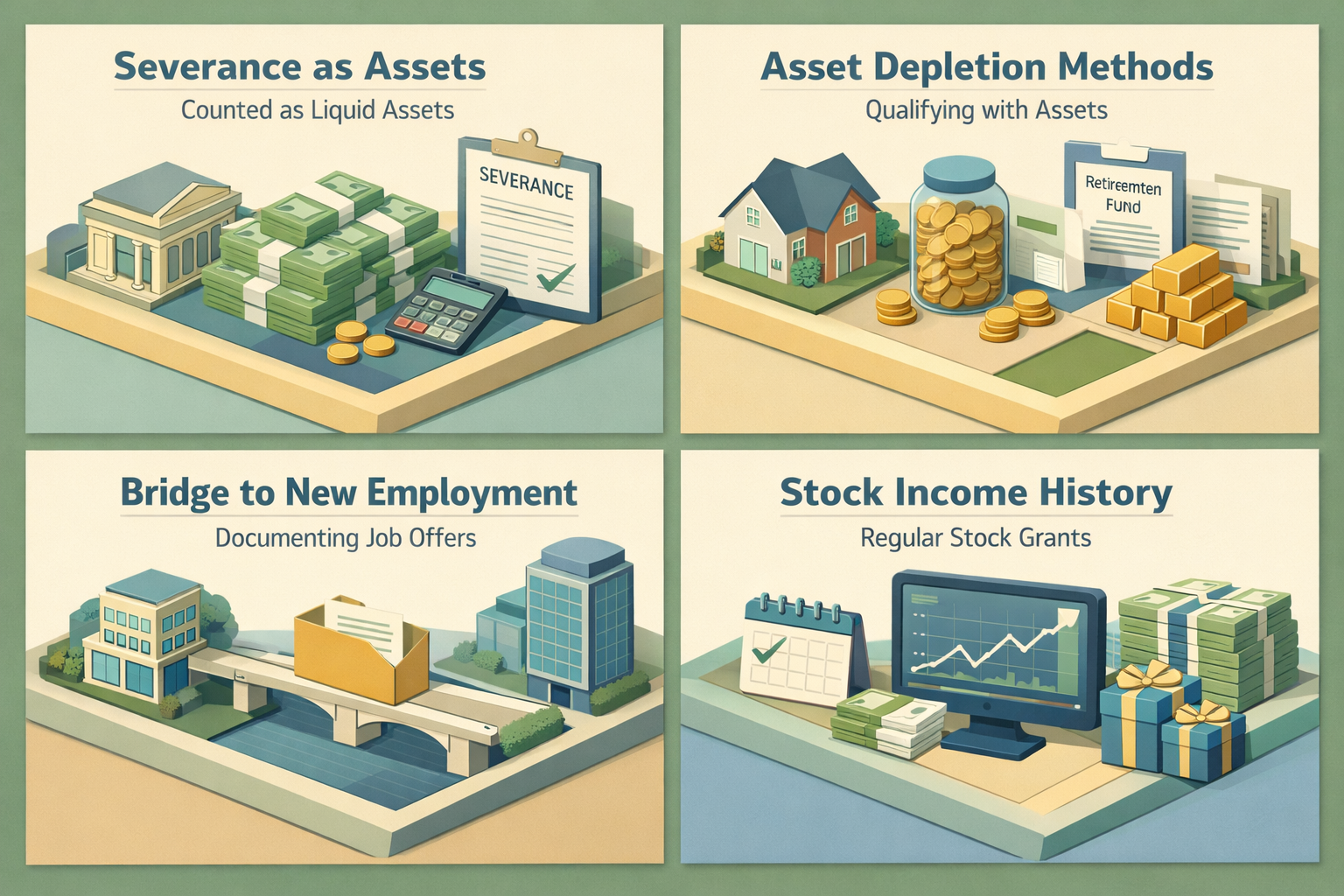
- Severance as assets: Even if lenders won't count your severance as income, they may count it as liquid assets, which can strengthen your overall borrower profile and demonstrate your ability to make payments during a job search period.
- Asset depletion or dissipation methods: Some lenders — particularly non-QM (non-qualified mortgage) lenders — offer programs that allow borrowers to qualify using a calculated draw-down of liquid assets over time. This method essentially converts your savings or severance into a hypothetical monthly income figure.
- Bridge to new employment: If you can document an offer letter or have already started a new job, many lenders will accept that as qualifying income, making the refinance process significantly smoother.
The key takeaway is that a severance package alone may not qualify you the traditional way, but it doesn't disqualify you either. Lenders look at the full picture, and working with a knowledgeable mortgage advisor can help you present your situation in the most favorable light.
Using Stock Options and Equity Compensation to Strengthen Your Refinance Application
Stock options and equity-based compensation — including RSUs (restricted stock units), ISOs (incentive stock options), and NSOs (non-qualified stock options) — are increasingly common forms of compensation, especially in the tech, finance, and startup sectors. When it comes to refinancing, how lenders treat these assets can vary considerably.
Here's what's generally true across most lending programs:
- Vested stock options that have been exercised and converted to cash or publicly traded shares may be counted as liquid assets. Lenders often require documentation such as recent brokerage statements showing the value and accessibility of these holdings.
- Unvested options are typically not counted at all, since they cannot yet be accessed and carry no guaranteed future value.
- Stock income history: If you've received regular stock grants or bonuses over a two-year period that show up on your W-2 or tax returns, some lenders may factor that into your income calculation — though they may use an average of the past two years rather than your most recent year's figure.
- Concentrated stock positions: If a significant portion of your net worth is tied up in a single employer's stock, some lenders may apply a discount to that value or require evidence of diversification before counting it as a usable asset.
Working with a lender who understands equity compensation is critical. Some lenders are more experienced with borrowers who have complex, non-traditional income profiles, and those lenders are typically better equipped to find a workable refinance solution when a refinance ARM severance bonus stock options scenario is in play.
Exploring the Best Refinance Options When Your Income Profile Is Non-Traditional
When your income doesn't fit neatly into a pay stub and W-2 box, you may need to explore loan programs beyond conventional financing. Here are some refinance paths worth considering as you evaluate the best options for refinancing ARM mortgage with recent severance package and stock options:
Conventional Refinance With a Co-Borrower
If you have a spouse, partner, or family member with strong, verifiable income, adding them as a co-borrower to your refinance application may be one of the simplest ways to qualify. The co-borrower's income could offset the temporary gap in your own employment earnings, while your combined assets — including your severance and stock holdings — further strengthen the application.
Non-QM (Non-Qualified Mortgage) Loans
Non-QM loans are designed for borrowers who don't fit conventional lending criteria. These programs may allow for bank statement qualification, asset depletion income calculations, or more flexible documentation of investment income. The trade-off is that non-QM loans often carry slightly higher interest rates and may require a larger down payment or equity stake. Still, for the right borrower, they can be a practical bridge to a stable fixed-rate mortgage.
Jumbo Refinance With Asset Documentation
If your home value and loan balance place you in jumbo territory, some jumbo lenders offer robust asset-based qualification programs. These lenders may be more sophisticated in evaluating complex borrower profiles, including those with significant stock holdings, severance reserves, or equity compensation histories.
Waiting for New Employment Income
Sometimes the most strategic option is patience. If you're actively job searching and expect to return to employment within a few months, waiting until you have at least one or two pay stubs from a new employer could dramatically simplify your refinance application. During that window, your severance could serve as a financial cushion, giving you time to secure the best possible terms.
Key Documentation You'll Need to Gather Before Applying
Preparation is everything when your income situation is unconventional. Lenders will look carefully at your documentation, so gathering the right paperwork in advance can speed up the process and reduce surprises. Here's what you'll likely need:
- Severance agreement or letter: This documents the terms of your package, including the total amount, payment schedule, and duration.
- Recent tax returns (typically two years): These show your overall income history, including any stock-related income from prior employment.
- W-2s and 1099s: These help lenders calculate your average income over time, including any bonus or equity compensation.
- Brokerage account statements: For vested stock options or equity holdings, recent statements showing current balances and the nature of the assets are essential.
- Bank statements (two to three months): These demonstrate liquid reserves and help lenders verify that your severance proceeds have been deposited and are accessible.
- Employment offer letter (if applicable): If you've accepted a new position, a signed offer letter from your future employer can be a powerful document in your refinance file.
- Current mortgage statement: Lenders need to verify your existing loan balance, payment history, and the terms of your current ARM.
Having these documents organized and ready before you begin the refinance process can make a meaningful difference in how quickly and smoothly things move forward.
How Your Credit Score and Home Equity Affect Your Refinance Outcome
Even when income documentation is complicated, two factors can significantly improve your chances of a successful refinance: a strong credit score and meaningful home equity. Lenders view these as evidence of financial responsibility and reduced risk.
A credit score of 740 or higher typically opens the door to the best available rates and terms on conventional refinances. Scores in the 680 to 739 range can still qualify for many programs, though you may see slightly higher rates. If your score has dipped recently — perhaps due to reduced income or increased credit utilization during a job transition — it may be worth spending a few months improving it before applying.
Home equity matters just as much. Most lenders require that you retain at least 20% equity after the refinance, though some programs allow for slightly less. Borrowers with 30% or more equity may qualify for more favorable terms and face fewer documentation hurdles, since the lender's risk is substantially lower when the loan-to-value ratio is conservative.
Together, a solid credit profile and strong equity position can help offset some of the uncertainty that comes with a non-traditional income scenario. If both are working in your favor, lenders may be more willing to work creatively with your refinance ARM severance bonus stock options profile.
●Conclusion
Refinancing an adjustable-rate mortgage while managing a severance package and stock options is undeniably more complex than a standard refinance — but it's far from impossible. The best options for refinancing ARM mortgage with recent severance package and stock options depend on your specific financial profile, the programs available through different lenders, and how well you present your full financial picture. Whether you pursue a conventional refinance with a co-borrower, explore a non-QM program, or simply wait until new employment income is documented, the path forward exists. At LoanWise, our experienced mortgage advisors understand complex borrower situations and can help you evaluate which refinance strategy fits your goals. Reach out today to explore your options with confidence.