
If you own a home and hold an adjustable-rate mortgage, you already know how unpredictable monthly payments can feel when interest rates shift. Now add dividend income from stocks into the picture, and the path to refinancing may seem even more complicated. But here's the good news — exploring the best options for refinancing ARM mortgage with dividend income from stocks is more achievable than many homeowners realize. Lenders have evolved, and several mortgage programs today are designed to accommodate borrowers who earn income from investments rather than a traditional paycheck. In this guide, we'll walk you through how dividend income is evaluated, which loan products tend to work well for your situation, and what steps you can take to strengthen your refinance application.
Understanding How Adjustable-Rate Mortgages Work and Why Refinancing Makes Sense
An adjustable-rate mortgage, commonly known as an ARM, starts with a fixed interest rate for an initial period — often five, seven, or ten years — and then adjusts periodically based on a market index. While ARMs can offer lower starting rates, they introduce uncertainty once the fixed period ends. When the rate adjusts upward, your monthly payment can increase significantly, putting pressure on your household budget.
For homeowners who rely on dividend income from stocks, this payment volatility can be especially concerning. Unlike a salaried employee with predictable monthly earnings, dividend investors may receive income quarterly or annually, and the amounts can fluctuate based on market conditions and company decisions. This mismatch between irregular income and a potentially rising mortgage payment is a key reason why many investment-income borrowers consider refinancing into a fixed-rate loan.
Refinancing your ARM into a fixed-rate mortgage could lock in a stable payment for the life of the loan, making long-term financial planning much easier. Even if today's fixed rates are higher than your current ARM rate, the predictability and protection from future rate increases may be worth the trade-off — especially if you plan to stay in the home for many years.
How Lenders Evaluate Dividend Income During the Mortgage Refinance Process
One of the most important things to understand when you refinance ARM mortgage with investment income is how lenders actually calculate and qualify that income. Most conventional lenders follow guidelines set by Fannie Mae or Freddie Mac, which have specific rules about documenting and averaging dividend income.
Typically, lenders will want to see at least a two-year history of dividend income. They'll usually average the income received over those two years, and may only count income that's likely to continue. This means your dividend-producing assets generally need to remain in place after closing, and lenders may verify this through brokerage account statements.
Here's what lenders commonly look for when qualifying dividend income:
- Two years of tax returns (IRS Form 1040) showing dividend and interest income on Schedule B
- Recent brokerage or investment account statements confirming the assets are held and active
- Consistency of income — irregular or one-time dividend payments may be harder to qualify
- Sufficient asset base to demonstrate that dividend distributions are sustainable
It's worth noting that some lenders may apply additional scrutiny if a significant portion of your dividend income comes from a single company or a highly volatile sector. Diversified dividend income from multiple holdings tends to be viewed more favorably.
Mortgage Refinance Options Most Likely to Work for Dividend Income Borrowers
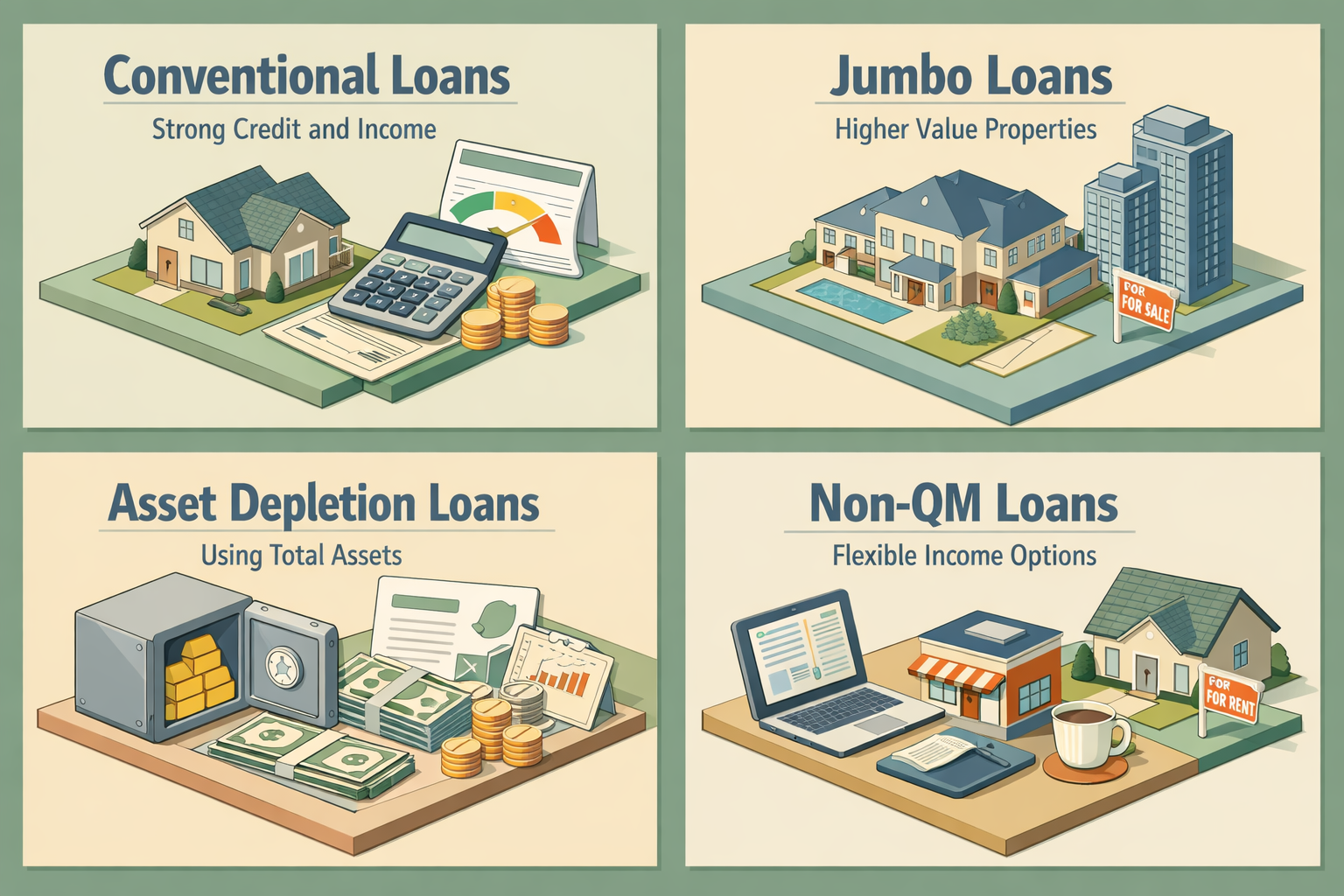
Not every loan program handles dividend income the same way. Understanding your mortgage refinance options helps you target lenders and products that are most compatible with your financial profile.
Conventional Conforming Loans
For borrowers with strong credit scores, substantial investment portfolios, and well-documented dividend income, a conventional conforming loan may be an excellent fit. Fannie Mae and Freddie Mac guidelines do allow dividend and interest income to be used for qualification — as long as the two-year history requirement is met and the income appears on your tax returns. These loans often come with competitive interest rates and flexible term options including 15-year and 30-year fixed rates.
Jumbo Mortgage Refinance
If your home's value exceeds conforming loan limits — which vary by county — you'll likely need a jumbo loan. Many portfolio lenders who offer jumbo products have their own underwriting guidelines, which may give them more flexibility in how they treat dividend income. Some jumbo lenders may be willing to consider asset depletion alongside dividend income, which could strengthen your application further.
Asset Depletion or Asset Dissipation Loans
This is a particularly relevant option for homeowners with large investment portfolios. Under an asset depletion methodology, a lender calculates an imputed monthly income based on your total eligible assets — even if you're not actively drawing on them. For example, a lender might divide your eligible liquid assets by a set number of months (such as 360 for a 30-year loan) to arrive at a qualifying income figure. This approach can be used alongside documented dividend income to strengthen your overall qualification profile.
Non-QM Loan Programs
Non-qualified mortgage (Non-QM) programs are designed specifically for borrowers whose income doesn't fit conventional molds. Many Non-QM lenders offer bank statement loans, asset-based loans, or DSCR (debt service coverage ratio) products that may accommodate investors with complex income streams. If your dividend income alone doesn't meet conventional thresholds, a Non-QM refinance could be a viable alternative — though interest rates and fees on these products may be higher.
Strengthening Your Application Before You Apply to Refinance
Knowing the best options for refinancing ARM mortgage with dividend income from stocks is just the first step. Preparing your financial profile thoroughly before you apply can meaningfully improve your chances of approval and help you secure a more favorable rate.
Organize Your Documentation Early
Gather at least two years of federal tax returns, all Schedule B attachments, and recent statements from every brokerage or investment account that generates dividends. Lenders will want a clear paper trail, so the more organized your documents are, the smoother your application process will be.
Check and Strengthen Your Credit Score
Your credit score plays a major role in determining your refinance interest rate and loan eligibility. Before applying, review your credit reports for any errors and pay down revolving balances where possible. A higher credit score — generally 740 or above — typically unlocks the most competitive rates on conventional and jumbo refinance products.
Calculate Your Debt-to-Income Ratio
Lenders assess your debt-to-income (DTI) ratio to ensure you can comfortably handle your mortgage payment relative to your monthly income. With dividend income, this calculation may work differently than with W-2 wages. It's helpful to run the numbers yourself using your averaged two-year dividend income and all monthly debt obligations before approaching lenders.
Consider Timing Around Dividend Distributions
If possible, time your refinance application shortly after you've received a dividend distribution. Having recent, verifiable deposits in your account can provide additional evidence of active income flow and may support your application during underwriting.
Rate Considerations and Cost-Benefit Analysis for ARM Refinancers
One of the most practical questions homeowners face is whether refinancing actually saves money. This depends on several factors including your current ARM rate, how much time remains in your fixed period, the new fixed rate you qualify for, and the closing costs involved.
Refinance closing costs typically range from 2% to 5% of the loan amount, covering items like origination fees, appraisal, title insurance, and prepaid interest. To determine whether a refinance makes financial sense, many borrowers calculate a break-even point — the number of months it takes for monthly savings to offset upfront costs. If you plan to stay in the home beyond that break-even period, refinancing may be financially advantageous.
For dividend income borrowers, there's another layer to consider: the opportunity cost of using liquid assets for a larger down payment or to pay down the loan balance versus keeping those funds invested and earning dividends. There's no universal right answer here, but a mortgage advisor or financial planner can help you model different scenarios based on your investment returns and projected mortgage savings.
It's also worth noting that interest rate environments change. If current fixed rates feel high relative to your ARM's current rate, you might also explore a shorter fixed-rate term (such as a 15-year mortgage) which typically carries a lower rate than a 30-year product, or even a new ARM with a longer initial fixed period to buy more stability without fully committing to a long-term fixed rate.
Working With the Right Lender Makes All the Difference
Not every mortgage lender is equally equipped to handle the nuances of investment income. When you're exploring mortgage refinance options as a dividend-income borrower, it's important to work with a lender who has genuine experience with non-traditional income sources.
Here are a few questions worth asking when evaluating potential lenders:
- Do you offer loan programs that accept dividend and interest income for qualification?
- How do you calculate and document investment income during underwriting?
- Do you have access to Non-QM products if conventional programs don't fit my profile?
- Can you explain how asset depletion is handled in your underwriting guidelines?
- What documentation will I need to provide, and how long does the process typically take?
A knowledgeable mortgage broker or loan officer may be particularly valuable in this situation because they can shop multiple lenders on your behalf and identify which institution's guidelines best match your income profile. This can save you significant time and prevent unnecessary credit inquiries from multiple lender applications.
At LoanWise, our team understands the unique challenges facing homeowners who earn income from investments. We work with a broad network of lenders — including conventional, jumbo, and Non-QM options — to find refinance solutions tailored to your situation.
●Conclusion
Navigating the best options for refinancing ARM mortgage with dividend income from stocks requires a clear understanding of how lenders evaluate investment income, which loan programs are most flexible, and how to position your financial profile for the strongest possible application. While the process may involve more documentation and planning than a standard salaried refinance, it's absolutely achievable — especially when you work with experienced lending professionals who understand your income structure. Whether you pursue a conventional conforming loan, a jumbo refinance, an asset depletion program, or a Non-QM product, the right strategy starts with getting informed and partnering with the right team. Ready to explore your options? Connect with a LoanWise mortgage specialist today and take the first step toward a more stable, predictable home financing structure.