
Adjustable-rate mortgages can feel like a smart move at first — lower initial rates, smaller early payments, and room to breathe financially. But as rate adjustment periods approach, many homeowners start looking for a way out. If you're in this situation and you also hold a meaningful amount of digital assets, the path forward might look a little different than it would for a traditional borrower. Exploring the options for refinancing an ARM mortgage with significant cryptocurrency holdings requires understanding how mortgage lenders currently view crypto, what documentation you may need, and which loan programs could be the best fit for your financial profile.
Why ARM Borrowers With Crypto Assets Face Unique Challenges
Refinancing out of an adjustable-rate mortgage into a fixed-rate loan is a goal many homeowners share, especially when rate caps feel uncomfortably close. The challenge for cryptocurrency holders is that traditional mortgage underwriting wasn't built with digital assets in mind. Most conventional loan guidelines were designed around verifiable, stable income streams and liquid assets held in insured bank or brokerage accounts.
Cryptocurrency, by contrast, is highly volatile. Its value can shift dramatically within days or even hours. Lenders assess risk very carefully, and an asset that could lose 40% of its value between application and closing introduces uncertainty they're not always comfortable with. That doesn't mean refinancing is impossible — it means the process requires more preparation, more documentation, and sometimes a different kind of lender altogether.
It's also worth noting that the regulatory landscape around digital assets and mortgage lending is still evolving. What one lender accepts today, another may not, and guidelines can change. Borrowers in this situation benefit from working with loan officers who have direct experience with ARM refinance crypto assets and understand how to present a strong application.
How Mortgage Lenders Currently Evaluate Cryptocurrency Holdings
Fannie Mae and Freddie Mac, the two major government-sponsored enterprises that set conventional mortgage guidelines, have issued limited formal guidance on cryptocurrency as a qualifying asset. As of recent updates, some lenders may allow crypto holdings to be counted toward reserves or down payment funds — but typically only after the funds have been converted to U.S. dollars and held in a traditional financial account for a minimum period, often referred to as a seasoning requirement.
This matters for refinancers because lenders want to see that your assets are stable and accessible. If your wealth is largely tied up in Bitcoin, Ethereum, or other digital currencies, you may need to liquidate a portion and move those funds into a verifiable account well before you apply. The exact seasoning window can vary by lender and loan program, so it's important to ask early in the process.
For borrowers whose primary wealth is in crypto, demonstrating repayment ability becomes a key challenge. Lenders look for consistent, documentable income. If you're earning staking rewards, mining income, or selling crypto regularly, some lenders may be willing to treat those cash flows as income — but the documentation requirements are often strict, and not all underwriters will accept them.
- Proof of ownership: Lenders may require screenshots of exchange accounts, wallet statements, or transaction histories.
- Conversion records: If you've liquidated crypto to fund reserves, bank statements showing the deposit and source of funds are typically required.
- Seasoning documentation: Some programs require assets to sit in a traditional account for 60 to 90 days before they can be used in qualifying.
- Two-month average value: Because of volatility, lenders may use a conservative valuation of your holdings rather than the current market price.
Loan Program Paths Worth Considering for Crypto-Heavy Borrowers
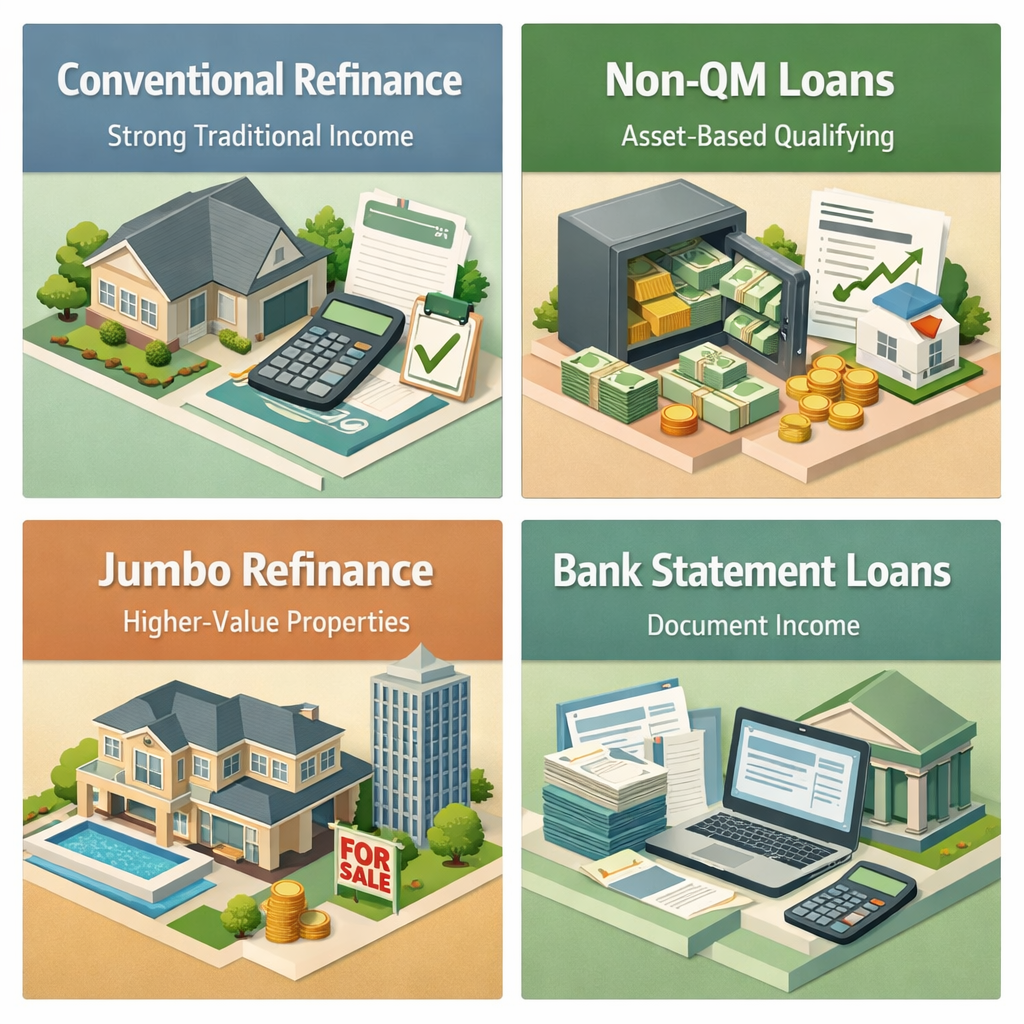
Not all loan programs treat non-traditional assets the same way. Depending on your overall financial profile, one of the following paths may be worth exploring with a qualified mortgage professional.
Conventional Conforming Refinance
If you have strong traditional income, a solid credit score, and sufficient liquid reserves after converting some crypto to cash, a conventional refinance through a Fannie Mae or Freddie Mac loan could work. The key is that the crypto-sourced funds typically need to be seasoned in a bank account before they're counted. Your debt-to-income ratio, credit history, and equity in the home will all play significant roles in approval.
Non-QM Loans for Asset-Based Qualifying
Non-qualified mortgage (Non-QM) lenders operate outside the standard Fannie Mae and Freddie Mac guidelines, which gives them more flexibility. Some Non-QM programs allow borrowers to qualify based on asset depletion — essentially, the lender calculates a theoretical monthly income based on dividing your total liquid assets by the loan term. If your crypto holdings are substantial and can be documented, this type of program may offer a viable path for mortgage refinancing cryptocurrency holders.
Jumbo Refinance Programs
For higher-value properties, jumbo lenders often set their own underwriting criteria. Some are more open to unconventional asset profiles, particularly for high-net-worth borrowers. If your home's value and your overall financial picture are strong, a portfolio lender offering jumbo products might be more willing to work with you than a standard conforming lender.
Bank Statement Loans
If you regularly convert crypto to cash and deposit those funds into a bank account, a bank statement loan program may allow you to use 12 to 24 months of deposit history to document income. This can be particularly useful if you don't have a traditional W-2 income stream and your cash flow primarily comes from digital asset activity.
Strategies to Strengthen Your Refinance Application Before You Apply
Preparation can make a significant difference when you're navigating the options for refinancing an ARM mortgage with significant cryptocurrency holdings. There are several practical steps you might take in the months leading up to your application to improve how lenders view your financial profile.
- Diversify into traditional accounts early: Moving a portion of your crypto wealth into insured bank or brokerage accounts well in advance gives those funds time to season and creates a paper trail lenders can follow.
- Maintain strong credit: Your credit score remains one of the most important factors in any refinance. Paying down existing debt and avoiding new credit inquiries before applying can help protect your score.
- Reduce your debt-to-income ratio: Paying off high-balance credit cards or other liabilities before applying could improve your qualifying ratios, especially if your verifiable income is lower than your overall net worth suggests.
- Build your home equity: The more equity you have in the property, the less risk a lender takes on. If possible, making extra principal payments before refinancing may improve your loan-to-value ratio and open up better rate options.
- Work with an experienced broker: Not every lender has the same appetite for crypto-related financial profiles. A mortgage broker who works with multiple lenders, including Non-QM specialists, may be able to find a program that fits your situation better than a single bank could.
Timing Considerations When Your ARM Adjustment Is Approaching
One of the most pressing reasons homeowners explore refinancing is an upcoming rate adjustment on their ARM. Most adjustable-rate mortgages have an initial fixed period — commonly five, seven, or ten years — after which the rate adjusts annually based on a benchmark index plus a margin. If rates have risen since you first took out the loan, that adjustment could meaningfully increase your monthly payment.
The challenge is that refinancing takes time. From application to closing, the process often takes 30 to 60 days under normal circumstances, and it can take longer when documentation is complex — as it often is for crypto holders. If your rate adjustment is approaching within the next six months, starting the process now rather than later is generally wise.
You'll also want to consider where mortgage rates are heading more broadly. Refinancing into a fixed-rate loan locks in your rate, which could be advantageous if rates are rising. However, if rates are expected to decline, waiting might result in a better outcome. It's difficult to time the market perfectly, so many financial professionals suggest focusing on what makes sense for your long-term budget stability rather than trying to predict short-term rate movements.
Market volatility in the crypto space adds another layer of timing complexity. If your holdings are near a recent high, converting a portion to cash for reserves while values are strong may give you more flexibility during the mortgage process. If the market is in a downturn, lenders may apply an even more conservative valuation to your portfolio.
Tax Implications of Liquidating Crypto for a Mortgage Refinance
This is an area where a qualified tax advisor becomes essential. In the United States, cryptocurrency is treated as property by the Internal Revenue Service. That means selling or converting crypto to cash is generally a taxable event, and any gain may be subject to capital gains tax — either short-term or long-term depending on how long you held the asset.
If you're planning to liquidate a significant portion of your holdings to fund reserves or a down payment for a refinance, the resulting tax liability could be substantial. Depending on your situation, a large capital gain in the same tax year as your refinance could actually affect your qualifying income or debt obligations for the following year's tax return, which lenders often review.
Coordinating with both a tax professional and a mortgage advisor before liquidating is a practical step that many borrowers overlook. Understanding the tax impact ahead of time allows you to plan the timing of any liquidation strategically, potentially spreading gains across tax years or taking other steps that align with your broader financial goals.
●Conclusion
Navigating the options for refinancing an ARM mortgage with significant cryptocurrency holdings isn't a straightforward process, but it's far from impossible. The key is understanding how lenders think about digital assets, preparing your financial profile well in advance, and finding the right loan program for your unique situation. Whether that means seasoning funds in a traditional account, exploring a Non-QM asset depletion loan, or working with a portfolio jumbo lender, there are paths worth investigating. At LoanWise, we work with borrowers across a wide range of financial profiles. If you're ready to explore your refinancing options, connecting with one of our experienced mortgage advisors could be a smart first step toward locking in stability and leaving rate uncertainty behind.