
If you currently have an FHA loan and a second mortgage on your home, you may be wondering whether refinancing is even possible. The good news is that it often is — but it does require a bit more planning than a standard refinance. The presence of a second mortgage, whether it's a home equity loan, a HELOC, or a piggyback loan, adds a layer of complexity that you'll need to address before moving forward. Understanding the best options for refinancing an FHA loan with an existing second mortgage can help you make a smarter financial decision and potentially lower your monthly payments or eliminate mortgage insurance premiums. Let's walk through what you need to know.
Why a Second Mortgage Complicates an FHA Refinance
When you refinance your primary mortgage, your new lender typically assumes first lien position on the property. This is straightforward when there's only one loan involved. However, if you have a second mortgage, that lender holds a junior lien — and they may not automatically agree to step aside when a new first mortgage is originated.
FHA loan guidelines generally require that the new FHA mortgage remain in first lien position. If you carry a second mortgage, you'll need to either pay it off, refinance it into the new loan, or ask the second mortgage lender to agree to subordinate their lien. Subordination means the second lender formally agrees to remain in the junior position after your refinance closes.
Not every second mortgage lender will agree to subordinate, and even those that do may have specific conditions — such as limits on how much equity you're pulling out or requirements tied to your combined loan-to-value ratio. This is why it's important to contact your second mortgage lender early in the process and understand their subordination policy before you commit to a refinance path.
Option One — Subordinating the Second Mortgage
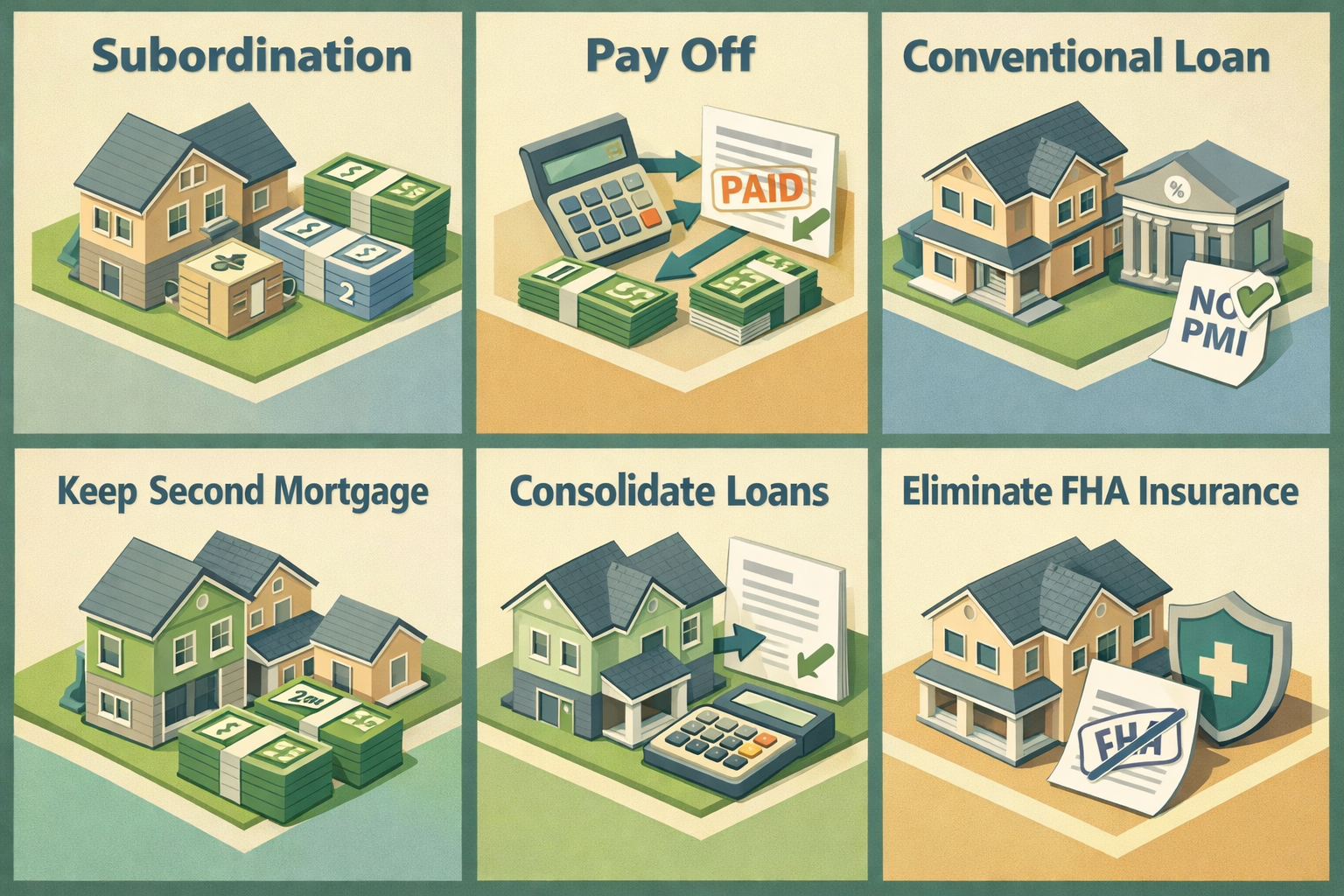
Subordination is often the most straightforward route when you want to refinance FHA with second mortgage intact. In this scenario, your second mortgage lender agrees to keep their lien in the junior position so your new FHA loan can take first position. This allows you to refinance without having to pay off the second loan entirely.
To pursue subordination, you'll typically need to submit a formal subordination request to your second lender. They'll review factors such as your credit profile, your combined loan-to-value (CLTV) ratio, and the terms of the new first mortgage. If your CLTV is high — meaning you don't have much equity — some lenders may decline the request.
- Advantages: You keep your second mortgage in place, avoid paying it off, and can still refinance the FHA loan at a potentially better rate.
- Potential challenges: The second lender has the right to say no. Processing time for subordination can also delay your closing by several weeks.
- Best for: Homeowners who have a favorable second mortgage rate or who don't have the cash to pay off the second loan at closing.
It's worth noting that subordination is more commonly approved when the refinance is a conventional rate-and-term refinances transaction rather than a cash-out refinance. If you're looking to pull equity out of your home, the second lender may be less willing to cooperate, since it increases the risk to their junior position.
Option Two — Paying Off the Second Mortgage at Closing
If your home has appreciated significantly or you've built up substantial equity, you might be able to use a cash-out refinance on the FHA loan to pay off the second mortgage entirely at closing. This consolidates both loans into a single monthly payment and eliminates the complexity of managing two liens.
FHA cash-out refinancing may allow eligible borrowers to access equity in their home, though the loan-to-value limits and eligibility requirements apply. Typically, FHA cash-out refinances are subject to a maximum LTV, meaning you'll need enough equity in the property to cover both the payoff of the original first mortgage and the second mortgage balance, while staying within FHA's lending limits.
- Advantages: Simplifies your mortgage situation by combining everything into one loan. Eliminates the subordination process entirely.
- Potential challenges: You'll need sufficient equity. Borrowing more may increase your monthly payment or extend your loan term. FHA mortgage insurance premiums (MIP) will still apply.
- Best for: Homeowners with significant equity who want to simplify their debt structure and avoid dealing with two separate lenders.
Keep in mind that FHA cash-out refinances require that the property be your primary residence and that you meet credit and income requirements set by FHA guidelines. Working with an experienced loan officer can help you determine if your equity position supports this approach.
Option Three — Refinancing Into a Conventional Loan
One of the most appealing alternatives for many homeowners is to refinance their FHA loan into a conventional mortgage. This strategy can be especially attractive if you've built enough equity to avoid private mortgage insurance (PMI) or if you want to permanently eliminate the FHA's annual mortgage insurance premium, which typically lasts for the life of the loan on certain FHA products.
When refinancing to a conventional loan, you still need to address the second mortgage — but conventional lenders may offer more flexibility in some cases. Conventional guidelines for subordination can vary by lender, and some may allow higher combined LTV ratios depending on the loan product and your creditworthiness.
- Advantages: Potential to eliminate FHA mortgage insurance. May offer more competitive rates for borrowers with strong credit. Possible path to consolidating or subordinating the second mortgage under more flexible terms.
- Potential challenges: Typically requires a higher credit score and lower debt-to-income ratio than FHA. If your equity is below 20%, you may still face PMI costs.
- Best for: Homeowners who have improved their credit profile, built equity above 20%, and want to shed FHA mortgage insurance for good.
This is often the most financially advantageous path over the long run, though it requires meeting conventional underwriting standards that may be stricter than FHA requirements.
Understanding the FHA Streamline Refinance and Its Limitations
The FHA Streamline Refinance is a popular program that allows existing FHA borrowers to refinance with reduced documentation and without a full appraisal in many cases. It's designed to make the refinance process faster and simpler. However, when a second mortgage is involved, the FHA Streamline comes with important limitations worth understanding.
The FHA Streamline Refinance does not allow for cash-out, so it cannot be used to pay off a second mortgage through additional borrowing. Additionally, the subordination requirement still applies — the second lender must agree to subordinate their lien for the new FHA Streamline loan to take first position. If the second lender refuses to subordinate, the Streamline refinance cannot proceed.
- When it works: If your second mortgage lender agrees to subordinate and your goal is simply to lower your FHA interest rate or switch from an adjustable to a fixed rate.
- When it doesn't: If you need cash to pay off the second mortgage, or if your second lender won't cooperate on subordination.
Given these constraints, many homeowners with a second mortgage find that the best options for refinancing involve a full FHA refinance or a conventional refinance that better suits their needs. The Streamline is still worth exploring, particularly if the subordination process goes smoothly and a lower rate is your primary goal.
Key Factors Lenders Evaluate When You Refinance FHA With Second Mortgage
Whether you choose subordination, payoff, or a shift to conventional financing, lenders will assess several core factors before approving your refinance. Understanding what they're looking for can help you prepare and improve your chances of approval.
- Combined Loan-to-Value (CLTV) Ratio: Lenders look at the total of both your first and second mortgage balances relative to your home's current value. A lower CLTV signals less risk and makes subordination approvals more likely.
- Credit Score: FHA refinances typically have more lenient credit score requirements than conventional loans, but a stronger score still works in your favor for rate pricing and lender confidence.
- Debt-to-Income Ratio (DTI): Your total monthly debt obligations, including both mortgage payments, relative to your gross monthly income should fall within acceptable limits. Lower DTI generally improves your approval odds.
- Payment History: Most lenders and the FHA itself want to see a solid record of on-time payments on both your first and second mortgage before approving a refinance.
- Home Equity: More equity in your home opens more doors — it may allow you to consolidate loans, avoid mortgage insurance, or make subordination easier to obtain.
Gathering your financial documents early — including pay stubs, tax returns, bank statements, and your current mortgage statements — can help streamline the lender review process considerably. Refinancing an FHA loan with a second mortgage requires careful preparation, and having your paperwork ready gives you a strong starting point.
●Conclusion
Navigating the best options for refinancing an FHA loan with an existing second mortgage takes some extra steps compared to a standard refinance, but it's absolutely achievable with the right guidance. Whether you pursue subordination, consolidate both loans into a new FHA or conventional mortgage, or use the FHA Streamline program where it fits, the key is to understand how each path affects your overall financial picture. Start by contacting your second mortgage lender to discuss subordination, then consult with a knowledgeable mortgage professional who can evaluate your equity, credit, and income to recommend the most strategic approach. With the right plan in place, refinancing could help you secure a lower interest rate, reduce your monthly payment, and put you on a stronger financial footing for years to come. Reach out to the LoanWise team today to explore your refinancing options and get personalized guidance tailored to your unique situation.