
If you've recently come into a large sum of money — whether from a home sale, inheritance, or savings — you might be wondering how to put it to work on your mortgage. One option that doesn't get nearly enough attention is mortgage recasting. Unlike refinancing, recasting allows homeowners to lower their monthly payment by applying a lump sum directly to their principal balance, without changing their interest rate or loan term in a dramatic way. It's a quiet but powerful financial tool that could make a real difference in your monthly budget. In this article, we'll break down exactly how mortgage recasting works, who it's best suited for, and what you should consider before making this move.
Understanding How Mortgage Recasting Works
At its core, mortgage recasting is a process where a borrower makes a large, one-time payment toward the principal balance of their loan. After that payment is applied, the lender reamortizes the remaining balance over the rest of the original loan term. The result? A lower monthly payment — while keeping the same interest rate and remaining loan duration.
Here's a simple way to think about it: imagine you have 20 years left on your mortgage and you apply a $50,000 lump sum to the principal. Your lender then recalculates your monthly payment based on the new, lower balance spread across those same 20 years. You don't get a new loan, you don't go through underwriting, and your interest rate stays exactly where it is.
This is what separates recasting from refinancing. A refinance replaces your existing loan with a brand-new one — often with a new rate, new term, and new closing costs. Recasting simply adjusts the payment schedule on your current loan. For many homeowners, that distinction makes all the difference.
Who Typically Qualifies for a Mortgage Recast
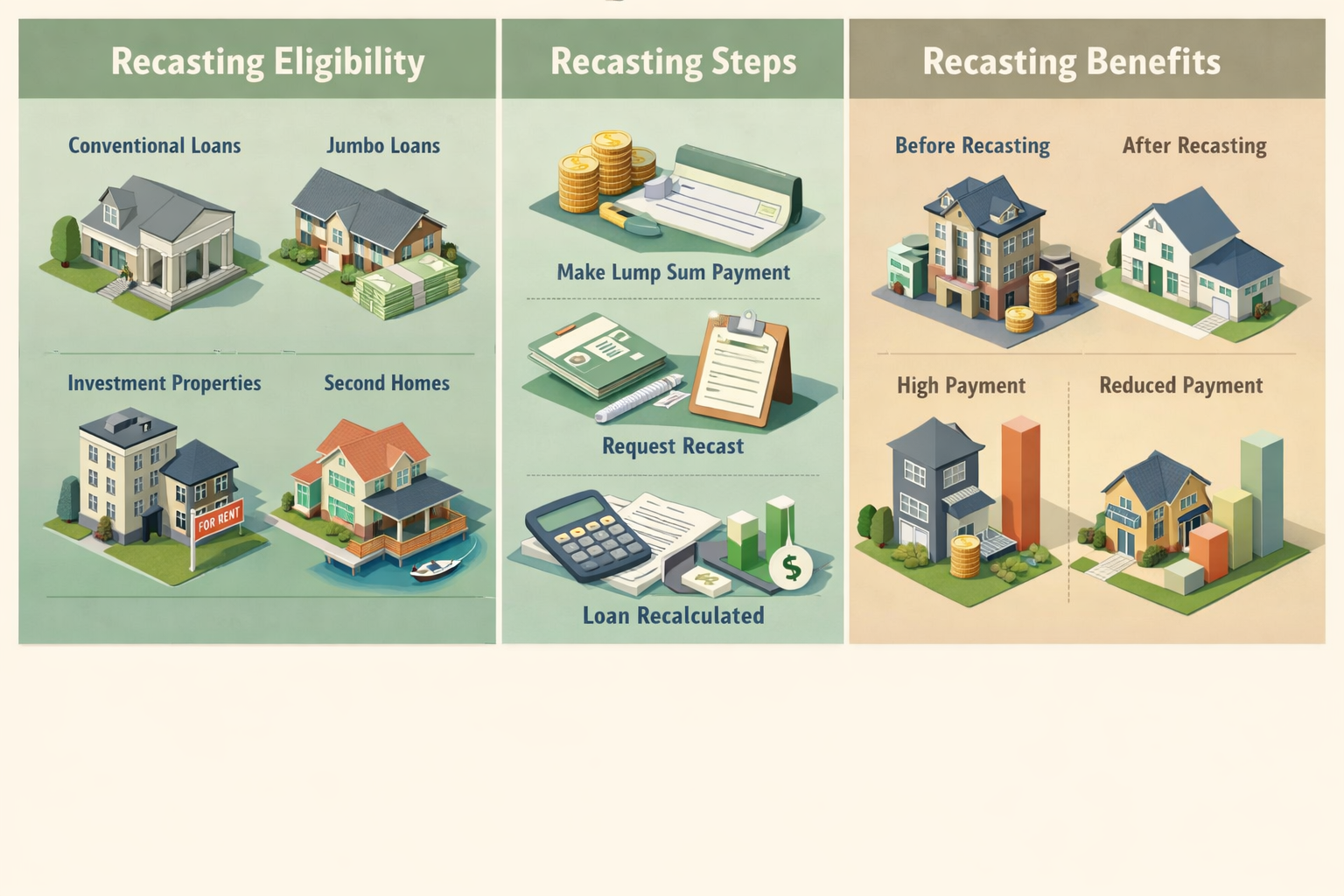
Not every borrower or loan type is eligible for recasting, so it's important to understand the general requirements before planning around it. Most conventional loans are eligible for recasting, but FHA loans, VA loans, and USDA loans are generally not eligible for this option. If you have one of these government-backed loan types, recasting likely isn't available to you, and refinancing may be your best alternative.
For conventional loan holders, lenders typically require a minimum lump-sum payment to approve a recast — this figure often falls somewhere in the range of $5,000 to $10,000 or more, though the exact threshold varies by lender. You'll also generally need to be current on your mortgage payments with no recent history of delinquency.
Some jumbo loan borrowers may also find recasting available, as private lenders who hold these larger loans sometimes offer this option. It's worth calling your loan servicer directly to ask whether your specific loan is eligible and what their minimum requirements are.
- Conventional loans: Most commonly eligible
- Jumbo loans: May be eligible depending on the lender
- FHA, VA, USDA loans: Generally not eligible
- Current payment status: Typically required
- Minimum lump-sum amount: Varies by lender
The Real Cost of Recasting — And What You'll Save
One of the most appealing aspects of mortgage recasting is how affordable it is compared to refinancing. Most lenders charge a modest administrative fee to process a recast — this fee is often somewhere between $150 and $500, though it can vary. Compare that to a refinance, which may involve closing costs that total thousands of dollars or even a percentage of your loan amount.
The savings from recasting depend heavily on how much you put toward the principal and where you are in your loan term. A larger lump-sum principal payment will result in a more meaningful reduction in your monthly obligation. And because the interest is being calculated on a smaller principal balance going forward, you'll also pay less in total interest over the life of the loan — even though your interest rate hasn't changed.
It's worth noting that recasting doesn't shorten your loan term. If you have 25 years remaining, you'll still have 25 years remaining after the recast. However, if your goal is to build equity faster or pay off the loan sooner, you could continue making your original higher payment voluntarily — directing the extra amount toward the principal each month.
Mortgage Recasting vs. Refinancing — Choosing the Right Path
Both recasting and refinancing can reduce your monthly mortgage payment, but they serve different financial situations. Understanding when each strategy makes sense can help you make the most informed decision for your household.
Recasting may be the better choice when:
- You already have a low interest rate and don't want to risk losing it
- You want to avoid the time and paperwork of a full refinance
- You have a lump sum available and want to immediately reduce your payment
- Your credit score has changed since you got your loan and you're concerned about qualifying for a better rate
- You want to minimize fees and closing costs
Refinancing may be the better choice when:
- Interest rates have dropped significantly since you got your original loan
- You want to change your loan term — for example, switching from a 30-year to a 15-year mortgage
- You have an FHA, VA, or USDA loan that isn't eligible for recasting
- You want to tap into home equity through a cash-out refinance
There's no universal right answer. The best path depends on your current rate, how long you plan to stay in the home, your available cash, and your broader financial goals. Consulting with a mortgage professional can help you model both scenarios side by side.
When Homebuyers Can Benefit Most from Recasting After Closing
Mortgage recasting is particularly useful for a specific type of homebuyer: someone who purchases a new home before selling their current one. This situation is more common than many people realize. A buyer might need to move quickly in a competitive market, securing their new home before their existing property sells. Once the old home sells and the proceeds come in, they're left with a significant lump sum — and recasting offers a clean way to apply those funds and reduce the payment on the new mortgage without refinancing.
This approach can ease a lot of financial stress. Instead of carrying two housing payments for an extended period, the homeowner can wait for the sale to close, apply the proceeds toward the new mortgage principal, and recast the loan to a more comfortable monthly payment level. It turns what could be a financially stressful transition into a manageable one.
Similarly, homeowners who receive a large bonus, an inheritance, or proceeds from selling investments might find recasting to be a smart, low-friction way to put those funds to work immediately — without the commitment or complexity of a full refinance.
Steps to Request a Mortgage Recast from Your Lender
The process of recasting your mortgage is generally straightforward, but it does require some proactive communication with your loan servicer. Here's a general outline of what to expect:
- Step 1 — Contact your loan servicer: Call or write to the company that currently handles your mortgage payments. Ask specifically whether your loan type is eligible for recasting and what their minimum lump-sum requirement is.
- Step 2 — Confirm the fee: Ask about the administrative fee for processing the recast so there are no surprises.
- Step 3 — Make the lump-sum payment: Transfer the funds directly toward your principal balance. Make sure to specify that this is a principal reduction payment, not a regular monthly payment.
- Step 4 — Submit a formal recast request: Your servicer will likely have a form or written request process. Follow their specific instructions carefully.
- Step 5 — Receive your new payment schedule: Once the recast is processed — which may take a billing cycle or two — you'll receive an updated amortization schedule showing your new, lower monthly payment.
Keep records of every step in this process. Request written confirmation of your new payment amount and updated loan balance once the recast is complete.
●Conclusion
Mortgage recasting is one of those underused financial strategies that can deliver real, lasting relief for the right homeowner. If you have a conventional loan, a healthy lump sum available, and a desire to lower your monthly payment without the cost and complexity of refinancing, recasting might be exactly what you're looking for. It's not the right fit for everyone — particularly those with government-backed loans or those who'd benefit more from a rate reduction — but for many homeowners, it offers a simple, affordable, and effective way to improve their financial position. At LoanWise, we encourage you to explore all your options and speak with a knowledgeable mortgage professional who can help you decide which path makes the most sense for your unique situation.