
Buying a high-value home is an exciting milestone, but financing it with commission-based or freelance income can feel like an uphill climb. Jumbo loans — those that exceed conforming loan limits — come with stricter qualification standards than conventional mortgages. Add variable, non-salaried income into the mix, and many borrowers wonder whether approval is even realistic. The good news is that it absolutely can be. Understanding how to get a jumbo loan with commission-based freelance income starts with knowing what lenders are actually looking for and how to present your financial picture in the strongest possible way.
What Makes Jumbo Loans Different From Conventional Mortgages
A jumbo loan is a mortgage that exceeds the conforming loan limits set by the Federal Housing Finance Agency (FHFA). Because these loans can't be purchased by Fannie Mae or Freddie Mac, lenders take on greater risk — and that means they typically impose tighter requirements on borrowers.
For homebuyers pursuing high-value properties, jumbo loans are often the only financing option available. But qualifying isn't the same as qualifying for a standard 30-year fixed mortgage. Lenders tend to scrutinize credit profiles, cash reserves, debt-to-income ratios, and income stability much more closely.
- Higher credit score thresholds: Most jumbo lenders look for a credit score of 700 or above, though some may require 720 or higher.
- Larger down payments: Down payment requirements often range from 10% to 20% or more, depending on the loan size and lender.
- More cash reserves: Lenders may want to see 6 to 12 months of mortgage payments held in reserve after closing.
- Stricter debt-to-income limits: Many lenders prefer a DTI ratio below 43%, though this can vary.
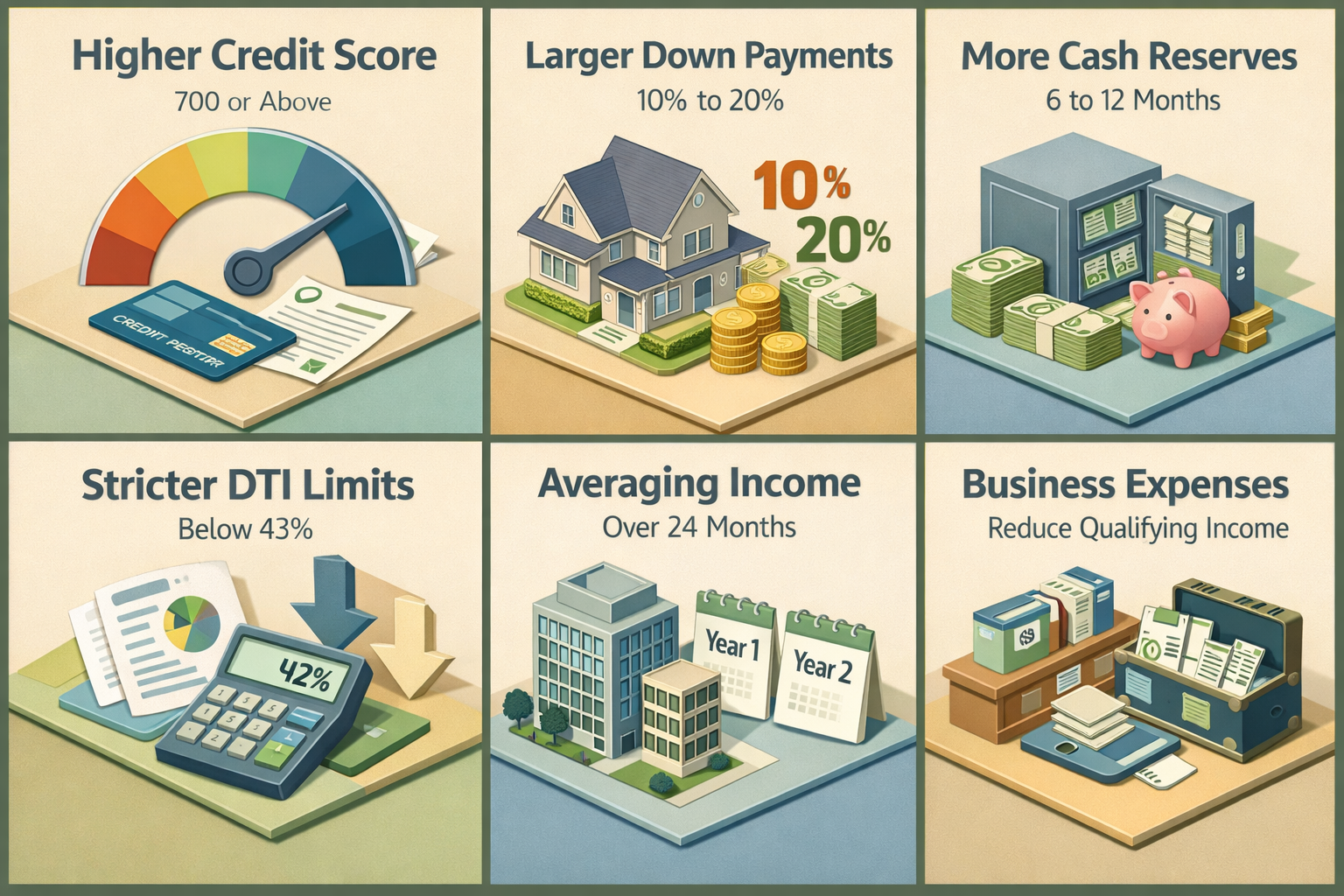
When you add commission-based or freelance income to this picture, the underwriting process becomes even more detailed. That doesn't mean it's impossible — it just means preparation matters more than ever.
How Lenders View Commission-Based and Freelance Income
One of the biggest challenges in jumbo loan qualifying with commission income is that lenders can't simply look at a pay stub. Commission earnings, freelance payments, and self-employment income tend to fluctuate from month to month and year to year, which makes it harder for underwriters to project future income with confidence.
Generally speaking, most lenders require at least two years of documented commission or self-employment income before they'll consider it stable enough to qualify for a mortgage. This two-year history helps them establish a reliable average and assess whether your income has been consistent or trending upward.
Here's how lenders typically approach commission-based income:
- Averaging income over 24 months: Lenders often average your gross commission earnings over the past two years to arrive at a usable monthly income figure.
- Trending matters: If your income has been declining year over year, some lenders may use the lower year's figure — or decline the application altogether.
- Business expenses reduce qualifying income: If you're self-employed or a 1099 contractor, lenders typically subtract business expenses reported on your tax returns from your gross income, which can significantly lower your qualifying number.
- Freelance income may need a track record: Newer freelancers or those who recently transitioned from salaried work may find it harder to document sufficient income history.
Understanding these nuances ahead of time gives you a much better chance of structuring your application in a way that resonates with underwriters.
Essential Documents You'll Need to Gather
Documentation is everything when you're applying for a jumbo loan with variable income. Lenders want a paper trail that tells a clear, consistent story about your earnings. Being organized and proactive with your paperwork can make a meaningful difference in how smoothly your application moves through underwriting.
For commission-based earners and freelancers, expect to provide most or all of the following:
- Two years of personal federal tax returns (1040s): This is typically the foundation of your income documentation. Lenders will review all schedules, especially Schedule C for self-employed borrowers.
- Two years of W-2s or 1099s: These confirm the income reported on your tax returns and identify your income sources.
- Year-to-date profit and loss statement: If you're self-employed, a current P&L prepared by a CPA can help demonstrate ongoing income.
- Bank statements: Lenders may review 12 to 24 months of bank statements to verify cash flow and confirm that income deposits align with what's reported on your returns.
- Evidence of active contracts or clients: Some lenders — especially those offering non-QM or bank statement loans — may ask for signed contracts or letters from clients to validate ongoing work.
- CPA letter or accountant verification: A letter from your accountant confirming the nature and duration of your self-employment can add credibility to your application.
The more complete and consistent your documentation, the fewer questions underwriters are likely to have. Consider working with a tax professional who understands mortgage qualifying before you apply, as strategic tax planning in the years leading up to your application can have a real impact on the income figure lenders use.
Strategies to Strengthen Your Jumbo Loan Application
If you know that your income type is going to raise questions, the smart move is to offset potential concerns with other financial strengths. Lenders look at the full picture, and a strong overall profile can help compensate for income variability.
Build Up Your Cash Reserves
One of the most effective ways to improve your standing as a jumbo borrower is to demonstrate substantial liquid assets. If you can show 12 months or more of mortgage payments sitting in savings or investment accounts, lenders may feel more comfortable with the risk of your income fluctuations. Some lenders may even allow significant asset reserves to partially offset income shortfalls through asset depletion calculations.
Reduce Your Debt Load Before Applying
Your debt-to-income ratio is one of the most closely watched figures in jumbo loan underwriting. Paying down credit cards, auto loans, or other recurring debts before you apply can lower your DTI meaningfully and expand your qualifying options. Even reducing one or two balances can shift your ratio into a more favorable range.
Optimize Your Credit Score
A higher credit score gives lenders more confidence and may open the door to better rates and terms. Before applying, review your credit reports for any errors, avoid opening new credit accounts, and try to keep your credit utilization low. Scores above 740 or 760 may qualify you for the most competitive jumbo loan pricing available.
Consider a Larger Down Payment
A bigger down payment reduces the lender's exposure and signals financial discipline. Even if you meet the minimum down payment requirement, offering more — say, 25% or 30% — could improve your approval odds and potentially lower your interest rate.
Exploring Non-QM and Bank Statement Loan Options
Traditional mortgage underwriting guidelines can be frustrating for borrowers with non-traditional income. Fortunately, the lending market has evolved to address this. Non-QM (non-qualified mortgage) loans and bank statement programs may offer a viable path for commission earners and freelancers who can't fully qualify through conventional channels.
With a bank statement loan, lenders assess your income based on 12 to 24 months of personal or business bank statements rather than tax returns. This approach can be particularly helpful if you write off significant business expenses on your taxes — because those deductions, while legitimate, often reduce the income lenders can count under traditional guidelines.
Key features of non-QM and bank statement jumbo programs may include:
- Income verification through deposits rather than tax returns
- More flexibility for borrowers with complex or variable earnings
- Potentially higher interest rates compared to conventional jumbo loans
- Larger down payment requirements in some cases
- Available through portfolio lenders, credit unions, and specialty mortgage lenders
It's worth noting that non-QM loans typically carry higher rates and fees than conventional jumbo products. However, for the right borrower, the trade-off may be well worth it — especially if a conventional path simply isn't available. Working with a mortgage broker who has access to multiple lenders and non-QM programs can help you find the most competitive option for your situation.
Working With the Right Lender for Your Income Profile
Not all lenders are created equal — and this is especially true when it comes to variable income. Some banks and mortgage companies have rigid guidelines that leave little room for nuance, while others — particularly portfolio lenders and specialty mortgage companies — have more flexible underwriting standards designed for borrowers like you.
Here are some things to consider when choosing a lender:
- Ask about their experience with commission-based borrowers: A lender who regularly works with self-employed and commission-income clients will understand your situation better and know how to package your file effectively.
- Compare jumbo-specific products: Some lenders offer jumbo programs with features tailored to high-earning but variable-income borrowers, including asset-based qualification or interest-only options.
- Consider working with a mortgage broker: A broker with access to multiple wholesale lenders and non-QM programs can shop your file more broadly and find the best fit for your income type.
- Get a pre-approval before house hunting: For jumbo borrowers with complex income, a thorough pre-approval — not just a pre-qualification — is essential. It gives you a realistic sense of your purchasing power and signals seriousness to sellers.
The relationship you build with a knowledgeable loan officer can make a real difference. Someone who understands the nuances of how to get a jumbo loan with commission-based freelance income can guide you through documentation requirements, suggest the right loan products, and help you avoid common pitfalls before they become problems.
●Conclusion
Qualifying for a jumbo loan with commission-based or freelance income takes more planning than a standard mortgage application — but it's far from out of reach. Lenders want to see a consistent income history, thorough documentation, strong creditworthiness, and healthy financial reserves. By understanding how your income is evaluated, gathering the right paperwork, and exploring all available loan options including non-QM programs, you can position yourself as a competitive borrower even with variable earnings. If you're ready to take the next step, connecting with an experienced mortgage professional who specializes in jumbo and non-traditional income lending could be the most valuable move you make on your journey to homeownership.