For eligible veterans, active-duty service members, and surviving spouses, a VA loan is one of the most powerful home financing tools available. It typically requires no down payment and offers competitive interest rates. But even with all these advantages, many buyers are surprised to discover that closing costs are still part of the equation. So, what are the closing costs for a VA loan purchase? Understanding what you might owe at the closing table — and what the VA actually restricts lenders from charging — can help you budget smarter and avoid unwelcome surprises. This guide walks you through each potential fee, so you can approach your purchase with confidence.
How VA Loan Closing Costs Differ From Other Loan Types
VA loans operate under a unique set of rules designed to protect borrowers from excessive fees. The Department of Veterans Affairs sets guidelines that limit certain charges lenders can pass on to the buyer. This makes the VA loan closing fees breakdown notably different from what you'd see with a conventional or FHA loan.
One of the most notable protections is the VA's non-allowable fees rule. Lenders are prohibited from charging VA borrowers certain costs — such as attorney fees for the lender's benefit, prepayment penalties, and some processing charges — that are common in other loan programs. This doesn't mean closing costs disappear entirely, but it does mean the overall expense may be more manageable compared to other mortgage types.
It's also worth noting that the VA loan program allows sellers to pay all of a borrower's loan-related closing costs, plus up to 4% of the loan amount in concessions. This seller contribution flexibility is broader than what many conventional loan programs permit, giving VA buyers a meaningful negotiating advantage in certain market conditions.
The VA Funding Fee: What It Is and How Much It Could Cost
The single largest cost unique to VA loans is the VA funding fee. This is a one-time fee paid to the Department of Veterans Affairs that helps sustain the loan program for future generations of eligible borrowers. Unlike private mortgage insurance required by conventional lenders, the VA funding fee is a government charge — and it's typically rolled into the loan balance rather than paid as cash at closing, though paying it upfront is also an option.
The VA funding fee amount varies based on several factors, including whether it's your first time using a VA loan or a subsequent use, and whether you're making a down payment. For first-time VA loan users with no down payment, the fee is currently set at a percentage of the loan amount that may hover around 2.3%, while subsequent users may pay a higher rate. Making a down payment of 5% or more could reduce the fee percentage, and putting down 10% or more may lower it further.
Importantly, some borrowers are exempt from paying the VA funding fee altogether. Veterans who receive VA disability compensation, surviving spouses of veterans who died in service or from a service-connected disability, and certain other eligible individuals may qualify for a full exemption. It's worth confirming your exemption status with your lender or the VA before closing.
A Full VA Loan Closing Fees Breakdown: A Detailed Look
Beyond the funding fee, there are several other costs that typically appear in the VA loan closing fees breakdown. These fall into two broad categories: lender fees and third-party fees.
Common Lender Fees
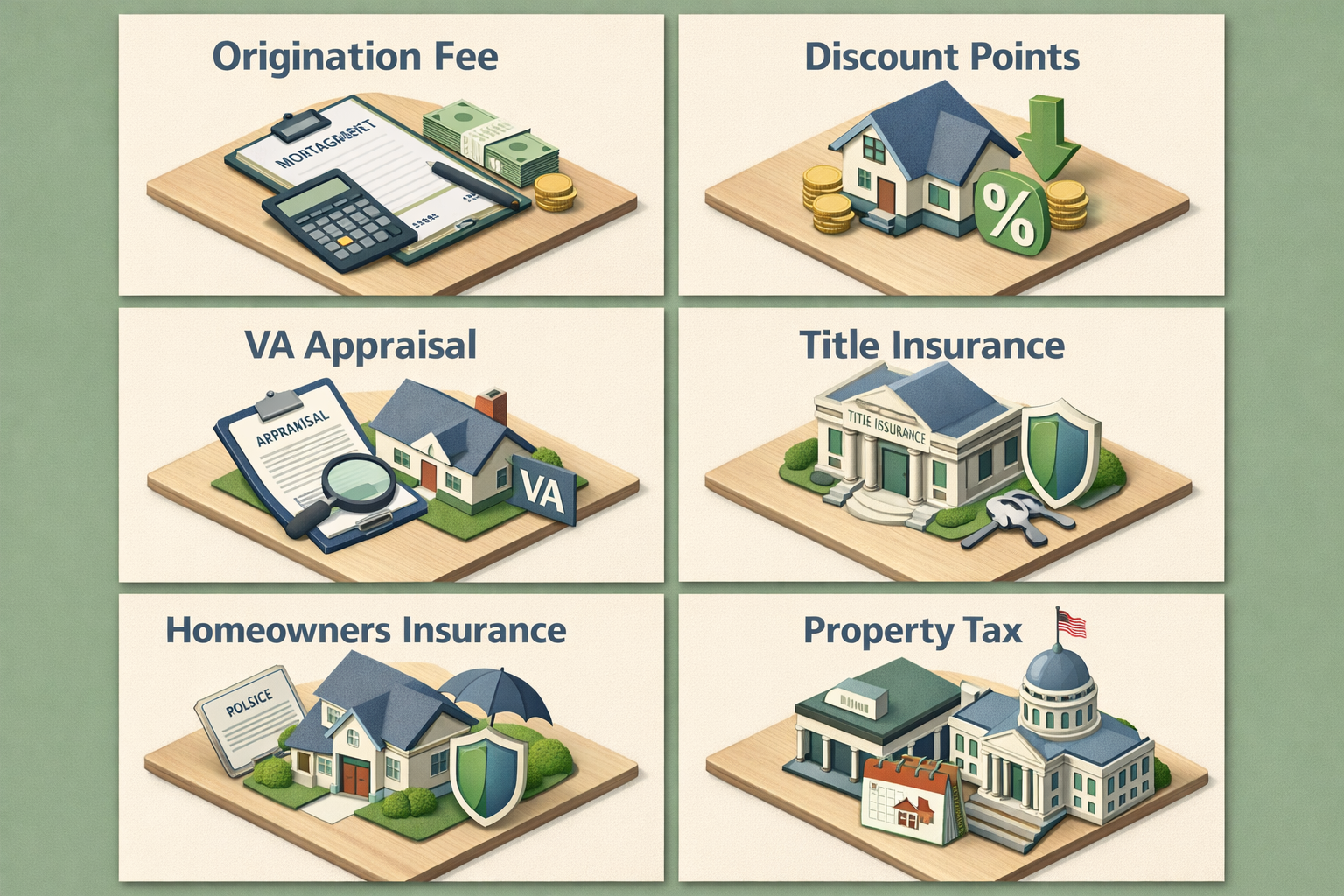
- Origination fee: The VA allows lenders to charge an origination fee of up to 1% of the loan amount. This fee covers the lender's administrative costs for processing the loan. Some lenders may charge less or waive it entirely, so it's worth shopping around.
- Discount points: These are optional prepaid interest charges that lower your mortgage rate. Each point typically costs 1% of the loan amount. Buyers sometimes choose to pay points to secure a lower monthly payment over the life of the loan.
Third-Party and Government Fees
- VA appraisal fee: The VA appraisal fees for purchase transactions are set by the VA and vary by region. A VA appraisal is required for all purchase loans and typically costs several hundred dollars. The appraisal evaluates both the market value of the property and whether it meets the VA's minimum property requirements.
- Title search and title insurance: These fees cover the cost of researching the property's ownership history and insuring against title defects. They can vary significantly by state and property price.
- Recording fees: Charged by the local government to officially record the change of ownership and the new mortgage lien in public records.
- Prepaid costs: These include upfront homeowners insurance premiums, property tax escrow deposits, and prepaid mortgage interest covering the days between closing and your first payment due date.
- Survey fees: In some transactions, lenders may require a property survey to confirm boundaries. This cost varies by location and lot complexity.
- Credit report fee: Lenders typically order a credit report during the underwriting process, and this cost is often passed to the borrower.
Average Cost of VA Loan Closing: What Buyers Typically Pay
The average cost of VA loan closing can vary widely depending on your loan amount, location, lender, and whether you're exempt from the funding fee. As a general estimate, closing costs — excluding the VA funding fee — might range from roughly 1% to 3% of the loan amount for most borrowers. When the funding fee is included and rolled into the loan, the total out-of-pocket obligation at closing may actually be quite low for eligible borrowers.
For example, on a $300,000 VA purchase loan, a first-time VA loan user without a down payment might expect to see a funding fee of approximately $6,900 (based on a 2.3% rate), which could be financed into the loan. Other closing costs might add several thousand dollars depending on location and lender. However, if the seller agrees to cover closing costs through concessions, the buyer's out-of-pocket expense at closing could be minimal.
It's important to get a Loan Estimate from your lender early in the process. This standardized document, required by federal law, itemizes all expected closing costs so you can compare offers from multiple lenders and make an informed decision. Reviewing the Loan Estimate carefully — and asking questions about any line items you don't understand — is one of the most practical steps a VA homebuyer can take.
Fees the VA Does Not Allow Lenders to Charge Borrowers
One of the most borrower-friendly aspects of the VA loan program is its list of non-allowable fees — charges that lenders simply cannot pass on to the VA borrower. Being aware of these protections can help you catch improper charges before they appear on your Closing Disclosure.
- Attorney fees for the lender: If the lender requires an attorney to represent their interests, the borrower cannot be billed for it.
- Mortgage broker fees beyond the 1% cap: Any broker compensation that pushes total origination charges above the 1% limit is not permitted.
- Pest inspection fees (in most cases): The VA generally prohibits charging the buyer for pest inspections in purchase transactions, though this may vary by state.
- Rate lock extension fees: In most cases, lenders cannot charge VA borrowers for extending a rate lock.
- Notary fees: These are typically non-allowable under VA guidelines.
- Prepayment penalties: VA loans cannot include prepayment penalties, protecting borrowers who want to pay off their loan early.
If you notice any of these charges on your Loan Estimate or Closing Disclosure, raise the issue with your lender immediately. A knowledgeable VA-approved lender will know these rules well and should not be including prohibited fees in the first place.
Smart Strategies to Reduce What You Pay at the VA Loan Closing Table
Even though VA loans already offer significant cost advantages, there are several strategies that may help eligible buyers reduce closing expenses even further.
Negotiate Seller Concessions
As mentioned earlier, VA rules allow sellers to contribute toward a buyer's closing costs. In a buyer's market or when a seller is motivated, negotiating these concessions into your purchase agreement can significantly reduce your out-of-pocket costs at closing. Working with a real estate agent experienced in VA transactions can make this negotiation smoother.
Shop Multiple Lenders
Not all VA-approved lenders charge the same fees. Origination fees, discount points, and third-party service costs can vary from one lender to another. Comparing Loan Estimates from at least two or three lenders could reveal meaningful savings over the life of your loan and at the closing table.
Ask About Lender Credits
Some lenders offer lender credits — where the lender covers some or all of your closing costs in exchange for a slightly higher interest rate. This can be a useful trade-off if you prefer lower upfront costs, though it does increase the long-term cost of the loan. It's worth running the numbers with your loan officer to see if this option makes sense for your situation.
Confirm Your Funding Fee Exemption Status Early
If you believe you may qualify for a VA funding fee amount exemption, verify this with the VA and your lender as early as possible. Receiving an exemption can eliminate the single largest cost unique to the VA program, dramatically reducing what you owe.
●Conclusion
Understanding what are the closing costs for a VA loan purchase is an essential step in planning a successful home purchase. While the VA loan program offers remarkable protections and savings compared to conventional financing, closing costs are still a reality — and being well-informed helps you avoid surprises. From the VA funding fee to appraisal charges and lender origination costs, each fee plays a role in the full picture of your financing expenses. The good news is that VA borrowers have more tools than most to manage these costs, from seller concessions to funding fee exemptions and lender shopping. At LoanWise, we're here to help you navigate every detail of your VA home purchase with clarity and confidence. Reach out today to connect with a VA loan specialist who can walk you through your personalized cost estimate.