
Relocating for a new job is exciting, but it can also create real financial complexity — especially if you're carrying an adjustable-rate mortgage (ARM). As rates shift and your income situation changes, the pressure to make the right financing decision only grows. Fortunately, there are clear, practical paths forward. Understanding the best options for refinancing ARM mortgage with recent job relocation can help you protect your financial stability and make a confident move. This guide walks you through what lenders look for, which loan products may work in your favor, and how to position yourself for the strongest possible refinance outcome.
Why an ARM Refinance After Relocation Presents Unique Challenges
Adjustable-rate mortgages can be a smart short-term strategy, but they carry inherent risk as rate adjustment periods approach. When you layer in a recent job relocation, the refinancing process becomes more nuanced. Lenders want assurance that your income is stable and likely to continue — something that a brand-new job, even a well-paying one, may not immediately demonstrate on paper.
Most mortgage underwriters prefer to see a consistent two-year employment history in the same field. A recent relocation doesn't automatically disqualify you, but it does mean you'll need to present your income story more deliberately. If you've moved to a higher-paying role within the same industry, that's generally viewed more favorably than a complete career shift. Lenders may also examine whether your new employment is salaried or commission-based, as variable income typically requires additional documentation.
There's also the question of your current property. Did you move away from the home tied to your ARM? If so, lenders will want to know whether that property is now a rental, is listed for sale, or remains your primary residence. Each scenario carries different qualification implications and may affect which loan programs you're eligible for.
How Lenders Evaluate Income and Employment After a Job Move
When you apply to refinance, lenders will pull your tax returns, W-2s, recent pay stubs, and an offer letter or employment verification from your new employer. If you've been at your new job for at least 30 days and can demonstrate continuity in your career path, many lenders will accept your current income for qualification purposes — though policies do vary by lender and loan type.
Here are some factors lenders typically review during income evaluation after relocation:
- Length of time at new job: The longer you've been employed, even a few months, the stronger your application may look.
- Industry continuity: Moving from one employer to another in the same field is viewed more favorably than switching industries entirely.
- Employment type: Salaried positions are easier to document than freelance, contract, or commission-based work.
- Income level comparison: If your new role pays more than your previous one, this could strengthen your debt-to-income (DTI) ratio.
- Offer letter documentation: A signed, non-contingent offer letter from your employer may be accepted in lieu of pay stubs if you're very new to the role.
Self-employed borrowers who've relocated face additional scrutiny. In these cases, lenders typically require two years of tax returns and may look at business bank statements to verify income. Non-QM (non-qualified mortgage) loan programs may offer more flexibility for self-employed refinancers navigating a job relocation scenario.
Exploring the Best Options for Refinancing ARM Mortgage With Recent Job Relocation
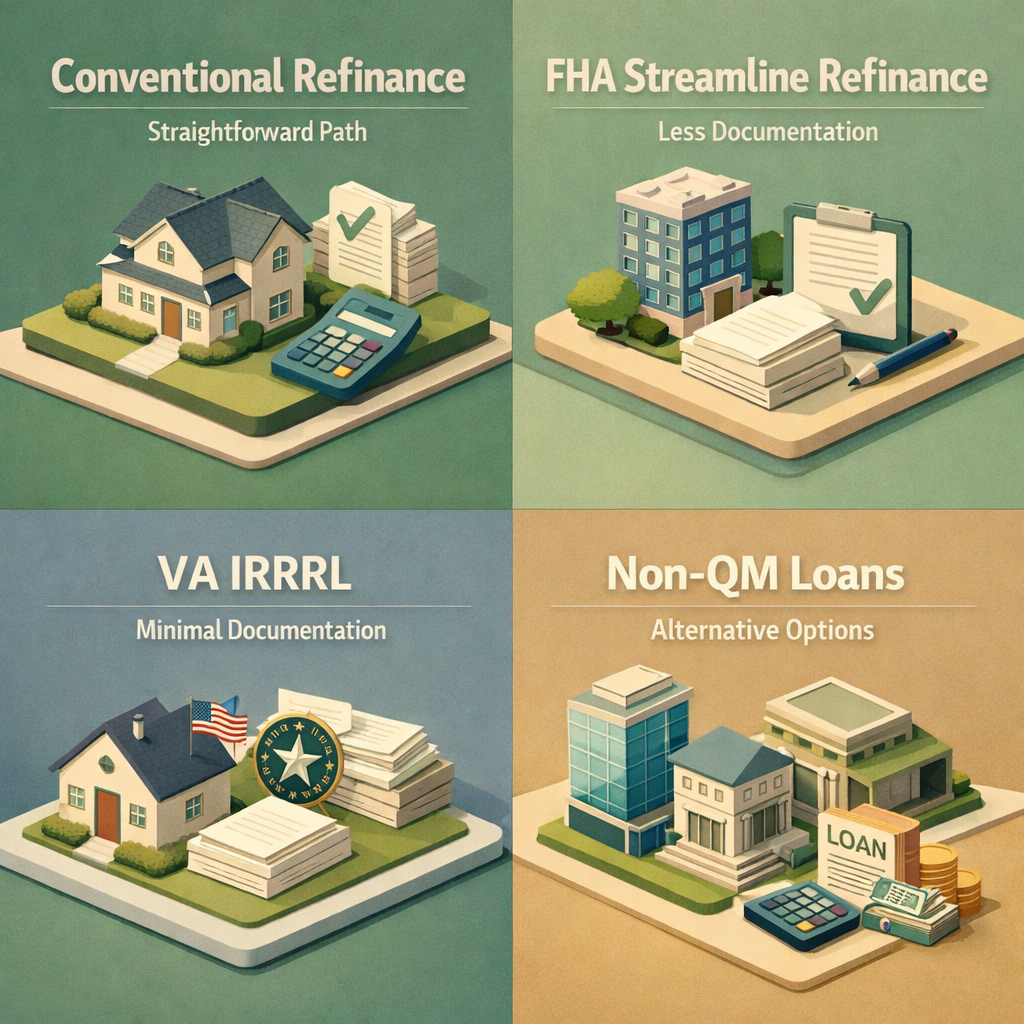
Once you understand what lenders are looking for, you can start evaluating which refinance products may suit your situation. The goal of an ARM refinance after relocation is often to convert your existing adjustable-rate loan into a fixed-rate mortgage for greater payment predictability — particularly important if your new city comes with a higher cost of living.
Conventional Rate-and-Term Refinance
If your credit score is solid and your income documentation is in order, a conventional refinance may be your most straightforward path. These loans typically require a credit score of at least 620, though better scores unlock better rates. With a conventional rate-and-term refinance, you can lock in a fixed rate and eliminate the uncertainty of future ARM adjustments without pulling equity from the property.
FHA Streamline Refinance
If your current ARM is an FHA-insured loan, an FHA Streamline Refinance may offer a simpler path. This program typically requires less documentation and may not require a full income verification in certain cases, which could be advantageous if you're newly employed after relocation. However, you generally must have a history of on-time payments and your new loan must provide a net tangible benefit, such as a lower monthly payment or conversion from an ARM to a fixed rate.
VA Interest Rate Reduction Refinance Loan (IRRRL)
For eligible veterans and active-duty service members, the VA IRRRL is one of the most streamlined refinance options available. It typically requires minimal documentation and does not mandate a new appraisal or credit underwriting in many cases. If you're a veteran who's relocated due to a PCS (Permanent Change of Station) or civilian job move, this option could simplify the refinance process significantly.
Non-QM Refinance Loans
For borrowers who don't fit neatly into conventional lending guidelines — perhaps because of a very recent start date, irregular income, or a gap in employment during relocation — non-qualified mortgage (non-QM) programs may offer a viable alternative. These products often use bank statements, asset depletion calculations, or other alternative documentation methods to verify income. They typically carry higher interest rates, but they provide access to refinancing ARM mortgage that might otherwise be unavailable.
Managing Your Debt-to-Income Ratio During a Transitional Period
Your debt-to-income (DTI) ratio is one of the most critical factors in any refinance application. Most conventional lenders prefer a DTI at or below 43%, though some programs may allow higher ratios with compensating factors. After a job relocation, your income may have shifted — upward or downward — so it's worth calculating your DTI before applying.
If relocation expenses, temporary housing costs, or a salary gap during your transition have increased your monthly obligations, consider addressing those before applying for a refinance. Paying down revolving debt like credit cards can meaningfully lower your DTI and improve your loan eligibility.
It's also worth noting that if you still own the home tied to your original ARM but are renting it out following your relocation, lenders may count a portion of the rental income toward your qualifying income. Typically, lenders apply a vacancy factor — often around 75% of the gross rent — to account for potential vacancies. This could help your DTI significantly if the rental income is well-documented.
Credit Score Considerations When Refinancing After a Move
Relocating for work can trigger several financial behaviors that may temporarily affect your credit score. Opening new utility accounts, applying for credit cards to manage moving expenses, or closing old accounts in your previous city could all create small fluctuations in your credit profile. Before you apply to refinance, it's smart to review your credit report carefully.
Here are some practical steps to help protect and optimize your credit before a refinance application:
- Avoid opening new lines of credit in the months leading up to your refinance application, as new inquiries can temporarily lower your score.
- Check for errors on your credit report that may have been introduced during a busy relocation period and dispute inaccuracies promptly.
- Keep existing credit card balances low relative to your credit limits, as credit utilization is a significant scoring factor.
- Continue making all payments on time, including your current ARM payment, to demonstrate financial responsibility to future lenders.
A higher credit score can unlock meaningfully better interest rates on your refinance, which adds up to real savings over the life of your loan. Even a small improvement in your score before applying could make a noticeable difference in the rate you're offered.
Timing Your Refinance for the Best Outcome
Timing matters both in terms of your personal circumstances and broader market conditions. On the personal side, waiting even a few months at your new job can significantly improve your refinance eligibility. Many lenders become more comfortable with your employment situation once you've received your first few pay stubs and can demonstrate income continuity. If your ARM's rate adjustment date isn't imminent, it may be worth giving yourself time to stabilize financially before applying.
From a market perspective, interest rates on refinance loans can vary considerably based on economic conditions, Federal Reserve policy decisions, and lender-specific pricing. While it's difficult to predict exactly where rates will move, monitoring rate trends and working with a knowledgeable mortgage advisor can help you identify a favorable window to lock in your rate.
It's also worth considering the break-even point on your refinance. Closing costs typically range from 2% to 5% of the loan amount, and you'll want to ensure you plan to remain in the home — or keep the property as a rental — long enough to recoup those costs through your monthly savings. If you're uncertain about how long you'll hold the property following your relocation, this calculation becomes especially important.
●Conclusion
Navigating the best options for refinancing ARM mortgage with recent job relocation requires a clear understanding of lender requirements, your own financial picture, and the loan products available to you. Whether you pursue a conventional refinance, an FHA Streamline, a VA IRRRL, or a non-QM solution, the key is preparation. Document your new income thoroughly, protect your credit score, and work with a mortgage professional who understands the nuances of post-relocation refinancing. The right strategy can help you convert an adjustable-rate loan into a stable, predictable mortgage — giving you one less thing to worry about as you settle into your new chapter. Reach out to a LoanWise lending specialist today to explore your personalized refinance options.