
If you're a veteran or active-duty service member considering a mortgage refinance, you've likely asked yourself: what are closing costs for VA loan refinance? It's a fair question — and an important one. While VA loans are well known for their borrower-friendly terms, refinancing still comes with costs that can affect your overall savings. Understanding each fee, what it covers, and how to manage it can make a real difference in your financial outcome. This guide breaks it all down in plain language so you can move forward with confidence.
Why Closing Costs Matter When Refinancing a VA Mortgage
Refinancing a mortgage can be a powerful financial move. It may lower your monthly payment, reduce your interest rate, or help you access home equity. But no refinance is truly free. Even with a VA loan, you'll likely encounter a range of fees at closing that affect the total cost of the transaction.
Understanding these costs upfront helps you calculate your break-even point — the point at which your monthly savings outweigh what you paid to refinance. If your closing costs total several thousand dollars but you save $150 per month, it might take two or more years to break even. Knowing this helps you decide whether refinancing makes sense right now.
VA loan refinancing generally falls into two main options: the Interest Rate Reduction Refinance Loan (IRRRL), also called a VA Streamline Refinance, and a VA Cash-Out Refinance. Each comes with its own cost structure, though both share some common fees. Let's explore what you can typically expect.
Breaking Down VA Loan Refinance Fees
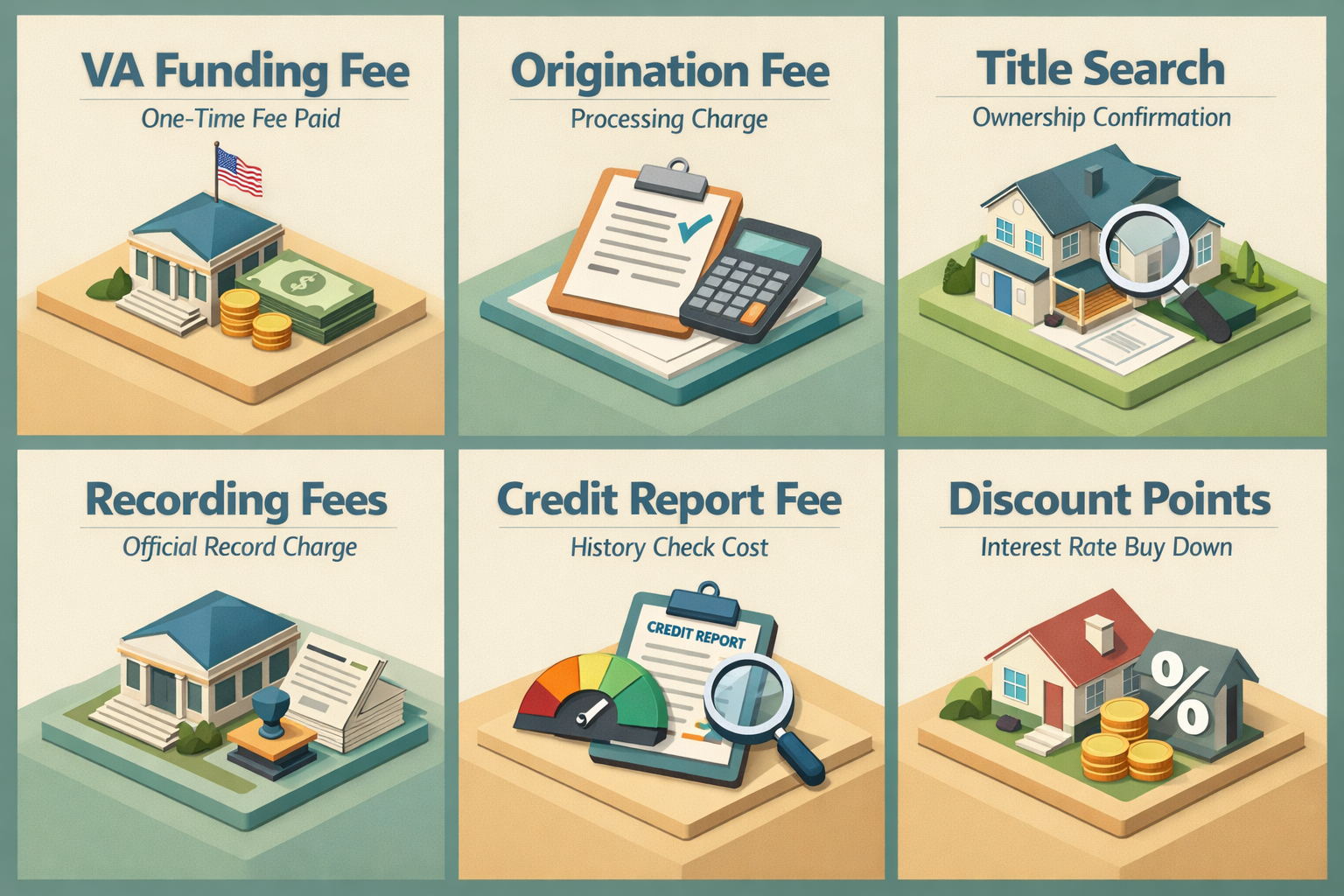
When asking what are closing costs for VA loan refinance, it helps to look at each fee individually. While exact figures vary by lender, loan size, and location, the following are the most common charges you may encounter:
- VA Funding Fee: This is a one-time fee paid directly to the Department of Veterans Affairs. For a VA Streamline Refinance (IRRRL), the funding fee is typically 0.5% of the loan amount. For a Cash-Out Refinance, it may range from approximately 2.15% to 3.3%, depending on whether it's your first or subsequent use and whether you made a down payment on the original loan. Some veterans with service-connected disabilities may be exempt from this fee.
- Origination Fee: Lenders may charge an origination fee to process your loan. The VA limits this to no more than 1% of the loan amount, which helps protect borrowers from excessive lender fees on VA refinances.
- Title Search and Title Insurance: These fees confirm ownership and protect against future claims on the property. Costs vary but are a standard part of most refinance transactions.
- Recording Fees: Local governments charge a fee to officially record the new mortgage in public records. These are typically modest but unavoidable.
- Credit Report Fee: Lenders pull your credit history as part of underwriting, and this cost is usually passed on to you.
- Discount Points: You may choose to pay points upfront to buy down your interest rate. This is optional but worth considering if you plan to stay in the home long term.
In total, VA loan refinance fees can range widely. For a streamline refinance, total costs may be on the lower end — sometimes between 2% and 3% of the loan amount — while a cash-out refinance may carry higher fees due to the larger funding fee and additional underwriting requirements.
VA Appraisal Fees for Refinance: What to Expect
VA appraisal fees for refinance transactions can vary depending on the loan type and your property's location. A VA appraisal is conducted by a VA-approved appraiser and is designed to confirm the property's current market value, as well as ensure it meets the VA's minimum property requirements.
For a VA Cash-Out Refinance, an appraisal is typically required. The appraiser assesses the home's value to determine how much equity you can access. Appraisal fees generally range from a few hundred dollars to over $500 in many markets, though costs in high-demand or rural areas may be higher.
For a VA IRRRL (Streamline Refinance), an appraisal is often not required, which is one of the program's major advantages. Skipping the appraisal can save you money and speed up the process significantly. However, some lenders may still require one, so it's worth confirming with your lender early in the process.
It's also important to note that VA appraisals are not the same as home inspections. An appraisal is focused on value and basic habitability — it doesn't replace a thorough home inspection. While an inspection isn't required for a refinance, it could reveal issues that affect your decision.
Understanding Lender Fees on a VA Refinance
Lender fees VA refinance borrowers encounter can sometimes be confusing because they go by different names depending on the institution. However, the VA provides some protection here. The VA prohibits lenders from charging certain fees on VA loans, known as non-allowable fees.
Non-allowable fees that lenders cannot charge VA borrowers include:
- Attorney fees (beyond a flat closing fee in some states)
- Escrow fees above a reasonable amount
- Prepayment penalties
- Broker fees passed directly to the borrower
- Document preparation fees charged separately from the origination fee
Allowable lender fees, on the other hand, include the 1% origination fee, discount points if you choose them, and certain third-party costs like credit reports and title services. Understanding the difference between these two categories helps you review your Loan Estimate more effectively and spot any charges that shouldn't be there.
When comparing lenders, always request a Loan Estimate from each one. This standardized document breaks down every fee you'll pay and makes it easier to compare offers side by side. Even small differences in lender fees can add up to meaningful savings over the life of a loan.
Average Cost to Refinance a VA Mortgage: Setting Realistic Expectations
The average cost to refinance a VA mortgage depends on several factors, including the loan balance, the type of refinance, your lender, and where you live. That said, it's helpful to have a general ballpark in mind before you start shopping.
For a VA IRRRL, total closing costs tend to be lower because the process is more streamlined. You may not need an appraisal, income verification is often simplified, and the funding fee is just 0.5%. Many borrowers find their total out-of-pocket costs are manageable, particularly if they roll fees into the loan balance.
For a VA Cash-Out Refinance, costs are typically higher. The funding fee alone can represent a significant portion of closing costs, and since a full underwriting process is required, you may encounter more third-party service fees as well.
One way to manage the average cost to refinance a VA mortgage is to roll your closing costs into the loan. This means you're not paying anything out of pocket at closing, but your loan balance — and monthly payment — may increase slightly. Whether this makes sense depends on your goals, your current equity, and how long you plan to stay in the home.
Smart Ways to Reduce What You Pay at Closing
Just because closing costs are a normal part of refinancing doesn't mean you can't take steps to reduce them. Here are some strategies that may help:
- Shop multiple lenders: Lender fees can vary significantly. Getting quotes from at least three lenders gives you leverage and helps you find the most competitive offer.
- Negotiate lender fees: Some lender fees, particularly the origination fee, may be negotiable. Don't be afraid to ask if there's flexibility.
- Check your VA funding fee exemption: If you have a service-connected disability rated at 10% or higher, you may be exempt from the VA funding fee. Confirm your eligibility before closing, as this could save you thousands.
- Consider a no-closing-cost refinance: Some lenders offer this option, where fees are either rolled into the loan or offset by a slightly higher interest rate. It's not truly free, but it reduces what you pay upfront.
- Time your refinance wisely: Closing at the end of the month may reduce the amount of prepaid interest you owe, slightly lowering your cash needed at closing.
- Review your Closing Disclosure carefully: Before signing, compare the final Closing Disclosure to the Loan Estimate you received earlier. If any fees have changed significantly, ask your lender for an explanation.
●Conclusion
Understanding what are closing costs for VA loan refinance transactions is the first step toward making a well-informed decision. From the VA funding fee and lender origination charges to appraisal costs and title services, each expense plays a role in your total refinancing cost. The good news is that VA loans come with built-in protections that limit certain fees — and eligible veterans may qualify for exemptions that reduce costs even further.
Whether you're pursuing a VA Streamline Refinance to lower your rate or a Cash-Out Refinance to tap into your home equity, knowing the full cost picture helps you plan better and negotiate smarter. If you're ready to explore your options, speaking with a VA-approved lender is a great next step. At LoanWise, we're here to help you navigate every detail of your refinance journey with clarity and confidence.