For eligible veterans, service members, and surviving spouses, a VA loan can be a powerful tool for achieving homeownership — including purchasing a manufactured home situated on a parcel of land. But many borrowers find themselves asking: what are closing costs for VA loan on a manufactured home with acreage? The answer involves a unique blend of standard VA loan fees, land-related costs, and manufactured home-specific charges. Understanding each component before you close can help you budget wisely and potentially save thousands of dollars. This guide breaks down every cost category clearly so you can move forward with confidence.
How VA Loans Apply to Manufactured Homes on Land
VA loans are backed by the U.S. Department of Veterans Affairs and are designed to help eligible borrowers purchase or refinance a primary residence with favorable terms. While most people associate VA loans with traditional stick-built homes, the program does extend to certain manufactured homes — provided those homes meet specific requirements.
To qualify for VA-backed manufactured home financing, the home typically must be built after June 15, 1976 and meet HUD construction and safety standards. It must also be classified as real property, meaning it needs to be permanently affixed to a foundation and titled as real estate rather than personal property. When the property also includes acreage — whether a few acres of rural land or a larger tract — the land must generally be included in the purchase and financed as part of the same loan package.
It's worth noting that not all VA-approved lenders offer manufactured home loans, and even fewer may be comfortable financing properties with significant acreage. Finding a lender experienced with this type of transaction is an important first step. VA loan land closing costs and property-specific fees can vary meaningfully depending on the lender, the state, and the characteristics of the land itself.
Breaking Down the VA Funding Fee for This Property Type
One of the most significant closing costs on any VA loan is the VA funding fee. This is a one-time fee paid to the Department of Veterans Affairs that helps sustain the loan program for future borrowers. Unlike many other closing costs, the funding fee can be rolled into the loan balance rather than paid upfront — which can be helpful for borrowers with limited cash reserves.
The funding fee amount depends on several factors, including whether it's your first time using a VA loan, your down payment amount, and the type of loan. For purchase loans with no down payment, first-time VA loan users may encounter a funding fee in the range of roughly 2% to 2.15% of the loan amount, while subsequent users might see a slightly higher rate. However, some borrowers are exempt from the funding fee entirely — including veterans receiving VA disability compensation and surviving spouses of veterans who died in service or from a service-connected disability.
Because manufactured home financing VA transactions may involve a smaller loan balance than a comparable stick-built home purchase, the funding fee in dollar terms could be lower — but it still represents a meaningful cost worth factoring into your budget. Always confirm your specific funding fee with your lender before closing.
Land-Related Fees That Come with Acreage Purchases
When a manufactured home sits on a parcel of acreage, closing costs extend beyond what you'd typically encounter for a standard single-family home purchase. Several land-specific fees may apply, and they can add up considerably depending on the size and complexity of the property.
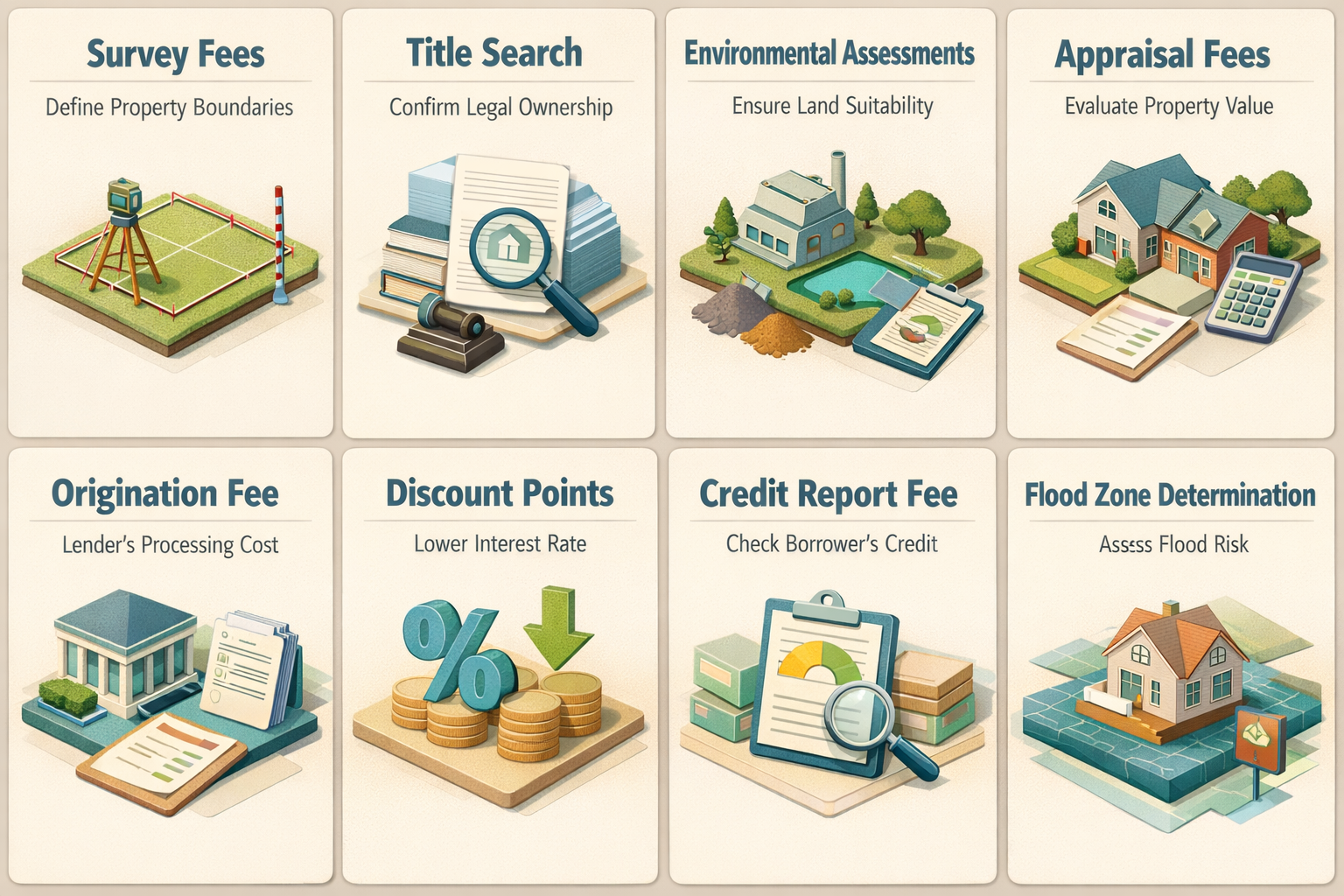
- Survey fees: Lenders and title companies commonly require a land survey when acreage is involved. A survey defines the exact boundaries of the property and may flag encroachments, easements, or other title concerns. Survey costs can vary widely based on acreage size, terrain, and local rates.
- Title search and title insurance: A title search examines public records to confirm legal ownership and identify any liens or claims on the property. Both lender's title insurance and owner's title insurance are typically involved in transactions that include land, and premiums may be higher for parcels with complex ownership histories.
- Environmental or soil assessments: Some lenders may require environmental reviews for rural acreage, particularly if there's a well, septic system, or prior agricultural use. These inspections help confirm the land is suitable for residential use and free of contamination.
- Appraisal fees: VA appraisals for manufactured homes on acreage can be more involved — and more expensive — than a standard appraisal. The VA requires an appraisal by a VA-certified appraiser, and finding comparable sales for a manufactured home with acreage can be more challenging in rural markets, which may affect both the appraisal cost and timeline.
VA loan land closing costs can vary significantly from state to state and even county to county, so it's important to get itemized estimates from your lender and title company early in the process.
Standard Lender and Third-Party Fees to Anticipate
Beyond the funding fee and land-specific charges, there are several standard closing costs associated with any VA loan transaction. Understanding these fees helps paint a complete picture of what are closing costs for VA loan on a manufactured home with acreage.
- Origination fee: The VA limits the lender's origination fee to no more than 1% of the loan amount. This fee covers the lender's administrative costs for processing and underwriting the loan. Some lenders charge less than 1%, so it's worth comparing offers.
- Discount points: Borrowers may choose to pay discount points upfront to lower their interest rate. While this is optional, it's worth evaluating whether paying points makes financial sense based on how long you plan to stay in the home.
- Credit report fee: Lenders typically charge a small fee to pull your credit report during the application process. This is usually a minor cost but should still appear on your Loan Estimate.
- Flood zone determination: For rural and acreage properties, lenders will determine whether any portion of the property falls within a FEMA-designated flood zone. If it does, flood insurance may be required, adding to your ongoing costs.
- Recording fees: Local governments charge fees to record the deed and mortgage documents in public records. These fees vary by jurisdiction and are typically modest.
- Prepaid items and escrow setup: Borrowers are generally required to prepay homeowner's insurance, property taxes, and mortgage interest for the period between closing and the first payment due date. An escrow account may also be established, requiring an initial deposit.
Together, these costs can represent a meaningful sum. Borrowers should carefully review the Loan Estimate they receive within three business days of submitting a complete application — it provides an itemized breakdown of all expected closing costs.
What the VA Restricts Lenders from Charging You
One of the distinct advantages of the VA loan program is its built-in consumer protections. The VA maintains a list of fees that lenders are not permitted to charge VA borrowers. These are sometimes called "non-allowable fees," and knowing them can help you push back on any improper charges that appear on your Closing Disclosure.
Non-allowable fees typically include attorney fees for the lender's legal work, prepayment penalties, broker commissions, and certain administrative or processing fees that exceed what the VA considers reasonable. While some of these costs might still appear in the transaction, they must be paid by the seller or the lender — not the borrower — under VA guidelines.
This protection is particularly valuable in manufactured home with acreage transactions, where additional third parties (such as land brokers or additional inspectors) may try to pass costs along to the buyer. Always ask your lender to clearly identify which fees are allowable under VA rules and which are not.
Seller Concessions and Other Ways to Reduce Out-of-Pocket Costs
The good news is that VA loan borrowers have several legitimate strategies available to reduce — or even eliminate — out-of-pocket closing costs. Here are some of the most effective approaches:
- Negotiate seller concessions: The VA allows sellers to pay up to 4% of the loan amount in concessions toward the buyer's closing costs, prepaid items, and the VA funding fee. In a buyer-friendly market, sellers may be willing to contribute — so don't hesitate to include this in your purchase offer.
- Roll costs into the loan: As mentioned earlier, the VA funding fee can be financed into the loan balance. Some lenders may also offer "lender credits" in exchange for a slightly higher interest rate, which can offset other closing costs.
- Shop multiple lenders: Because lender fees can vary, comparing Loan Estimates from at least two or three VA-approved lenders could reveal meaningful differences in origination fees and discount points.
- Request a closing cost assistance program: Some state housing finance agencies and nonprofit organizations offer grants or low-interest loans specifically to help veterans cover closing costs. Eligibility requirements vary, so research options in your state early.
Manufactured home financing VA transactions may have fewer lender options available, but shopping around remains one of the most impactful things a borrower can do to manage total loan costs.
●Conclusion
Understanding what are closing costs for VA loan on a manufactured home with acreage requires looking at several layers: the VA funding fee, land-related expenses like surveys and appraisals, standard lender fees, and the protective rules the VA places on what you can be charged. While these costs can add up, the VA loan program's built-in safeguards — combined with strategies like seller concessions and lender shopping — can meaningfully reduce what you pay at the closing table.
At LoanWise, we're here to help veterans and eligible borrowers navigate every step of the financing process, from understanding your loan options to comparing costs with confidence. If you're ready to explore VA loan financing for a manufactured home with acreage, connect with one of our experienced loan advisors today — and take the next step toward the property you've earned.