
Refinancing your condo with an FHA loan can be a smart financial move — whether you're looking to lower your monthly payment, tap into your home's equity, or switch from an adjustable rate to a fixed one. But before you move forward, it's important to understand what are closing costs for FHA loan refinance on condo, because these fees can add up quickly and affect whether the refinance truly makes financial sense. From lender charges to government-mandated mortgage insurance premiums, condo owners face a unique set of expenses that differ slightly from those of single-family homeowners. This article walks you through each cost, explains why condos carry additional considerations, and offers practical guidance on how to keep your out-of-pocket expenses as manageable as possible.
Understanding FHA Refinance Closing Costs: The Basics
Closing costs are the fees and charges you pay at the end of the refinancing process — the moment your new loan officially replaces your old one. For an FHA refinance, these costs typically fall into two broad categories: lender fees and third-party fees. Together, they usually range somewhere between 2% and 6% of the loan amount, though the exact figure will depend on your lender, your location, and the specifics of your condo unit.
Lender fees may include origination charges, underwriting fees, and processing costs. These are what your lender charges for preparing and administering your loan. Third-party fees, on the other hand, cover services provided by outside professionals — such as title companies, appraisers, and government recording offices. Both categories will appear on your Loan Estimate, a standardized document your lender is required to provide within three business days of your application.
It's worth noting that FHA loans carry certain costs that conventional loans don't. Most notably, borrowers are required to pay a Mortgage Insurance Premium (MIP), which comes in two parts: an upfront MIP paid at closing and an annual MIP spread across monthly payments. Understanding these charges upfront helps you compare refinance options more accurately.
FHA Refinance Condo Closing Fees: A Detailed Breakdown
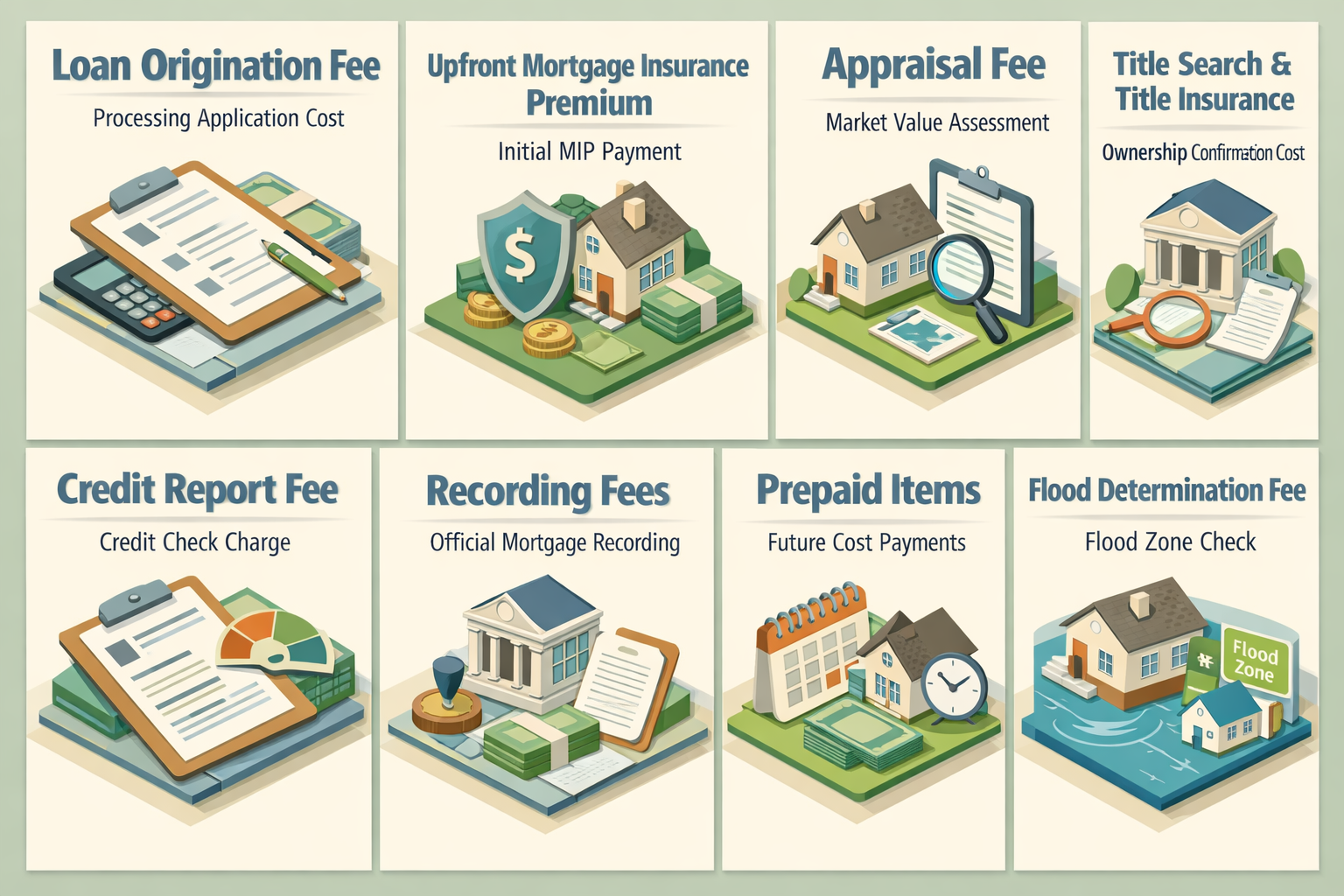
When reviewing what are closing costs for FHA loan refinance on condo specifically, it helps to go line by line through the most common charges you're likely to see. Here's a breakdown of typical FHA refinance condo closing fees:
- Loan Origination Fee: This is what your lender charges to process your application and create the new loan. It's often expressed as a percentage of the loan amount — typically around 0.5% to 1%, though this can vary.
- Upfront Mortgage Insurance Premium (UFMIP): FHA loans require an upfront MIP of 1.75% of the base loan amount. This can be rolled into the loan balance if you prefer not to pay it at closing.
- Appraisal Fee: An FHA-approved appraiser must evaluate your condo to confirm its market value. Appraisal fees for condos can sometimes be slightly higher than for single-family homes due to the additional complexity involved, and may range from a few hundred to over a thousand dollars depending on your market.
- Title Search and Title Insurance: A title company searches public records to confirm clean ownership of the property, and title insurance protects against future ownership disputes. These fees combined can be several hundred dollars or more.
- Credit Report Fee: Lenders pull your credit report during underwriting. This fee is relatively modest but will appear on your Loan Estimate.
- Recording Fees: Your local government charges a fee to officially record the new mortgage in public records. These vary by county and state.
- Prepaid Items: These aren't exactly fees — they're upfront payments for future costs, including prepaid homeowners insurance, prepaid interest, and an initial deposit into your escrow account for property taxes and insurance.
- Flood Determination Fee: Lenders may require a check to confirm whether your property is in a flood zone.
Together, these charges make up the bulk of your closing costs. While each individual fee may seem manageable, they add up quickly — making it essential to review your Loan Estimate carefully before committing to any lender.
Why Condo Refinancing Adds Extra Layers to the Process
Refinancing a condo with an FHA loan isn't quite the same as refinancing a single-family home. Condominiums must meet specific FHA approval requirements before a borrower can use FHA financing — and that approval process can introduce additional steps and, in some cases, extra costs.
For starters, the condo project itself must be on the FHA-approved list or go through a spot approval process. If your condo association is not currently FHA-approved, your lender may need to submit documentation for project approval. This can potentially extend your timeline and may involve additional administrative fees depending on how your lender structures that process.
Additionally, FHA appraisers evaluating condos must assess not just the individual unit but also the overall health of the condo project — including reserve funds, owner-occupancy ratios, and pending litigation involving the HOA. These additional checks may influence how the appraisal is priced and could affect loan eligibility if significant issues are uncovered.
It's also important to note that your HOA fees will factor into your debt-to-income (DTI) ratio calculation during underwriting. Higher HOA fees could affect how much you qualify to borrow, which in turn affects your overall loan amount and therefore your closing costs calculations.
Average Closing Costs for FHA Condo Loan: What to Realistically Expect
Estimating the average closing costs for FHA condo loan refinances can be tricky because so many variables are at play — your loan size, your state, your lender's fee structure, and current market conditions all play a role. That said, most homeowners refinancing with an FHA loan can expect to pay somewhere in the range of 2% to 5% of their loan balance in total closing costs, not including the upfront MIP if they choose to roll it in.
For example, on a $250,000 condo loan, closing costs might fall somewhere between $5,000 and $12,500 before accounting for the UFMIP. If the UFMIP of 1.75% is paid out of pocket, that's an additional $4,375. Of course, these are rough estimates — your actual figures could be higher or lower depending on your specific circumstances.
Some costs, like the origination fee and title fees, may be negotiable or vary significantly between lenders. Others, like the UFMIP and recording fees, are set by federal guidelines or local governments and offer little flexibility. Shopping around with multiple lenders and comparing their Loan Estimates side by side is one of the most effective ways to get a clearer picture of what you'll owe — and potentially reduce your costs.
FHA Streamline Refinance: A Lower-Cost Option for Condo Owners
If you already have an FHA loan on your condo, you may qualify for an FHA Streamline Refinance — a simplified process designed to reduce paperwork, speed up approval, and potentially lower closing costs compared to a standard FHA refinance. This program is one of the more borrower-friendly options available for existing FHA borrowers.
With a Streamline Refinance, there's typically no requirement for a new full appraisal, which can save you several hundred dollars. The income and employment verification process is also often less intensive, which may reduce underwriting fees. However, the UFMIP still applies, though FHA offers a reduced rate for borrowers who refinance within three years of their original loan closing date.
It's important to understand that the Streamline program is designed specifically to lower your rate or monthly payment — not to give you cash out. If you're hoping to tap into your condo's equity, you'd need a standard FHA cash-out refinance, which comes with the full set of closing costs described earlier.
For condo owners who meet the eligibility requirements, the Streamline Refinance can be an efficient and cost-effective path to a better rate. Ask your lender whether your condo project's FHA approval status affects your eligibility before moving forward.
Strategies to Reduce Your Out-of-Pocket Closing Costs
Knowing what you'll owe is only half the battle — the other half is figuring out how to manage those costs strategically. Here are several approaches that condo owners refinancing with FHA loans might consider:
- Roll costs into the loan: Many lenders allow you to finance your closing costs by adding them to the new loan balance. This eliminates your out-of-pocket expense at closing, though it does mean you'll pay interest on those costs over the life of the loan.
- Negotiate lender fees: Origination fees and certain other lender charges may be negotiable, especially if you have strong credit and a stable financial profile. Don't hesitate to ask your lender what flexibility they have.
- Accept a slightly higher rate for lender credits: Some lenders offer what's called a "no-closing-cost" refinance, where they absorb some or all of your closing costs in exchange for a slightly higher interest rate. This can make sense if you don't plan to stay in your condo long-term.
- Shop multiple lenders: Loan Estimates from different lenders can vary significantly. Getting quotes from at least two or three lenders gives you leverage and a clearer picture of the true market rate for your situation.
- Time your closing strategically: Closing near the end of the month reduces the amount of prepaid interest you owe at closing, since you're paying for fewer days before your first payment.
None of these strategies will eliminate your closing costs entirely, but combining a few of them could meaningfully reduce what you pay — making your FHA condo refinance more financially rewarding from day one.
Is Refinancing Your FHA Condo Loan Worth the Closing Costs?
One of the most practical questions any condo owner should ask before refinancing is whether the long-term savings justify the upfront expense. A simple way to evaluate this is the break-even calculation: divide your total closing costs by the amount you'll save each month after refinancing. The result tells you how many months it will take to recoup your investment.
For example, if your closing costs total $6,000 and your new payment saves you $150 per month, your break-even point is 40 months — just over three years. If you plan to stay in your condo beyond that point, refinancing likely makes good financial sense. If you're considering selling sooner, the math may not work in your favor.
Keep in mind that condo owners should also factor in their ongoing annual MIP when calculating true savings. FHA loans require annual MIP for the life of the loan in most cases, which can affect the net benefit compared to refinancing into a conventional loan if your equity has grown sufficiently. A mortgage advisor can help you model both scenarios side by side to determine which path offers the greatest long-term value.
●Conclusion
Understanding what are closing costs for FHA loan refinance on condo is the foundation of any smart refinancing decision. From origination fees and appraisal costs to the upfront MIP and condo-specific approval requirements, the total expenses involved can be significant — but they're also manageable with the right preparation and guidance. By reviewing your Loan Estimate carefully, comparing offers from multiple lenders, and exploring options like the FHA Streamline Refinance, you can approach your condo refinance with confidence and clarity. At LoanWise, we're here to help you navigate every step of the process and find the financing solution that fits your goals. Ready to explore your refinance options? Connect with a LoanWise mortgage specialist today.