
Buying a condominium with an FHA loan is an exciting step toward homeownership — but it comes with a set of financial responsibilities that many first-time buyers don't fully anticipate. One of the most important questions you'll need to answer before closing day is: what are closing costs for FHA loan on a condo with shared amenities? The answer isn't always simple, because condominiums with pools, fitness centers, lobbies, and other shared spaces introduce layers of review and fees that standard single-family home purchases may not. Understanding what you'll owe at the closing table — and why — can help you plan ahead, avoid surprises, and feel confident going into one of the biggest financial decisions of your life.
How FHA Loans Work for Condo Buyers
The Federal Housing Administration (FHA) offers mortgage insurance on loans made by approved lenders, making it easier for buyers with lower credit scores or smaller down payments to qualify. FHA loans typically require a minimum down payment of 3.5% for borrowers with a credit score of 580 or higher, which is one reason they're popular among first-time homebuyers.
However, not every condominium is automatically eligible for FHA financing. The condo project itself must be approved by the FHA — either through the full project approval process or through a single-unit approval (also called "spot approval"). This approval process evaluates whether the homeowners association (HOA) is financially stable, whether the building meets occupancy and ownership requirements, and whether there are any pending legal issues. All of these factors add complexity — and potentially cost — to your transaction.
When a condo community includes shared amenities such as swimming pools, fitness centers, elevators, rooftop decks, or concierge services, lenders and the FHA pay close attention to how these facilities are funded and maintained. A well-funded HOA with a strong reserve account is typically viewed as a positive sign, while an underfunded HOA could raise red flags during the underwriting process.
Breaking Down What Are Closing Costs for FHA Loan on a Condo with Shared Amenities
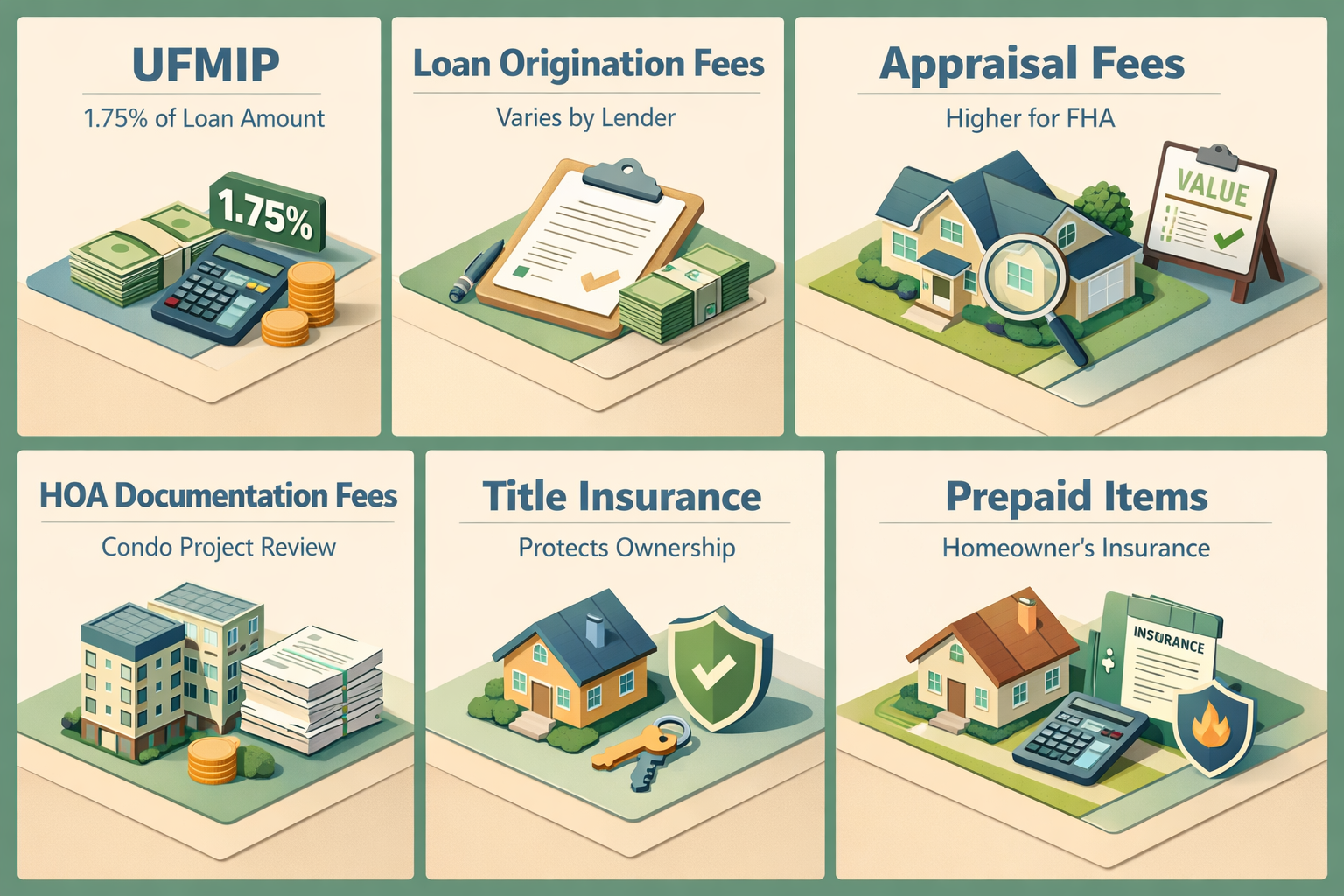
Closing costs are the fees and expenses you pay at settlement to finalize your mortgage. For FHA condo buyers, these costs typically fall into several categories. While exact amounts vary by lender, location, and loan size, it's helpful to understand each fee and what it covers.
FHA Upfront Mortgage Insurance Premium (UFMIP)
One of the most distinctive costs in an FHA transaction is the Upfront Mortgage Insurance Premium, commonly known as UFMIP. This fee is currently set at 1.75% of the base loan amount and can either be paid at closing or rolled into the loan balance. For example, on a $300,000 loan, the UFMIP would be $5,250. This premium is separate from the annual mortgage insurance premium (MIP), which is paid monthly throughout the life of the loan.
Loan Origination and Lender Fees
Lenders charge origination fees to cover the cost of processing and underwriting your loan. These may include an origination charge, discount points (if you choose to buy down your rate), and administrative fees. On FHA loans, lenders must follow guidelines that limit certain charges, but origination fees can still vary widely from one lender to another — which is why shopping around is always a smart move.
Appraisal Fees with FHA-Specific Requirements
All FHA loans require an appraisal by an FHA-approved appraiser. The appraisal does two things: it confirms the market value of the condo unit and verifies that the property meets HUD's minimum property standards. For condos with shared amenities, the appraiser may also evaluate the condition of common areas, which can influence the final value assessment. FHA appraisal fees may be slightly higher than conventional appraisals due to these added requirements, and costs can range depending on the market and property complexity.
Condo Project Review and HOA Documentation Fees
This is where FHA condo closing fees with shared facilities can diverge from a typical single-family purchase. Lenders often need to gather HOA financial documents, meeting minutes, reserve study reports, master insurance policies, and condo project questionnaires. In some cases, lenders charge a fee for this condo review process. Additionally, the HOA itself may charge a document preparation or transfer fee, which is often passed along to the buyer or seller depending on local customs.
Reserve study documentation and HOA financial review become especially important when shared amenities are involved. A pool, for instance, requires ongoing maintenance and insurance. Lenders want to see that the HOA has set aside sufficient reserves to cover future repairs and replacements for these shared spaces. If the reserve fund is underfunded, it could affect your loan approval — not just your closing costs.
Title Insurance and Settlement Fees
Title insurance protects both you and your lender from any ownership disputes or liens that may surface after closing. FHA loans require lender's title insurance, and most buyers also purchase an owner's title policy for added protection. Title-related fees may include the title search, title examination, settlement or escrow fee, and recording fees. These costs vary by state and settlement company but are typically a standard part of any real estate closing.
Prepaid Items and Escrow Deposits
Beyond the fees above, you'll also need to prepay certain items at closing. These typically include prepaid homeowner's insurance, prepaid interest (covering the days between closing and your first payment), and an initial escrow deposit for property taxes and insurance. For condo buyers, it's worth noting that HOA dues are usually not escrowed through your mortgage — they're paid directly to the HOA — but your lender may factor them into your debt-to-income ratio when qualifying you for the loan.
How Shared Amenities Affect Your Total Cost to Close
Condominiums with shared amenities are often more desirable — and can command higher purchase prices — than units without them. But from a lending perspective, shared facilities introduce variables that lenders must account for during the approval process.
The presence of shared amenities may lead to additional scrutiny of HOA financials, which could mean more documentation is required and, in some cases, more time to process your loan. If the condo project hasn't been previously approved by the FHA, you or your lender may need to pursue a single-unit approval, which can involve its own processing fees and timeline.
Master insurance policies for condo buildings — which cover shared spaces like hallways, elevators, and amenity areas — are also reviewed during underwriting. FHA guidelines require that the HOA carry adequate hazard and liability insurance for common areas. If coverage is found to be insufficient, the HOA may need to obtain additional insurance before your loan can close, which could delay your transaction and affect your rate lock or other time-sensitive fees.
It's also worth considering that HOA dues for amenity-rich buildings tend to be higher. While HOA dues aren't a closing cost per se, they affect your overall affordability and your debt-to-income ratio, which is a key factor in FHA loan qualification. Higher monthly dues could reduce the loan amount you qualify for, indirectly shaping your budget for the transaction.
Estimating Your Total Closing Costs as a Condo Buyer
While exact figures depend on your loan amount, location, and lender, FHA closing costs for a condo purchase often range from approximately 2% to 5% of the loan amount, not including the UFMIP (which may be financed). This is a broad estimate, and your Loan Estimate — a standardized document your lender is required to provide within three business days of your application — will give you a much more precise breakdown.
Here's a general checklist of costs to anticipate:
- FHA Upfront Mortgage Insurance Premium (UFMIP): 1.75% of the loan amount
- Loan origination fee: Varies by lender
- FHA appraisal fee: Typically higher than conventional due to HUD standards
- Credit report fee: Usually a flat fee charged by the lender
- Condo project review or HOA document fee: Charged by lender or HOA
- Title search and title insurance: Varies by state and property value
- Settlement or escrow fee: Paid to the closing agent
- Recording fees: Charged by local government
- Prepaid homeowner's insurance: Typically one year paid upfront
- Prepaid interest: Prorated from closing date to end of month
- Initial escrow deposit: For property taxes and insurance
- HOA transfer or move-in fee: Set by the condo association
Reviewing this list with your loan officer early in the process can help you avoid sticker shock at closing and give you time to negotiate or prepare accordingly.
Strategies to Reduce FHA Condo Closing Fees with Shared Facilities
The good news is that there are several practical ways to reduce the out-of-pocket burden of closing costs on an FHA condo loan. None of these approaches eliminate costs entirely, but they can make a meaningful difference in your upfront expenses.
Negotiate Seller Concessions
FHA guidelines allow sellers to contribute up to 6% of the sales price toward the buyer's closing costs. This is called a seller concession, and it's one of the most effective ways to reduce what you'll need to bring to the closing table. In a buyer's market or with motivated sellers, asking for concessions is often a reasonable negotiating strategy.
Shop Multiple Lenders
Not all lenders charge the same fees. Origination charges, processing fees, and lender-specific costs can vary significantly. Getting quotes from at least two or three lenders allows you to compare Loan Estimates side by side and choose the most competitive offer. Pay attention to both the interest rate and the fee structure — a slightly lower rate isn't always worth it if the upfront costs are substantially higher.
Ask About Lender Credits
Some lenders offer lender credits in exchange for accepting a slightly higher interest rate. These credits can be applied toward your closing costs, reducing your out-of-pocket expenses at closing. While this means you'll pay a bit more in interest over time, it can be a helpful option if you're tight on cash at closing.
Roll the UFMIP Into the Loan
Rather than paying the 1.75% UFMIP as a lump sum at closing, FHA borrowers have the option to finance it into the loan balance. This spreads the cost over the life of the loan, reducing what you need at closing — though it does slightly increase your monthly payment and total interest paid over time.
Explore Down Payment Assistance Programs
Many state and local housing agencies offer down payment and closing cost assistance programs for eligible buyers. Some of these programs are specifically designed for FHA borrowers or first-time homebuyers, and a few may provide grants or forgivable loans that can cover a portion of your closing expenses. Eligibility requirements vary, so it's worth researching what's available in your area.
FHA Condo Approval and Its Impact on Your Timeline and Budget
One factor that many buyers overlook when asking what are closing costs for FHA loan on a condo with shared amenities is the potential impact of the FHA condo approval process on their overall budget. If the condo you're purchasing isn't already on the FHA-approved list, your lender will need to either pursue full project approval or a single-unit approval before your loan can close.
Single-unit approvals, introduced under the FHA's updated condominium policy, have made it easier to purchase in non-approved buildings, but they still require documentation and review. This process can add days or even weeks to your closing timeline. If you have a rate lock expiring, you may need to pay a fee to extend it — an additional cost worth factoring into your planning.
Additionally, buildings with complex shared amenity structures — such as mixed-use developments with commercial space or buildings with high investor-owned unit percentages — may face additional hurdles during FHA review. Understanding the approval status of your target building early in your home search can save you time, stress, and money.
●Conclusion
Understanding what are closing costs for FHA loan on a condo with shared amenities is an essential part of preparing for a successful purchase. From the FHA Upfront Mortgage Insurance Premium to condo project review fees and HOA documentation costs, the expenses involved are real — but they're also manageable when you know what to expect. By working with an experienced loan officer, reviewing your Loan Estimate carefully, and exploring cost-saving strategies like seller concessions and lender credits, you can approach closing day with confidence. At LoanWise, we're here to help you navigate every step of the FHA condo loan process — from the first application to the final signature. Reach out today to speak with a knowledgeable lending specialist who understands the unique nuances of condo financing.