
Buying a condominium with an FHA loan can be a smart path to homeownership, especially for first-time buyers who may have limited savings or a less-than-perfect credit history. But before you sign on the dotted line, it's important to understand the full picture of what you'll owe at the closing table. A common question among prospective condo buyers is: what are closing costs for FHA loan on a condo with HOA fees? The answer involves more moving parts than a typical single-family home purchase — and knowing what to expect could save you from financial surprises. This guide breaks down every key cost you're likely to encounter, from lender fees to HOA-related charges, so you can walk into closing with confidence.
Understanding FHA Loans and Condo Eligibility Requirements
Before diving into closing costs, it helps to understand why buying a condo with an FHA loan is slightly more complex than buying a house. The Federal Housing Administration (FHA) insures loans made by approved lenders, which reduces lender risk and allows borrowers to qualify with lower down payments — typically as low as 3.5% — and more flexible credit requirements.
However, not every condominium complex qualifies for FHA financing. The entire condo project must be on the FHA-approved condominium list, or the buyer must pursue a single-unit approval (also called spot approval), which allows individual units in non-approved complexes to be eligible under certain conditions. This approval process can affect both your timeline and your upfront costs.
When a condo community is FHA-approved, it means the project meets specific guidelines around owner-occupancy ratios, reserve fund requirements, and insurance coverage. These factors are closely tied to how the homeowners association (HOA) manages the property — and they directly influence what you'll pay at closing.
FHA Condo Closing Costs Breakdown: What Buyers Typically Pay
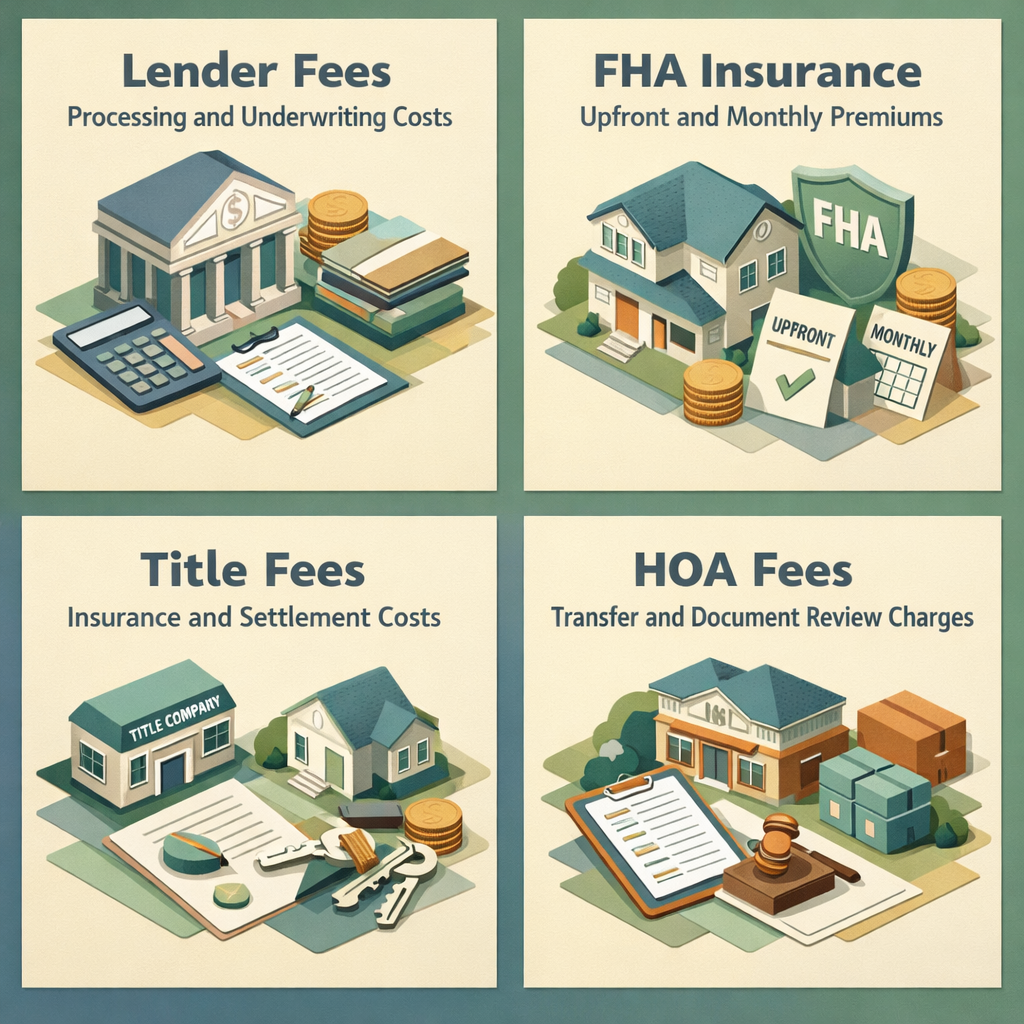
When exploring the FHA condo closing costs breakdown, it's useful to separate costs into categories: lender fees, third-party fees, prepaid items, and government charges. Together, these typically range from about 2% to 5% of the loan amount, though the exact total will vary based on your lender, location, and the specific condo project.
Lender and Origination Fees
These are fees charged by your mortgage lender for processing and underwriting your loan. They may include:
- Origination fee: Often around 0.5% to 1% of the loan amount, though this varies by lender.
- Underwriting fee: A flat fee charged to evaluate your application, typically ranging from a few hundred to over a thousand dollars.
- Application fee: Some lenders charge this upfront, while others fold it into other costs.
- Credit report fee: A smaller charge to pull your credit history during the approval process.
FHA-Specific Mortgage Insurance Costs
One of the most significant costs unique to FHA loans is mortgage insurance. You'll pay two types:
- Upfront Mortgage Insurance Premium (UFMIP): Currently set at 1.75% of the base loan amount. This is typically paid at closing but can be financed into your loan.
- Annual MIP: Paid monthly as part of your mortgage payment. The rate depends on your loan term, amount, and loan-to-value ratio.
The UFMIP alone can be a substantial line item on your closing disclosure, so it's important to budget for it accordingly — or decide whether rolling it into the loan makes sense for your situation.
Title and Settlement Fees
Title insurance, title search, and settlement or escrow fees are standard across most home purchases. For condos, however, the title search may be slightly more involved, as it must account for the HOA's lien rights and any existing assessments on the unit. Expect to see:
- Lender's title insurance: Required by most lenders to protect against title defects.
- Owner's title insurance: Optional but strongly recommended to protect your own interest.
- Settlement or closing fee: Paid to the title company or escrow officer handling the transaction.
Appraisal and Inspection Fees
FHA loans require an appraisal by a HUD-approved appraiser. For a condo, the appraiser must also evaluate the project's overall condition and compliance, which can make the appraisal slightly more thorough — and sometimes costlier — than for a single-family home. A home inspection, while not required by FHA, is strongly recommended and represents an additional out-of-pocket expense.
How HOA Fees Impact FHA Loans at Closing and Beyond
Understanding HOA fees impact on FHA loans is crucial for condo buyers. Homeowners associations manage common areas, enforce community rules, and maintain shared amenities. When you purchase a condo, you're legally obligated to pay HOA dues — and lenders take these fees seriously during the approval process.
HOA Dues and Debt-to-Income Ratio
Monthly HOA fees are included in your debt-to-income (DTI) ratio calculation, which is the percentage of your gross monthly income that goes toward recurring debt payments. FHA guidelines generally require a DTI of no more than 43%, though some lenders may allow higher ratios with compensating factors. Adding HOA dues to your mortgage payment, property taxes, and insurance could push your DTI above qualifying limits, potentially reducing the loan amount you're eligible for.
Closing Costs Related to HOA Accounts
At closing, you may encounter several fees directly tied to the HOA, including:
- HOA transfer fee: Charged by the association when ownership of a unit changes hands. This can range from a nominal amount to several hundred dollars, depending on the HOA's policies.
- HOA initiation or capital contribution fee: Some associations charge new owners a one-time fee to join, which can be a flat amount or a multiple of the monthly dues.
- HOA document review fee: Your lender will typically request governing documents from the HOA, including meeting minutes, bylaws, and financial statements. Some associations charge for providing these records.
- Prepaid HOA dues: You may be required to prepay one or more months of HOA dues at closing, similar to how homeowners insurance is often prepaid.
These HOA-related charges can add up quickly, sometimes totaling anywhere from a few hundred to over a thousand dollars depending on the association's fee structure. It's wise to request a full HOA fee disclosure early in the buying process so there are no surprises on closing day.
Prepaid Items and Escrow Reserves You Should Plan For
Beyond lender fees and HOA charges, a significant portion of your closing costs will go toward prepaid items and escrow reserves. These aren't technically fees — they're funds collected in advance to cover future obligations. Still, they require real cash at closing.
Homeowners Insurance Prepayment
FHA lenders require proof of homeowners insurance before closing, and you'll typically need to pay the first year's premium upfront. For condos, this may be a bit different: many HOA master policies cover the building structure, meaning your individual policy (often called an HO-6 or condo unit policy) may be less expensive. However, you should verify exactly what the master policy covers and ensure there are no gaps in coverage.
Prepaid Interest
If your closing date falls mid-month, you'll owe interest for the remaining days of that month. This is known as prepaid interest or per diem interest. The amount is relatively small but varies based on your loan balance and interest rate.
Escrow Account Deposits
Most FHA loans require an escrow account where your lender collects monthly amounts to cover property taxes and homeowners insurance on your behalf. At closing, lenders typically collect an initial deposit — often two to three months' worth of taxes and insurance — to establish this reserve. The exact amount will depend on your local tax rates and insurance premiums.
Government Recording Fees and Transfer Taxes
Local and state governments charge fees to record the transfer of property ownership and the creation of a new mortgage. These costs are relatively modest in most areas, but they vary significantly by location. Common government charges include:
- Recording fees: Paid to the county recorder's office to officially document the deed and mortgage. Typically a flat fee of $50 to $250, though some jurisdictions charge by the page.
- Transfer taxes or stamps: Some states and municipalities charge a tax when property changes hands. These can be negotiated between buyer and seller in certain markets.
- Mortgage tax: A few states impose a tax specifically on the creation of a new mortgage.
Your loan estimate and closing disclosure will itemize these charges specific to your location, so you'll know exactly what your government fees will be well before the closing date.
Smart Strategies to Reduce Your FHA Condo Closing Costs
The good news is that closing costs aren't entirely fixed. There are several strategies homebuyers might use to reduce what they owe upfront when purchasing a condo with an FHA loan.
Negotiate Seller Concessions
FHA guidelines allow sellers to contribute up to 6% of the purchase price toward the buyer's closing costs. In a buyer's market or with a motivated seller, this can be a powerful way to reduce your out-of-pocket expenses at closing. You can include a request for seller concessions in your purchase offer.
Shop Multiple Lenders
Lender fees, origination charges, and even title-related costs can vary considerably from one lender to another. Getting loan estimates from at least three lenders allows you to compare not just interest rates but the full cost of the loan. Even small differences in lender fees could save you hundreds of dollars.
Ask About Lender Credits
Some lenders offer lender credits in exchange for accepting a slightly higher interest rate. This reduces your upfront closing costs, though it does increase your monthly payment over the life of the loan. It's a trade-off worth evaluating based on how long you plan to stay in the home.
Time Your Closing Date Strategically
Closing at the end of the month reduces your prepaid interest because there are fewer days remaining in that billing cycle. While the savings may be modest, every dollar counts when you're managing a tight budget.
●Conclusion
So, what are closing costs for FHA loan on a condo with HOA fees? The honest answer is that they're a layered combination of lender charges, FHA mortgage insurance, title fees, government costs, prepaid items, and HOA-specific expenses. While the total typically falls somewhere between 2% and 5% of the loan amount, condo buyers using FHA financing should budget carefully for HOA transfer fees, document fees, and the potential impact of monthly dues on their DTI ratio.
The more informed you are going into the process, the better positioned you'll be to negotiate, compare lenders, and avoid surprises on closing day. If you're ready to explore your FHA condo financing options, consider speaking with a knowledgeable mortgage professional who can provide a personalized loan estimate and help you map out the full cost of your purchase. At LoanWise, we're here to help you make confident, well-informed decisions at every step of your homebuying journey.