
Buying a condominium with an FHA loan can be a smart path to homeownership, especially for first-time buyers who appreciate lower down payment requirements and flexible credit guidelines. But before you get your keys, there's one important milestone to navigate: closing day. If you've been asking yourself, what are closing costs for FHA loan on a condo purchase, you're not alone. Many buyers are surprised to discover that condo purchases may involve a layer of fees beyond what's typical for a single-family home. Understanding exactly what you'll owe at the closing table — and why — can help you plan your finances more confidently and avoid any last-minute surprises.
What Closing Costs Actually Mean for FHA Borrowers
Closing costs are the collection of fees and expenses you pay when finalizing a mortgage loan. For FHA borrowers, these costs are governed partly by FHA guidelines and partly by lender practices and local market norms. They're separate from your down payment, which for an FHA loan is typically as low as 3.5% for borrowers who meet the minimum credit score requirement.
In general, closing costs on any mortgage loan — FHA or otherwise — tend to range somewhere between 2% and 5% of the loan amount. That's a meaningful chunk of money, so knowing what's included and what you might be able to negotiate is genuinely important. For condo purchases specifically, there may be a few additional line items that single-family homebuyers don't encounter, which we'll cover in detail below.
It's also worth noting that the FHA program does place some limits on what lenders can charge borrowers. Certain fees are considered allowable under FHA guidelines, while others are classified as non-allowable and must be paid by the seller or absorbed by the lender. This distinction can actually work in your favor as a buyer.
Breaking Down the Core FHA Condo Loan Fees
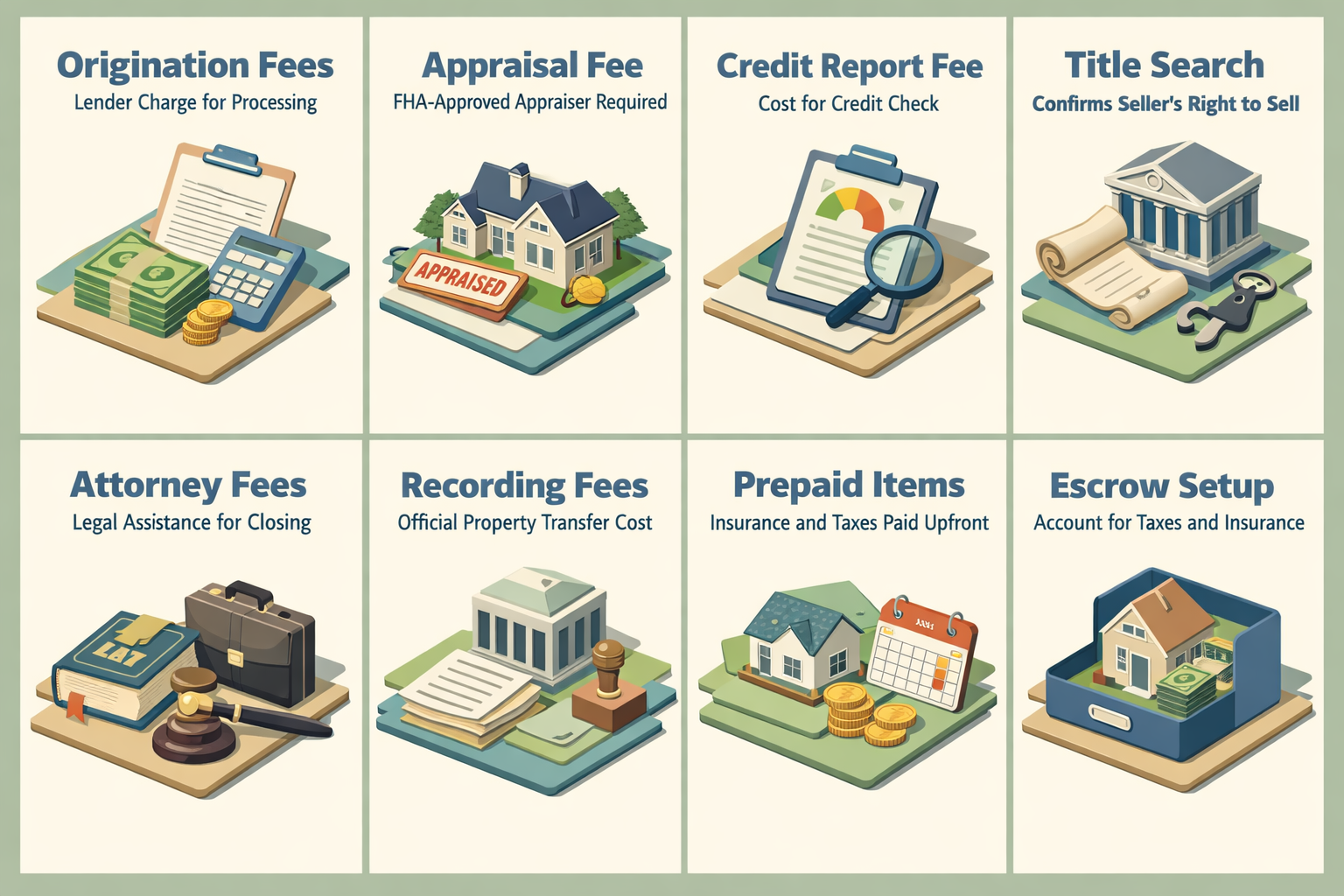
When you review your Loan Estimate — a standardized document lenders are required to provide early in the application process — you'll see closing costs organized into several categories. Here's a breakdown of the most common FHA condo loan fees you're likely to encounter:
- Origination Fees: This is the lender's charge for processing your loan. It may be expressed as a flat fee or a percentage of the loan amount, often around 0.5% to 1%.
- Appraisal Fee: FHA loans require an FHA-approved appraiser to assess the property's value. For condominiums, this appraisal also includes a review of the unit's compliance with FHA property standards, which can make it slightly more involved than a standard appraisal.
- Credit Report Fee: Lenders typically pull your credit from all three major bureaus and pass that cost on to the borrower.
- Title Search and Title Insurance: A title search confirms the seller has the legal right to sell the property. Title insurance protects you and your lender in case any ownership disputes arise after closing.
- Attorney or Settlement Agent Fees: Depending on your state, either an attorney or a title/escrow company handles the closing. Their fees vary by location but are a standard part of the process.
- Recording Fees: Your local government charges a fee to officially record the property transfer in public records.
- Prepaid Items: These include prepaid homeowner's insurance, prepaid property taxes, and prepaid mortgage interest from your closing date to the end of the month.
- Escrow Setup (Impound Account): FHA loans typically require an escrow account for taxes and insurance. You'll need to fund this account at closing, which adds to upfront costs but keeps your ongoing payments predictable.
Each of these fees is fairly standard across most mortgage transactions, but the amounts can vary significantly depending on your loan size, lender, and the state where the property is located.
Condo-Specific Costs That May Catch Buyers Off Guard
Here's where condo purchases differ from buying a traditional single-family home. When you purchase a condo, you're not just buying a unit — you're also becoming a member of a homeowners association (HOA). This adds a few unique considerations to your closing costs and overall transaction.
HOA Transfer Fees and Setup Charges
Most condo associations charge a fee when ownership of a unit changes hands. This transfer fee covers the administrative work of updating their records and setting up your account as the new owner. Some associations also charge a move-in fee or require an initial contribution to a reserve fund. These charges are often set by the HOA itself and may not be negotiable.
HOA Document Review Fees
As part of the purchase process, your lender and your attorney (or closing agent) will likely review the condo association's governing documents, including bylaws, financials, meeting minutes, and reserve fund status. This review helps confirm that the association is financially healthy and that the property meets FHA approval requirements. There may be a fee charged by the HOA for providing these documents, sometimes called a document preparation fee or resale package fee.
FHA Condo Project Approval
This is perhaps the most important condo-specific factor. For an FHA loan to be used on a condo purchase, the condo project itself must be on the FHA-approved list, or the individual unit must qualify under what's known as Single Unit Approval (SUA). While this approval process doesn't always generate a direct fee for the buyer, it can affect your timeline and, in some cases, may require additional documentation or a lender-paid review that gets factored into your loan costs.
The FHA Mortgage Insurance Premium: A Key Cost to Understand
One of the most distinctive FHA condo loan fees is the mortgage insurance premium (MIP). Unlike conventional loans where private mortgage insurance (PMI) can be removed once you reach sufficient equity, FHA MIP works differently and has two components:
Upfront Mortgage Insurance Premium (UFMIP)
This is a one-time charge assessed at closing. As of current FHA guidelines, the UFMIP is typically 1.75% of the base loan amount. So on a $250,000 loan, that's $4,375 due at closing — though most borrowers choose to roll this cost into the loan rather than pay it out of pocket. It's important to be aware that financing the UFMIP increases your total loan balance and the amount of interest you'll pay over the life of the loan.
Annual Mortgage Insurance Premium (Annual MIP)
In addition to the upfront charge, FHA loans carry an ongoing annual MIP that's divided into monthly payments and added to your mortgage payment. The rate varies based on your loan term, loan amount, and down payment size. For many borrowers, this annual MIP remains in place for the life of the loan if the down payment was less than 10%, which is a meaningful long-term cost to factor into your decision.
Understanding both components of MIP is essential when comparing the true cost of an FHA loan against other financing options. Your lender should provide a clear breakdown of these charges in your Loan Estimate.
What Are Closing Costs for FHA Loan on a Condo Purchase: Estimating Your Total
Let's put some rough numbers together to give you a sense of what you might be looking at. Suppose you're purchasing a condo for $280,000 with a 3.5% down payment. Your loan amount would be approximately $270,200. Here's a simplified estimate of potential closing costs:
- Origination fee (1%): approximately $2,700
- Appraisal: typically $400 to $700 for a condo
- Title insurance and search: varies widely, often $1,000 to $2,000
- Attorney or settlement fees: $500 to $1,500 depending on location
- Prepaid interest, taxes, and insurance: $1,000 to $3,000+
- Escrow setup: two to three months of taxes and insurance
- HOA transfer and document fees: $200 to $800 (varies by association)
- UFMIP (1.75% financed into loan): $4,729 added to loan balance
Even without the UFMIP (if financed), your out-of-pocket expenses could realistically fall between $5,000 and $10,000 or more depending on your location and lender. This is why it's so important to request a Loan Estimate early and compare offers from multiple lenders.
These figures are illustrative and may vary. Always ask your lender for a detailed Good Faith breakdown specific to your transaction.
Smart Ways to Reduce Your Out-of-Pocket Closing Expenses
The good news is that there are several legitimate strategies that may help lower your closing cost burden as an FHA condo buyer.
Negotiate Seller Concessions
FHA guidelines allow sellers to contribute up to 6% of the purchase price toward the buyer's closing costs. This is one of the most effective tools available. In a buyer's market, or when a seller is motivated to close quickly, requesting seller concessions is well worth exploring. Your real estate agent can help you structure this into your offer.
Shop Multiple Lenders
Not all FHA lenders charge the same fees. Origination fees, lender credits, and even some third-party fees can vary meaningfully from one lender to the next. Getting Loan Estimates from at least two or three lenders allows you to make a true apples-to-apples comparison of your total closing costs.
Ask About Lender Credits
Some lenders offer lender credits in exchange for a slightly higher interest rate. This arrangement reduces your upfront closing costs, though it may increase your monthly payment over time. Whether this trade-off makes sense depends on how long you plan to stay in the home and your current cash position.
Look Into Down Payment Assistance Programs
Many state and local housing agencies offer closing cost assistance programs alongside down payment help. These programs are sometimes available exclusively for FHA borrowers and first-time homebuyers, making them worth researching early in your home search.
Review All Fees Carefully
Before closing, ask your lender to walk you through every line item on your Closing Disclosure. Occasionally, fees may appear that weren't on your original Loan Estimate, or amounts may have shifted. You have the right to question any charge you don't understand.
●Conclusion
Understanding what are closing costs for FHA loan on a condo purchase is one of the most practical steps you can take before entering the homebuying process. From standard lender fees and title charges to FHA-specific mortgage insurance premiums and condo association costs, there's quite a bit to keep track of. But with the right preparation — comparing lenders, reviewing your Loan Estimate carefully, and exploring assistance programs — you can approach closing day with confidence rather than confusion.
At LoanWise, we're committed to helping buyers like you navigate the full cost picture of homeownership. Whether you're purchasing your first condo or adding to your real estate portfolio, connecting with an experienced mortgage professional early in the process can make a meaningful difference in your outcome. Ready to get started? Reach out to a LoanWise lending expert today and take the guesswork out of your condo financing journey.