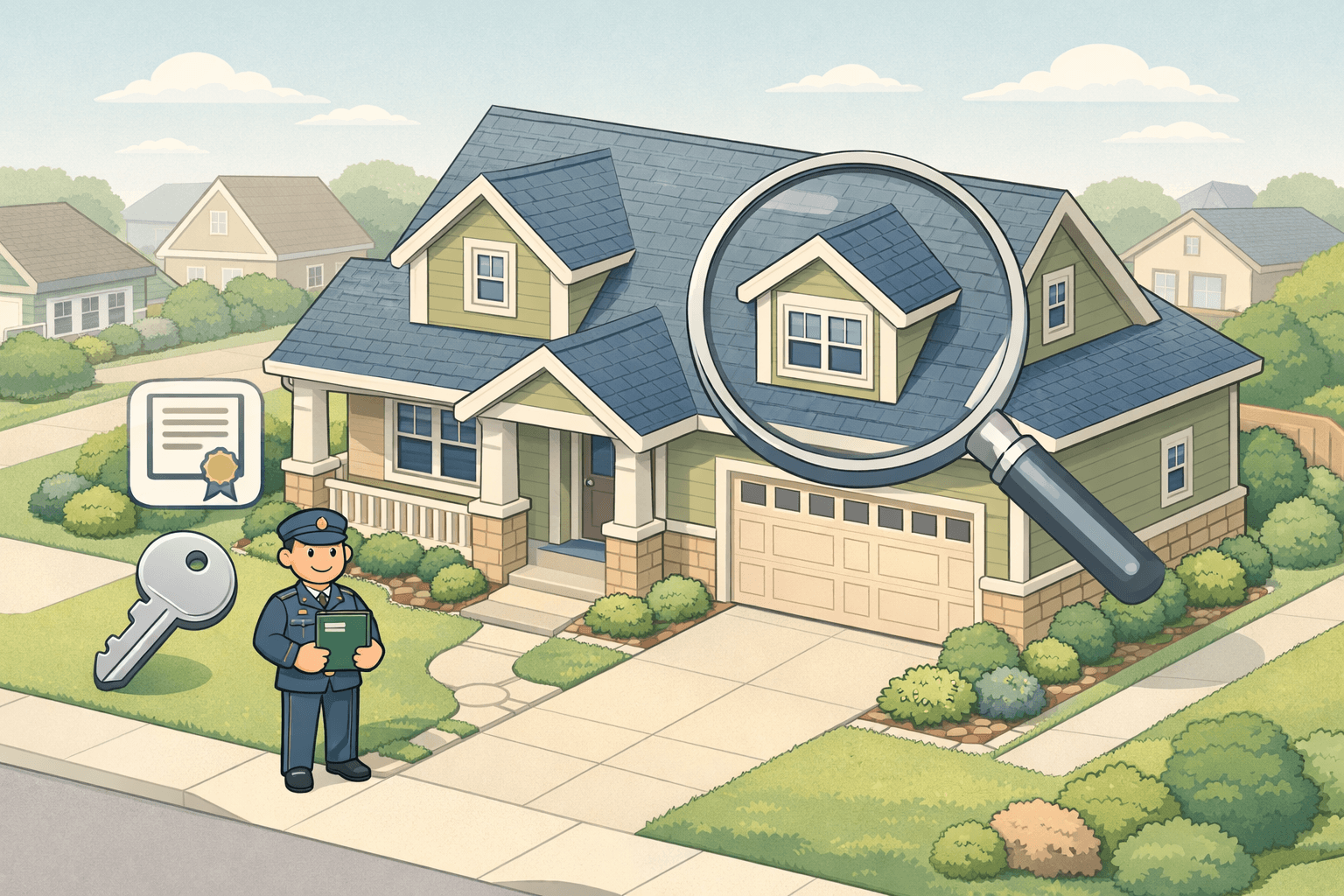
For veterans, active-duty service members, and surviving spouses, the VA loan program is one of the most valuable home financing tools available. It offers the potential to purchase a home with no down payment, no private mortgage insurance, and competitive interest rates. But before you can take advantage of these benefits, you'll need to understand the VA loan requirements that apply to both the borrower and the property. This guide walks you through everything you need to know, from basic eligibility to the final steps of the loan process, so you can make informed decisions on your path to homeownership.
Understanding VA Loan Eligibility and Service Requirements
The first step in securing a VA loan is confirming that you meet the Department of Veterans Affairs' service requirements. Your eligibility typically depends on how long you served, when you served, and the nature of your discharge.
In general, veterans who served at least 90 consecutive days of active duty during wartime, or 181 days during peacetime, may qualify. National Guard and Reserve members are often eligible after six years of service, though those who were called to active duty may qualify sooner under different rules. Surviving spouses of veterans who died in service or as a result of a service-related disability may also be eligible in many cases.
To officially establish your eligibility, you'll need to obtain a Certificate of Eligibility (COE). This document confirms to lenders that you have met the VA's service requirements. You can request a COE through the VA's online portal, through your lender, or by mailing in the required documentation. Many lenders can pull this certificate on your behalf during the application process, which can save time.
- Wartime veterans: Typically 90 days of active service required
- Peacetime veterans: Generally 181 continuous days of service
- National Guard and Reserve: Often six years of service or active-duty activation
- Surviving spouses: May qualify under specific conditions tied to the veteran's service or death
It's worth noting that having a dishonorable discharge will typically disqualify a borrower from using a VA loan. Other types of discharges, such as general or other-than-honorable, may be reviewed on a case-by-case basis by the VA.
Credit Score and Financial Standards Lenders Look For
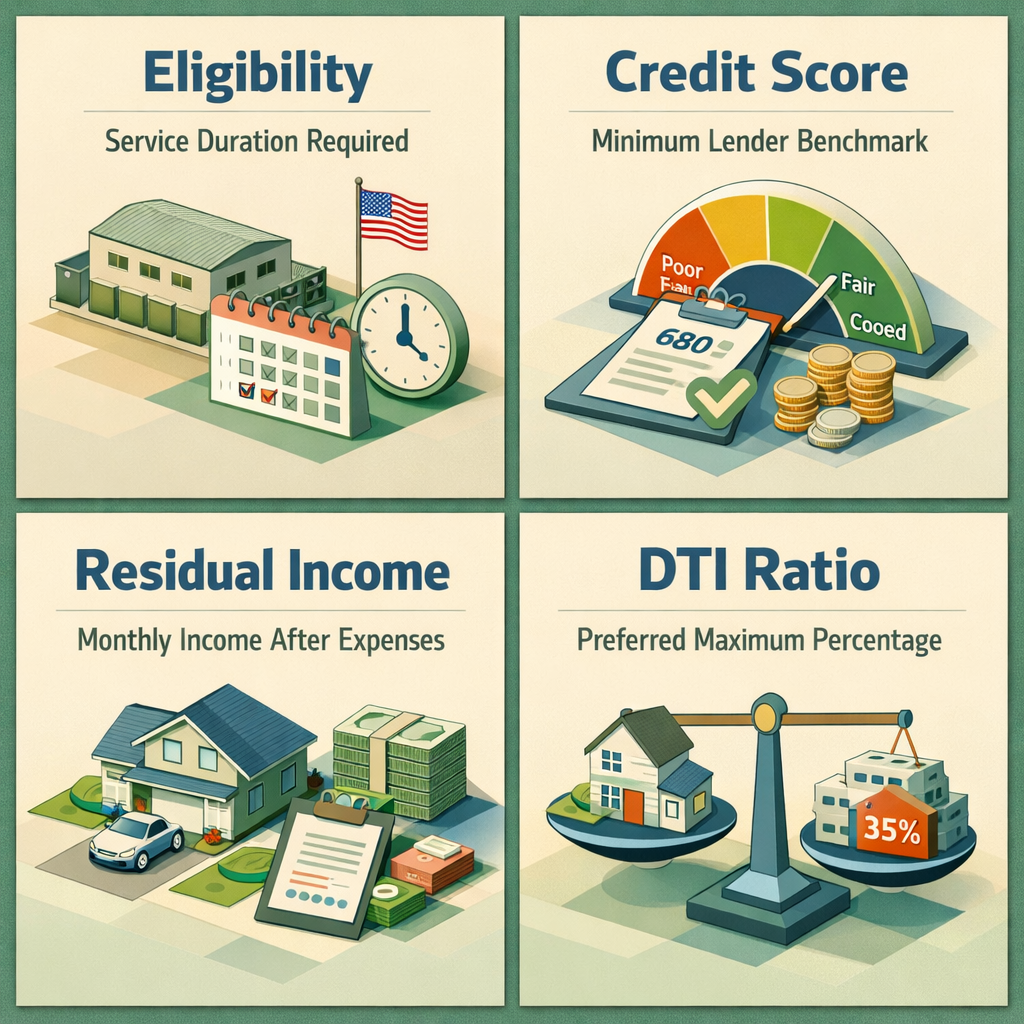
While the VA itself does not set a minimum credit score, most private lenders who issue VA loans do have their own internal benchmarks. Many lenders look for a credit score of at least 580 to 620, though some may require higher scores depending on the loan amount and overall borrower profile. It's important to shop around, as VA loan requirements can vary slightly from lender to lender.
The VA does require lenders to assess a borrower's residual income, which is the amount of money left over each month after paying all major expenses including housing costs, debts, and taxes. This residual income standard is designed to ensure that borrowers can comfortably afford their mortgage payments without financial strain. The threshold varies based on family size and the geographic region of the property.
Debt-to-income (DTI) ratio is another important factor. While the VA doesn't impose a strict maximum, most lenders prefer a DTI of 41% or below. Borrowers with higher DTI ratios may still qualify if their residual income is strong or if other compensating factors are present, such as substantial savings or a long history of on-time payments.
Key Financial Factors That Influence Approval
- Credit score: No official VA minimum, but lenders often look for 580–620 or higher
- Residual income: Must meet VA guidelines based on family size and region
- Debt-to-income ratio: Typically preferred at 41% or below
- Employment history: Steady, verifiable income for at least two years is commonly expected
Self-employed veterans and those with non-traditional income may need to provide additional documentation, such as tax returns or profit-and-loss statements, to satisfy lender requirements.
The VA Funding Fee: What It Is and Who Pays It
One of the most commonly misunderstood aspects of the VA loan program is the funding fee. Unlike conventional loans that require private mortgage insurance (PMI) when the down payment is less than 20%, VA loans replace this cost with a one-time VA funding fee. This fee helps sustain the program and offset costs for taxpayers.
The amount of the funding fee depends on several factors, including whether it's your first time using your VA loan benefit, the size of your down payment, and your type of service. For a first-time use with no down payment, the fee is typically around 2.15% of the loan amount for most borrowers, though this can change based on congressional updates. If you make a down payment of at least 5%, the funding fee may be reduced.
Importantly, some borrowers are exempt from paying the VA funding fee altogether. Veterans receiving VA disability compensation, surviving spouses of veterans who died in service or from a service-related disability, and certain other eligible borrowers may not be required to pay this fee. Always confirm your exemption status early in the process so it can be reflected in your loan estimate.
The funding fee can be rolled into the loan amount rather than paid upfront, which makes it more manageable for buyers who want to preserve their savings for closing costs or home improvements after purchase.
Property Eligibility and the VA Appraisal Process
Not every property qualifies for VA financing. The home must be your primary residence — investment properties and vacation homes do not meet VA occupancy requirements. Additionally, the property must pass a VA appraisal, which evaluates both the home's market value and its compliance with the VA's Minimum Property Requirements (MPRs).
The VA's Minimum Property Requirements exist to protect both the borrower and the government's financial interest. These standards ensure that the home is safe, structurally sound, and sanitary. Common issues that could cause a property to fail a VA appraisal include roof damage, pest infestations, inadequate heating systems, lead-based paint hazards (especially in older homes), and significant foundation concerns.
Types of Properties That May Qualify for a VA Loan
- Single-family homes
- Condominiums in VA-approved developments
- Manufactured homes, subject to specific conditions
- Multi-unit properties (up to four units) if the veteran occupies one unit
- New construction homes that meet VA guidelines
If a VA appraisal identifies required repairs, the seller is often asked to address them before closing. In some cases, the buyer and seller can negotiate who handles the repair costs. Unlike a conventional home inspection — which is separate from the appraisal — a VA appraisal is mandatory for all VA-backed purchase loans.
It's a good practice to also schedule an independent home inspection in addition to the VA appraisal. The appraisal confirms value and basic safety, but a thorough home inspection can uncover issues that go beyond the VA's required checklist.
Using Your VA Loan Benefit More Than Once
One of the lesser-known advantages of the VA loan program is that your entitlement can be restored and used again. Many veterans mistakenly believe that the VA loan benefit is a one-time opportunity, but that's not the case. You may be able to use it multiple times throughout your life under the right circumstances.
If you've paid off a previous VA loan and sold the property, your full entitlement is typically restored. This means you can apply for a new VA loan as if you're using the benefit for the first time. You can also apply for a restoration of entitlement even if you haven't sold the property, as long as the prior VA loan has been fully paid off.
It's also possible to have two active VA loans at the same time in certain situations, such as when a military family relocates due to a permanent change of station (PCS) and still has an outstanding balance on the previous home. In these cases, your remaining or bonus entitlement may cover the second loan, though limits may apply.
Veterans who previously experienced a foreclosure on a VA-backed loan may have reduced entitlement unless certain repayment or waiting period conditions are met. Speaking with a VA-approved lender or a HUD-approved housing counselor can help clarify your specific entitlement situation.
Refinancing Options Available to VA Loan Borrowers
Veterans and active-duty homeowners who already have a VA loan have access to a streamlined refinancing option known as the Interest Rate Reduction Refinance Loan (IRRRL), sometimes called the VA Streamline Refinance. This option is designed to help borrowers lower their interest rate or move from an adjustable-rate mortgage to a fixed-rate loan with minimal paperwork and no out-of-pocket appraisal costs in many cases.
To use the IRRRL, you must already have an existing VA loan on the property, and the refinance must result in a financial benefit to the borrower — typically a lower monthly payment or a more stable loan type. Credit underwriting is often less rigorous compared to a standard purchase loan, and income verification may be limited in some cases.
For homeowners who want to tap into their home's equity, the VA Cash-Out Refinance is another powerful tool. This option allows eligible borrowers to refinance their existing mortgage — even a non-VA loan — into a new VA-backed loan while pulling cash out for home improvements, debt consolidation, or other financial needs. Full underwriting and a new VA appraisal are typically required for this type of refinance.
Comparing VA Refinance Options at a Glance
- IRRRL (Streamline Refinance): Lower rate or better terms on an existing VA loan, minimal documentation
- VA Cash-Out Refinance: Access home equity or convert a non-VA loan to VA-backed financing
- Full underwriting required: Yes for cash-out, often reduced for IRRRL
- Funding fee applies: Generally yes, unless the borrower is exempt
Homeowners considering a refinance should calculate their break-even point — the time it takes for monthly savings to offset closing costs — to determine whether refinancing makes financial sense for their situation.
●Conclusion
Navigating the VA loan requirements doesn't have to be overwhelming. With the right preparation and a clear understanding of eligibility rules, credit standards, property guidelines, and available options, veteran homebuyers are well-positioned to make the most of one of the most generous home financing programs in the country. Whether you're buying your first home, upgrading to a larger space, or exploring refinancing opportunities, the VA loan program offers meaningful advantages that can make homeownership more accessible and affordable. At LoanWise, we're here to help you understand your options and connect with lenders who specialize in serving those who've served. Start your journey today and put your hard-earned benefit to work.