
Homeowners who have added an accessory dwelling unit to their property often find themselves sitting on significantly more equity than they realize. Whether it's a detached backyard cottage, a converted garage, or an attached in-law suite, an ADU can boost your home's appraised value in meaningful ways. But when it comes to borrowing against that equity through a Home Equity Line of Credit, or HELOC, the process involves a few extra layers of consideration. Understanding HELOC requirements for property with existing accessory dwelling unit structures is essential before you apply, so you're not caught off guard by lender guidelines that differ from a standard single-family home loan. This article walks you through what lenders typically look for, how your ADU affects the equation, and what steps you can take to strengthen your application.
What Is a HELOC and How Does It Work for Homeowners
A Home Equity Line of Credit is a revolving credit line secured by the equity in your home. Think of it like a credit card, but instead of unsecured borrowing, your property serves as collateral. Lenders typically allow you to borrow up to a certain percentage of your home's appraised value, minus any outstanding mortgage balance. This percentage is often referred to as the combined loan-to-value ratio, or CLTV.
HELOCs usually come with two phases: a draw period and a repayment period. During the draw period, which commonly lasts around ten years, you can borrow funds as needed and may only be required to pay interest. After that, the repayment period begins and you'll start paying back both principal and interest. The interest rate on a HELOC is typically variable, meaning it can fluctuate based on market conditions over time.
For homeowners with strong equity positions, a HELOC can be a flexible and cost-effective way to access funds for renovations, debt consolidation, education expenses, or even further property improvements. If you already have an ADU on your property, you may have more home equity available than you expect — but it's important to understand how lenders evaluate that equity.
How an Existing ADU Affects Your Property's Appraised Value
One of the most important factors in any HELOC application is the appraised value of your home. When an appraiser visits a property that includes an accessory dwelling unit, they'll need to assess not just the main residence but also the ADU itself. This process can be more nuanced than a standard single-family appraisal.
Appraisers typically use comparable sales, or "comps," to determine market value. For properties with ADUs, finding accurate comps can sometimes be challenging, particularly in areas where ADUs are less common. In markets where ADUs are more prevalent — such as urban California cities or Pacific Northwest neighborhoods — appraisers may have richer data to draw from, which could lead to a stronger valuation.
A permitted ADU that's in good condition and complies with local zoning regulations is far more likely to be recognized fully in an appraisal than an unpermitted structure. Lenders are generally cautious about unpermitted ADUs because they may introduce legal and insurance complications. If your ADU was built without proper permits, the appraiser might give it little to no value, and some lenders may decline your HELOC application altogether until the structure is brought into compliance.
It's worth having a candid conversation with your lender early in the process about how they handle ADU appraisals. Some lenders may order a specific ADU-inclusive appraisal methodology, while others follow standard single-family guidelines that could undervalue your property.
Key Lender Eligibility Criteria for an ADU HELOC
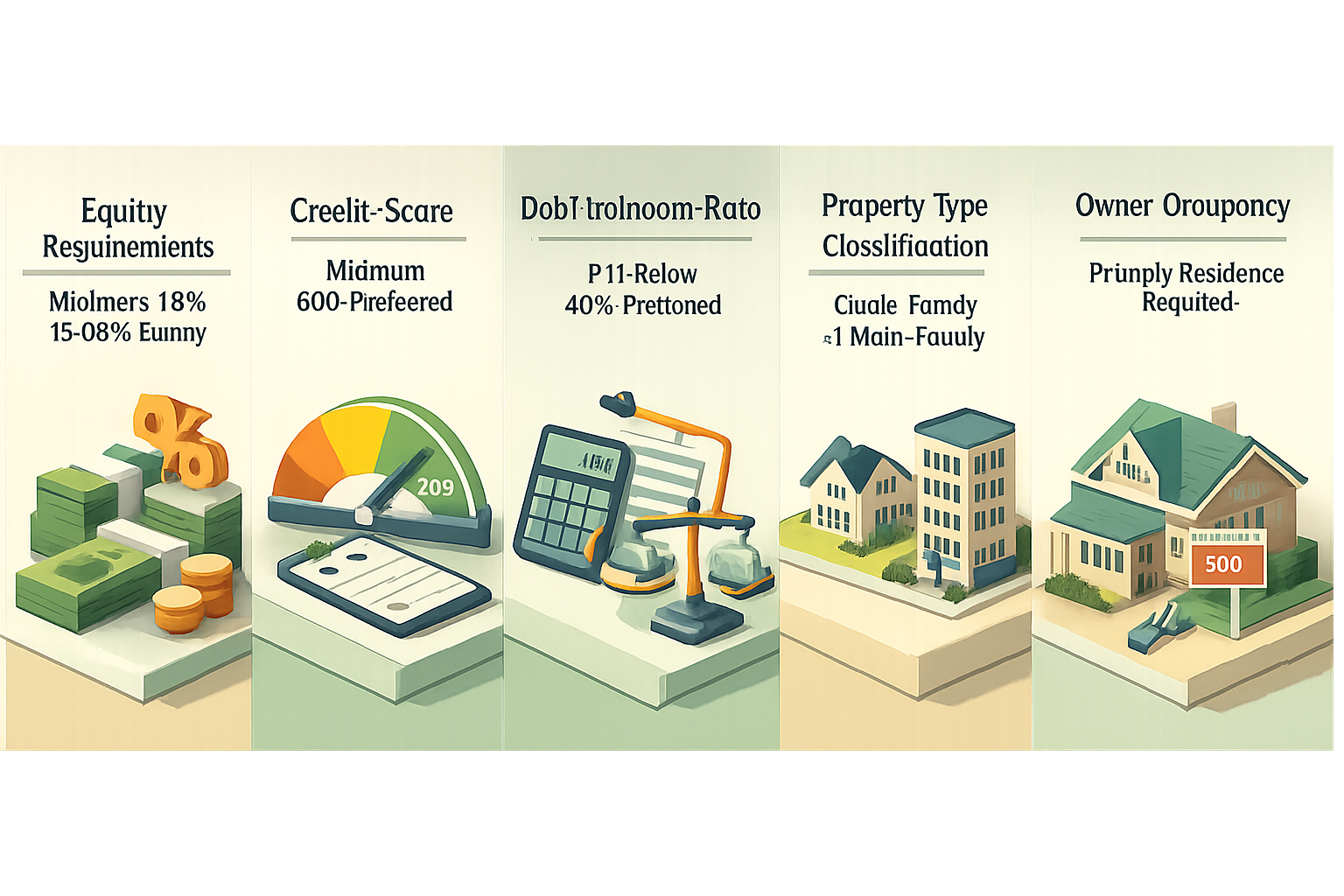
When it comes to HELOC accessory dwelling unit applications, lenders evaluate several qualification factors beyond just your home's value. Here's a breakdown of the most common criteria you'll encounter:
- Equity requirements: Most lenders require that you retain at least 15% to 20% equity in your home after the HELOC is factored in. This means your CLTV ratio typically cannot exceed 80% to 85%, though this varies by lender and loan program.
- Credit score: A strong credit score is usually needed to qualify for a HELOC. Many lenders look for a minimum score of around 620, but competitive rates and terms are often reserved for borrowers with scores of 700 or higher.
- Debt-to-income ratio (DTI): Lenders will calculate your total monthly debt obligations relative to your gross monthly income. A DTI below 43% is commonly preferred, though some lenders may extend more flexibility depending on your overall financial profile.
- Property type classification: How the lender classifies your property matters. A single-family home with an ADU is typically treated differently than a multi-family property. If your ADU makes your home look like a duplex in the lender's eyes, it could change which loan guidelines apply.
- Owner occupancy: Most HELOC programs require that the property be your primary residence. If you're renting out the ADU, you'll still likely qualify as long as you live in the main home — but lenders may ask for documentation.
Understanding these criteria upfront helps you gauge whether you're in a strong position before submitting a formal application.
Income Counting Rules When Your ADU Generates Rental Revenue
Many homeowners with accessory dwelling units rent them out to generate additional income. This rental revenue can be a financial asset in your HELOC application — but lenders handle ADU rental income in varying ways, so it's important not to assume it will automatically strengthen your file.
Some lenders may allow you to count a portion of your ADU rental income toward your qualifying income, which could help lower your effective DTI ratio. However, this typically requires documentation such as a signed lease agreement, rental history, or Schedule E from your tax returns if you've been reporting the income. New or informal rental arrangements may not be counted at all.
If you haven't been reporting ADU rental income on your taxes, lenders who require documented income history may not be able to use it to qualify you. This is an area where transparency and proper record-keeping can make a real difference. Borrowers who have consistently documented their rental income over one to two years are generally in a stronger position to have it counted.
It's also worth noting that some lenders take a conservative approach and simply don't count ADU rental income for HELOC qualification purposes. In those cases, you'd need to qualify based entirely on your primary income sources. Shopping around among multiple lenders may reveal more favorable income-counting policies for your specific situation.
Understanding HELOC Requirements for Property with Existing Accessory Dwelling Unit Permit Status
Permit status is one of the most critical — and sometimes overlooked — factors in the HELOC requirements for ADU properties. Lenders and appraisers treat permitted and unpermitted ADUs very differently, and the distinction could determine whether your application is approved or denied.
A permitted ADU is one that was constructed or converted with proper approval from local building authorities and passed all required inspections. These units are recognized as legal living spaces, which means appraisers can typically include them in the property's value assessment and lenders can feel confident in the collateral they're securing.
An unpermitted ADU, on the other hand, may be seen as a liability. If local authorities were to require removal or remediation of the structure, it could reduce your property's value and the lender's collateral position. As a result, many conventional lenders will either discount the value of an unpermitted ADU or decline to lend against a property with one present.
If your ADU is currently unpermitted, it may be worth exploring whether your local municipality has an ADU amnesty program or a streamlined permitting process. Many cities have introduced more flexible ADU regulations in recent years to encourage housing density, and getting your unit permitted could open the door to better financing options. Consulting with a local permit expediter or contractor before applying for your HELOC could be a smart preliminary step.
How to Strengthen Your Application Before Approaching a Lender
Preparation is one of the most effective tools you have when pursuing an ADU HELOC. The more organized and informed you are going into the process, the smoother your experience is likely to be. Here are some practical steps to consider:
- Verify your ADU's permit status: Pull records from your local building department to confirm whether your ADU has all required permits and certificates of occupancy. If something is missing, address it before applying.
- Gather property documentation: Compile your current mortgage statement, any existing appraisals, property tax records, and HOA documents if applicable. Lenders will need these to verify your equity position and property details.
- Document rental income properly: If your ADU is rented, make sure you have a current lease agreement and that income is reported on your tax returns. This creates a clear paper trail that lenders can rely on.
- Review your credit report: Obtain a free copy of your credit report and look for any errors or outdated negative items. Disputing inaccuracies ahead of time can help protect your credit score during the application process.
- Calculate your estimated equity: Use recent sales of comparable homes in your area to estimate your current property value. Subtract your outstanding mortgage balance to get a rough sense of your available equity before a formal appraisal is ordered.
- Shop multiple lenders: Not every lender handles ADU properties the same way. Comparing offers from banks, credit unions, and online lenders gives you a better chance of finding one whose guidelines align with your situation.
Working with the Right Lender for Your ADU Property Financing Goals
Not all lenders are equally experienced with ADU properties, and this can have a real impact on your borrowing experience. A lender who regularly works with properties that include accessory dwelling units will be more familiar with the nuances of appraisals, income documentation, and property classification — which can mean fewer surprises during underwriting.
When evaluating potential lenders, consider asking directly how they treat ADU rental income, what appraisal methodology they use for ADU-inclusive properties, and whether they have specific programs designed for homeowners in your situation. Some lenders may have overlays — their own internal guidelines that are stricter than standard guidelines — that could affect your eligibility. Others may be more flexible.
Credit unions, community banks, and portfolio lenders can sometimes offer more flexibility than large national lenders because they're not bound by the same secondary market guidelines. A portfolio lender keeps loans on their own books rather than selling them to investors, which may give them more discretion in how they evaluate ADU properties.
Working with an experienced mortgage broker can also be helpful here. Brokers have access to multiple lenders and can help match you with one whose guidelines are a good fit for your property type and financial profile. The right lending partnership can make the difference between a smooth HELOC approval and a frustrating back-and-forth process.
●Conclusion
Tapping into your home equity through a HELOC is a compelling option for homeowners who've invested in their property — and having an ADU can add meaningful value to that equation. But as this guide has shown, understanding HELOC requirements for property with existing accessory dwelling unit structures takes a bit more homework than a standard home equity application. From permit status and appraisal methodology to rental income documentation and lender selection, each piece of the puzzle matters. The good news is that with proper preparation and the right lending partner, a well-positioned homeowner with an ADU can be in an excellent spot to access flexible, competitive financing. If you're ready to explore your options, consider reaching out to a knowledgeable lending professional who can walk you through the process with your specific property in mind.