
Buying a home is one of the biggest financial steps you'll ever take, and coming up with a down payment can feel like the hardest part. Fortunately, many homebuyers receive financial help from family members — including grandparents — to bridge the gap. If you're planning to use a monetary gift to help fund your purchase, it's important to understand the requirements for conventional loan with gifted down payment from grandparents. Lenders have specific rules about gift funds, and knowing them in advance can help you avoid delays or surprises during underwriting. This guide walks you through everything you need to know, from eligibility rules to the paperwork involved.
What Are Gift Funds in a Conventional Loan?
Gift funds refer to money given to a homebuyer by another person — typically a family member — with no expectation of repayment. For conventional loans backed by Fannie Mae or Freddie Mac, gift funds are an accepted source of down payment funds, but they must meet certain conditions to be considered eligible.
The key distinction lenders make is between a gift and a loan. If there's any expectation that the money will be paid back, it cannot be classified as a gift. Lenders take this seriously because the repayment obligation would affect your debt-to-income ratio and overall loan qualification. A genuine gift, on the other hand, is considered an acceptable asset toward your down payment, closing costs, or financial reserves — depending on the loan program and occupancy type.
Grandparents are considered eligible gift donors under conventional loan guidelines. As long as they have a documented familial relationship with the borrower and the funds are properly sourced, their gift may be used toward the purchase of a primary residence, a second home, or even an investment property in some circumstances. That said, the rules for investment properties tend to be stricter, so it's worth verifying the current guidelines with your lender before proceeding.
Who Can Give a Gift for a Conventional Loan Down Payment?
Under Fannie Mae and Freddie Mac guidelines, gift funds for a conventional loan must come from an eligible donor. Grandparents clearly qualify as eligible donors because they fall under the broader category of relatives. Acceptable relatives typically include parents, grandparents, siblings, aunts, uncles, and other family members connected by blood, marriage, or adoption.
This means that if your grandmother or grandfather wants to contribute money toward your home purchase, their gift is generally welcomed by conventional lenders. However, gifts from non-family members — such as friends, employers, or unrelated third parties — may be subject to additional scrutiny or may not be allowed at all under certain loan programs.
It's also worth noting that gifts from domestic partners or fiancés are often permitted, depending on the lender's interpretation of the guidelines. If you're unsure whether a particular gift source qualifies, your loan officer can help you confirm eligibility early in the process, saving you from potential complications later on.
Requirements for Conventional Loan with Gifted Down Payment from Grandparents
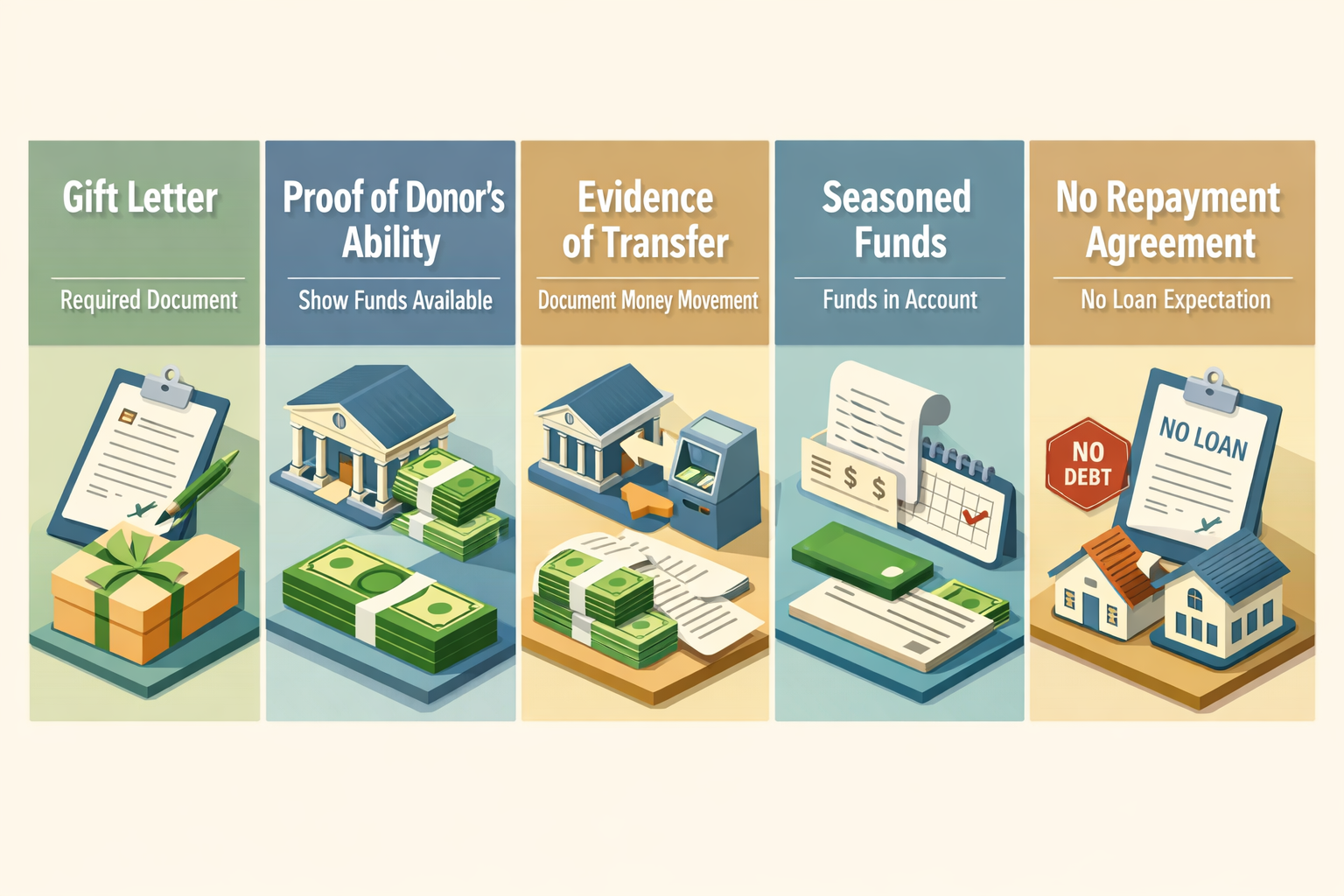
Meeting the requirements for conventional loan with gifted down payment from grandparents involves more than just receiving the money. Lenders follow a structured set of documentation and verification steps to confirm that the funds are legitimate and properly sourced. Here's what you'll typically need to satisfy:
- Gift Letter: The most critical document is a signed gift letter from your grandparent. This letter must state the donor's name, address, and relationship to you. It must also confirm the exact dollar amount of the gift, the address of the property being purchased, and — most importantly — a clear statement that no repayment is expected or required.
- Proof of Donor's Ability to Give: Lenders will often request documentation showing that your grandparent actually has the funds available. This could be a recent bank statement from the donor's account reflecting the gift amount.
- Evidence of Transfer: You'll need to show that the money has been transferred from the donor's account to yours. This may involve providing bank statements showing both the withdrawal on the donor's end and the deposit on your end.
- Seasoned Funds: If the gift has been in your account for 60 days or more before your loan application, it may be considered "seasoned" and require less documentation. However, if the funds were deposited recently, lenders may request a full paper trail tracing the origin of the money.
- No Repayment Agreement: There must be no written or verbal agreement between you and your grandparent that the money will be repaid. Any suggestion of repayment converts the gift into a loan, which changes how lenders evaluate your debt obligations.
These requirements are fairly standard across most conventional lenders, though individual institutions may have additional steps or nuances. Working with an experienced loan officer who understands Fannie Mae and Freddie Mac guidelines can make the process much smoother.
How Much of Your Down Payment Can Be a Gift?
One common question homebuyers have is whether the entire down payment can come from a gift. The answer depends largely on the loan-to-value ratio and the property type.
For a primary residence with a down payment of 20% or more, Fannie Mae guidelines generally allow the entire down payment to come from gift funds. This is great news if your grandparents are in a position to be particularly generous. If the down payment is less than 20%, the rules may require that the borrower contribute a minimum amount from their own funds, depending on the overall loan structure.
For second homes, a portion of the down payment may need to come from the borrower's own savings. For investment properties, gift funds are typically not allowed to cover the down payment — the borrower is usually expected to use their own verified assets.
It's also important to understand that even if gift funds cover your down payment, lenders will still evaluate your overall financial profile. Your credit score, income stability, employment history, and existing debt obligations all play a role in whether you qualify for the loan. A generous gift from grandparents helps with the down payment, but it doesn't replace the need for strong borrower qualifications.
The Role of the Gift Letter and Why It Matters So Much
Among all the documents involved in using conventional loan gift funds from grandparents for a down payment, the gift letter stands out as the most important. Without a properly written and signed gift letter, your lender may be unable to approve the use of those funds — no matter how legitimate the transfer actually was.
A gift letter should be concise and cover every required element. Most lenders will provide a template, but if yours doesn't, make sure the letter includes the following details:
- The full name of the gift donor (your grandparent)
- Their mailing address and contact information
- Their relationship to you as the borrower
- The exact gift amount in dollars
- The property address where the funds will be used
- A clear statement confirming no repayment is required
- The donor's signature and the date
Some lenders may also require the donor to provide their own bank statement showing that the funds were available before the transfer. This helps underwriters confirm that the gift did not come from an undisclosed loan, a cash advance, or another borrowed source. Being thorough with this paperwork upfront can significantly reduce underwriting delays and keep your closing timeline on track.
How Gift Funds Affect Your Overall Mortgage Qualification
Using conventional loan gift funds can be a powerful way to reach your down payment goal, but it's helpful to understand how they interact with the rest of your mortgage application. Lenders look at the complete picture of your finances when evaluating your loan, not just your down payment source.
Here are a few ways gift funds may influence your qualification:
- Debt-to-Income Ratio (DTI): Since a legitimate gift doesn't need to be repaid, it won't add to your monthly debt obligations. This keeps your DTI ratio clean and helps you qualify for a larger loan amount.
- Reserves: Some loan scenarios require borrowers to maintain a certain number of months' worth of mortgage payments in reserve after closing. If your grandparents' gift covers the down payment and your own savings cover the reserves, you may be in a stronger position than if you had stretched your own funds across both.
- Loan-to-Value Ratio: A larger down payment — even when funded by a gift — reduces your LTV ratio. This can help you avoid private mortgage insurance (PMI) if you reach the 20% threshold, potentially lowering your monthly payment.
- Credit Score Still Matters: Lenders typically require a minimum credit score for conventional loans, often around 620 or higher depending on the lender. A gift doesn't compensate for a low credit score, so it's wise to review your credit before applying.
Ultimately, using gift funds from grandparents is a perfectly legitimate strategy. When combined with solid credit and stable income, it can make homeownership much more accessible for first-time buyers or those who haven't had time to fully save on their own.
Tips for a Smooth Gift Fund Approval Process
Navigating the gift fund documentation process doesn't have to be stressful. A little planning goes a long way. Here are some practical tips to help everything go smoothly:
- Start early: Talk to your grandparents about the gift well before you apply for the loan. Getting the funds transferred and seasoned in your account ahead of time can reduce the documentation burden significantly.
- Keep a clear paper trail: Save bank statements, wire transfer confirmations, and any written communication related to the gift. The more clearly you can trace the funds, the easier the underwriting process becomes.
- Use a lender experienced with gift funds: Not all loan officers handle gift fund transactions regularly. Working with someone familiar with Fannie Mae and Freddie Mac guidelines for gifts can help you avoid common mistakes.
- Avoid depositing cash: If your grandparent gives you cash — physical currency — it can be extremely difficult to document and trace. Electronic transfers or checks are much easier to verify and are strongly preferred by lenders.
- Don't commingle funds confusingly: If you receive a large gift deposit, try not to immediately mix it with other transactions. Keeping the deposit clearly identifiable in your statements helps underwriters confirm its origin without extra back-and-forth.
Following these steps can help you move through the approval process with confidence. The requirements for conventional loan with gifted down payment from grandparents are manageable when you're organized and proactive from the start.
●Conclusion
Receiving a gift from your grandparents to help purchase a home is a meaningful and financially practical arrangement — and conventional loan programs are designed to accommodate it. By understanding the documentation requirements, eligible donor rules, and how gift funds interact with your broader mortgage qualification, you'll be well-prepared to navigate the process with ease. Whether you're a first-time homebuyer or someone looking to reduce the out-of-pocket cost of a new purchase, conventional loan gift funds from grandparents for a down payment can be a smart and fully legitimate strategy. Take the time to work with an experienced mortgage professional, gather your paperwork early, and communicate openly with your grandparents about the process. With the right preparation, your path to homeownership may be closer than you think. Ready to explore your options? Connect with a LoanWise mortgage expert today to get started.