
Homeowners who've added an attached accessory dwelling unit to their property may find themselves sitting on significant equity — but accessing that equity through a Home Equity Line of Credit isn't always straightforward. Understanding HELOC requirements for property with attached accessory dwelling unit configurations is becoming increasingly important as ADUs grow in popularity across the country. Whether you built a unit to house family members, generate rental income, or simply increase your property's value, knowing how lenders evaluate these homes can make the difference between a smooth approval and an unexpected roadblock. This guide walks you through the key factors lenders typically consider, so you can approach the process with confidence.
What Is an Attached ADU and Why It Matters for Home Equity Lending
An attached accessory dwelling unit is a secondary living space that shares a wall, floor, or ceiling with the primary residence. It may have its own entrance, kitchen, bathroom, and sleeping area, but it remains structurally connected to the main home. Common examples include converted garages, basement apartments, and in-law suites built as additions to the existing structure.
For lenders, the presence of an attached ADU changes how a property is classified, appraised, and underwritten. Unlike detached guest houses or separate rental units on the same lot, attached ADUs are generally treated as part of the same single-family or two-family dwelling — depending on how the unit is permitted and how local zoning defines it. This classification directly affects how much equity a lender will recognize and what loan products are available to you.
Lenders also pay close attention to whether the ADU was built with proper permits. An unpermitted unit can complicate appraisals, raise lender concerns about liability, and in some cases disqualify a property from certain loan programs altogether. Before applying for a HELOC, it's worth confirming that your ADU is legally recognized by your local municipality.
How Lenders Determine HELOC Eligibility on ADU Properties
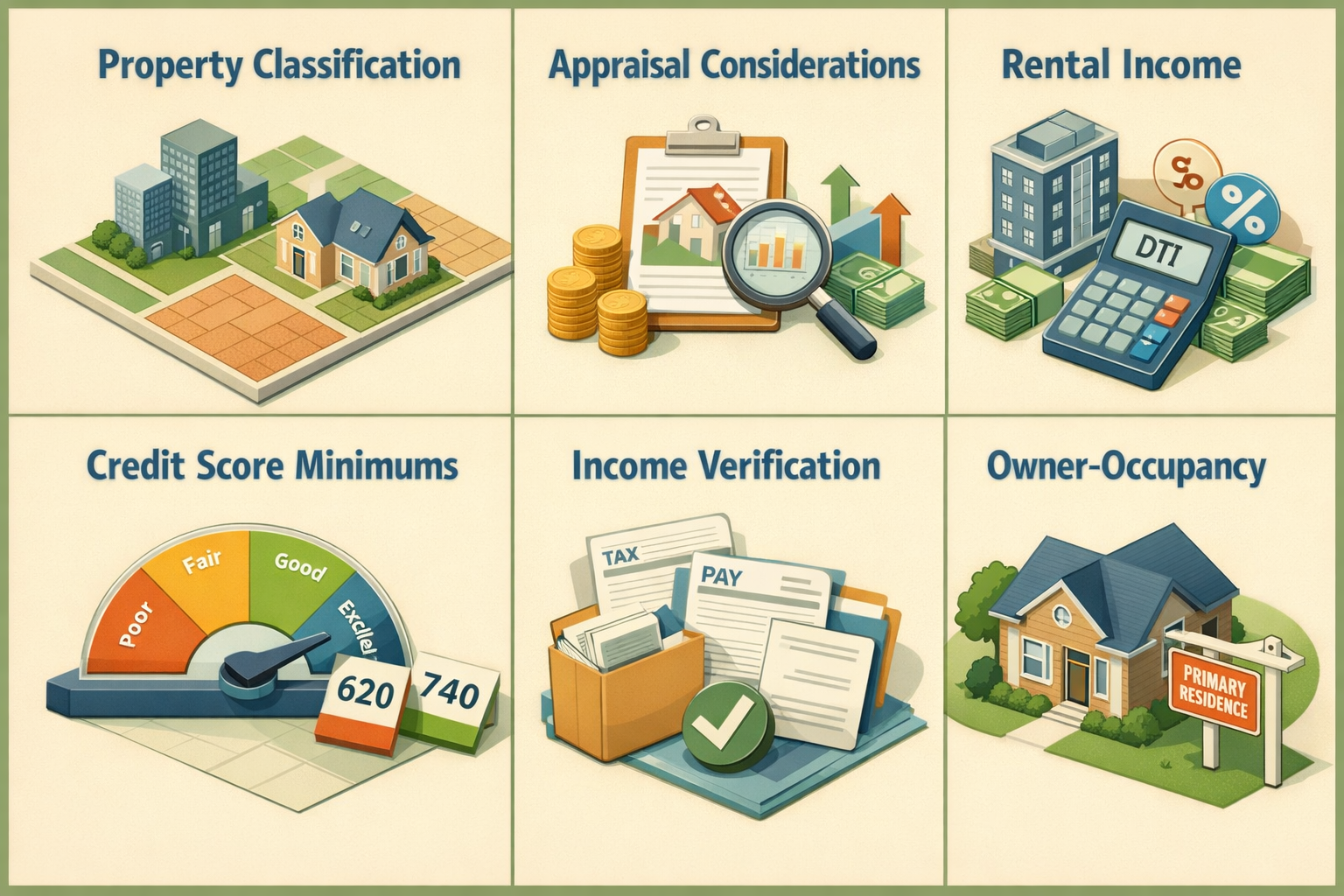
When it comes to HELOC eligibility ADU property considerations, lenders typically evaluate several interconnected factors. Understanding these elements in advance can help you position your application more effectively.
Property Classification and Zoning
One of the first things a lender will examine is how the property is zoned and how the ADU is classified. A home with an attached ADU may be considered a single-family residence with an accessory unit, or it could be reclassified as a two-family or multi-family property depending on local zoning laws and the unit's features. This distinction matters because many HELOC eligibility products are designed specifically for owner-occupied, single-family homes. Properties classified as multi-family may face different underwriting standards, higher interest rates, or stricter loan-to-value limits.
Appraisal Considerations
A licensed appraiser will assess the market value of the entire property, including the ADU. In markets where ADUs are common and well-regarded, the attached unit may meaningfully boost the appraised value, which could increase the equity available to borrow against. However, appraisers rely on comparable sales — often called "comps" — in the area. If similar ADU-equipped homes haven't sold recently nearby, the appraiser may have limited data to work with, which could affect the final valuation. Homeowners should be prepared for some variability in appraisal outcomes.
Rental Income and Debt-to-Income Ratios
If the attached ADU generates rental income, some lenders may allow a portion of that income to count toward your qualifying income, potentially improving your debt-to-income ratio. However, lenders typically require documentation such as a signed lease agreement and, in many cases, a history of rental income reported on tax returns. Policies vary significantly from one lender to another, so it's worth asking about this early in the process.
Equity Requirements and Loan-to-Value Limits for ADU Homes
Like all HELOC applications, those involving ADU properties hinge heavily on how much equity the homeowner has built up. Most lenders set a maximum combined loan-to-value ratio (CLTV) — meaning the total of your existing mortgage balance plus the HELOC amount generally cannot exceed a certain percentage of the home's appraised value. A CLTV limit of around 80% to 85% is common, though specific thresholds vary by lender and loan program.
For ADU properties, this calculation may be applied more conservatively. Some lenders are cautious about extending large credit lines on properties that don't fit neatly into standard single-family categories. If your property has been reclassified as a two-unit or investment property due to the ADU, you may encounter lower CLTV limits, which effectively means you'd need more equity to qualify for the same credit line.
It's also worth noting that the appraised value used in the CLTV calculation will reflect how the market views your specific property configuration. If ADU-friendly comparable sales are strong in your area, you may find yourself in a favorable position. If the market is less familiar with ADU properties, the appraised value — and therefore your borrowable equity — could be more modest than expected.
Credit Score and Income Standards Lenders Typically Apply
Beyond the property itself, HELOC lenders scrutinize the borrower's financial profile just as carefully. Understanding HELOC requirements for property with attached accessory dwelling unit means recognizing that your personal creditworthiness plays an equally significant role in the approval process.
Credit Score Minimums
Most lenders look for a minimum credit score somewhere in the mid-600s to low-700s for HELOC approval, though requirements can vary. A stronger credit score not only improves your chances of approval but may also qualify you for a lower interest rate and a more favorable draw period. If your score is on the lower end, it may be worth taking steps to strengthen it before applying — such as paying down revolving balances and addressing any errors on your credit report.
Income Verification and Employment Stability
Lenders want to see that you have consistent, verifiable income to support your monthly payments. Standard documentation typically includes recent pay stubs, W-2s, and federal tax returns. Self-employed borrowers or those with variable income may need to provide additional documentation, and some lenders may apply more scrutiny to income derived from ADU rental arrangements. Demonstrating a stable financial history can go a long way toward reassuring lenders about your ability to repay.
Owner-Occupancy Rules and How They Apply to ADU Configurations
Most HELOC programs require that the property serve as the borrower's primary residence. This owner-occupancy requirement is generally straightforward for a traditional single-family home, but it can get more nuanced when an attached ADU is involved.
If you live in the main dwelling and rent out the attached unit, most lenders will still consider the property owner-occupied — which is a favorable classification. However, if you've moved out and rent both the primary home equity and the ADU, lenders may classify the property as an investment or non-owner-occupied property. That classification typically triggers stricter underwriting standards, lower CLTV limits, and potentially higher rates.
It's also possible that some lenders may view a property with a large, fully self-contained attached unit as a two-family home regardless of owner occupancy. In those cases, you may need to work with lenders who specialize in multi-family or mixed-use financing, or who have specific products designed for properties with accessory units. Shopping around and being transparent with lenders about your property's configuration from the start can help you avoid surprises later in the process.
Tips for Strengthening Your HELOC Application on an ADU Property
With the right preparation, many homeowners successfully access their equity through a HELOC even when their property includes an attached ADU. Here are some practical steps that may improve your chances of approval.
- Confirm your ADU's permit status: Obtain copies of all permits and certificates of occupancy for the ADU. Lenders and appraisers will likely ask for this documentation, and having it ready signals that your property is legally compliant.
- Request a preliminary property valuation: Before applying formally, you might consult with a local real estate agent or request a broker's price opinion to get a sense of how comparable ADU properties are valued in your market.
- Organize rental income documentation: If your ADU generates rental income, gather your lease agreements, rent deposit records, and the last two years of tax returns showing that income reported.
- Compare multiple lenders: Not all lenders treat ADU properties the same way. Credit unions, community banks, and specialty mortgage lenders may have more flexible guidelines than large national institutions. Comparing options could uncover better terms.
- Review your credit report in advance: Pull your credit report from all three bureaus and dispute any inaccuracies before you apply. Even small improvements in your score can affect your rate and approval odds.
- Work with an experienced mortgage professional: A loan officer who has handled ADU properties before can guide you through lender-specific nuances and help you present your application in the strongest possible light.
●Conclusion
Navigating understanding HELOC requirements for property with attached accessory dwelling unit configurations takes a bit more preparation than a standard home equity application, but it's entirely achievable for well-prepared homeowners. The key is to understand how your property is classified, ensure your ADU is properly permitted, and align your financial profile with lender expectations. Because guidelines and flexibility vary from one lender to the next, working with a knowledgeable mortgage professional can be one of the most valuable steps you take. At LoanWise, we're here to help you explore your home equity options with clarity and confidence — so you can make the most of the investment you've already built.