
If you own a home with an accessory dwelling unit, a guest house, or any type of secondary living space, you may already be sitting on a valuable financial asset. A Home Equity Line of Credit — commonly called a HELOC — lets you borrow against the equity you've built in your property. But when your home includes an existing second unit, the borrowing process can feel a bit more complex. Understanding HELOC requirements for a property with existing second unit is an important first step before you contact a lender. From how appraisers value your home to how lenders assess your rental income, there's a lot to unpack. This guide will walk you through what you need to know so you can move forward with confidence.
What Is a HELOC and How Does It Work for Homeowners?
A HELOC is a revolving line of credit secured by your home's equity. Think of it like a credit card, but with your property as collateral. You're approved for a maximum credit limit, and you can draw from that limit as needed during a set draw period — often around ten years. After that, a repayment period begins, and you pay back what you borrowed, typically with interest.
The amount you can borrow is based on how much equity you've accumulated. Lenders generally allow you to access up to a certain percentage of your home equity appraised value, minus what you still owe on your mortgage. This percentage — known as the combined loan-to-value ratio, or CLTV — is a key metric lenders use to determine your credit limit.
HELOCs often come with variable interest rates, which means your monthly payment can fluctuate over time. Some lenders may offer a fixed-rate option on portions of the balance, but variable rates are the most common structure. Homeowners typically use HELOCs to fund home improvements, consolidate higher-interest debt, cover education expenses, or handle large unexpected costs.
For owners of properties with a second unit, a HELOC can also serve as a strategic tool — for example, funding renovations on the ADU to increase rental income, or using the line of credit as a financial cushion between tenants. Understanding the basics of how a HELOC works helps set the foundation for navigating the more nuanced requirements that apply to your specific property type.
How Lenders Define and Classify Properties with a Second Unit
One of the first things lenders will do when you apply for a HELOC is classify your property. This classification has a direct impact on which loan programs you qualify for and how strict the underwriting requirements will be.
A property with an accessory dwelling unit — commonly referred to as an ADU — is typically defined as a residential structure that contains a primary dwelling and a smaller, self-contained secondary unit on the same lot. The secondary unit usually has its own entrance, kitchen, bathroom, and sleeping area. Common examples include garage conversions, basement apartments, detached cottages, and attached guest suites.
Lenders and appraisers may categorize your property differently depending on the ADU's size, permanence, and whether it was built with proper permits. A legal ADU — one that was constructed according to local building codes and has the necessary permits — will generally be treated more favorably than an unpermitted unit. If your second unit was added without permits, some lenders may not count it in the property's appraised value, or they may flag it as a compliance risk.
Properties are broadly classified as owner-occupied single-family with an ADU, two-unit (duplex), or investment property. These classifications carry different lending criteria. For example, a property classified as a two-unit residence may require a higher equity stake or a more detailed income analysis than a standard single-family home. Knowing how your property is likely to be classified before you apply can save you time and prevent unwelcome surprises during underwriting.
Understanding HELOC Requirements for a Property with Existing Second Unit
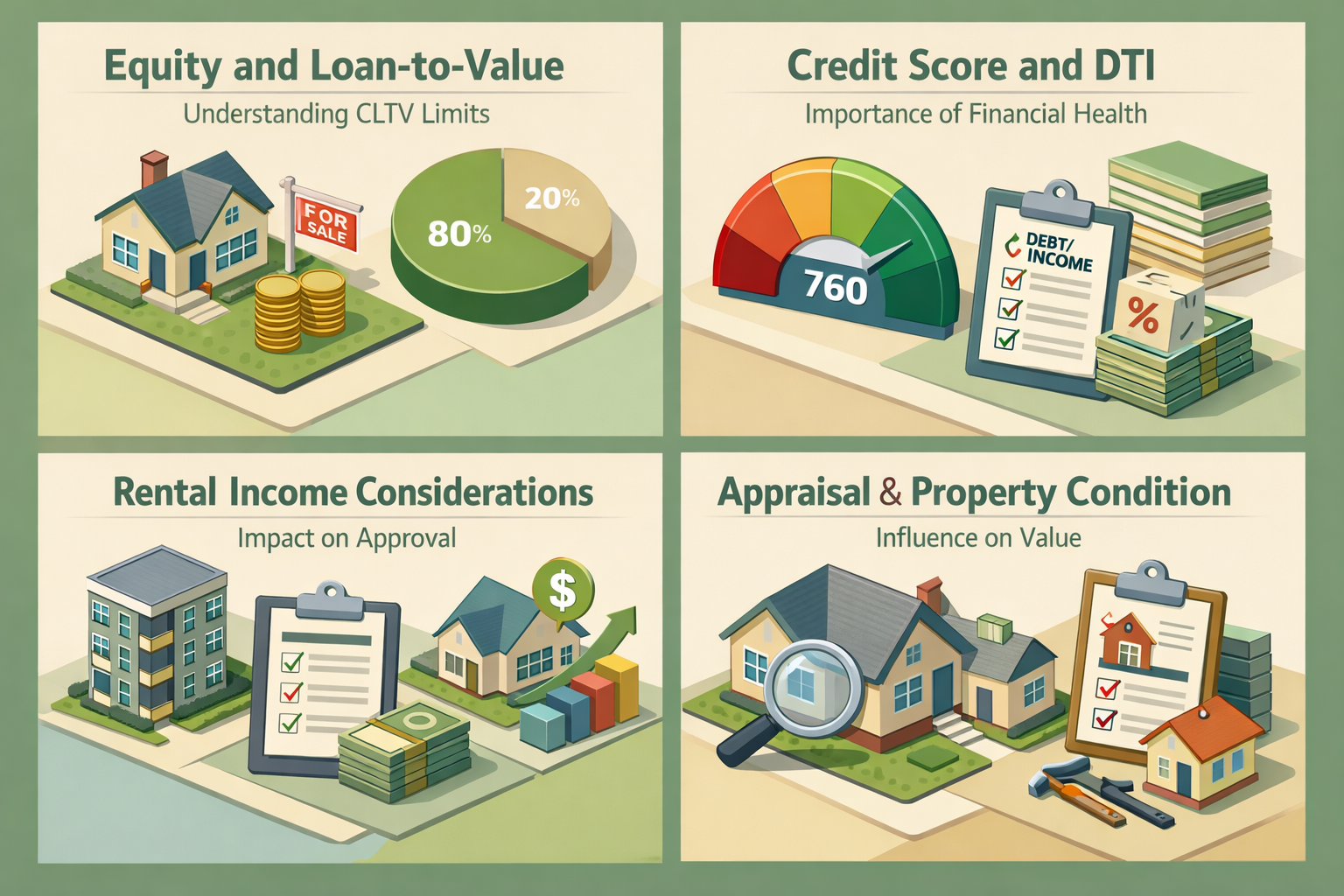
When it comes to understanding HELOC requirements for a property with existing second unit, several factors come into play that wouldn't apply to a standard single-family home. Lenders tend to take a more detailed look at your overall financial picture, the property's condition, and how the second unit impacts value and risk.
Equity and Loan-to-Value Requirements
Most lenders require that you maintain a certain amount of equity after the HELOC is factored in. For properties with a second unit, some lenders may apply a lower maximum CLTV compared to a standard single-family home. While a typical HELOC on a primary residence might allow up to 85% CLTV, lenders may cap that figure more conservatively for multi-unit or ADU properties — though this can vary significantly by lender and loan program.
Credit Score and Debt-to-Income Thresholds
A strong credit score is typically required for HELOC approval on any property type, but lenders may set the bar slightly higher for properties with a second unit, given the perceived complexity. A score of 680 or above is often cited as a general minimum, though competitive rates and higher credit limits are usually reserved for borrowers with scores above 720. Your debt-to-income ratio — the percentage of your gross monthly income that goes toward debt payments — is also closely evaluated. Lenders generally prefer a DTI below 43%, though some programs may allow slightly higher ratios depending on compensating factors.
Rental Income Considerations
If your second unit is currently rented out, lenders may consider that rental income when evaluating your ability to repay. However, policies vary widely. Some lenders require documented lease agreements and a history of rental income on your tax returns before they'll count it toward your qualifying income. Others may only count a portion of the rental income — often 75% — to account for vacancy and maintenance costs. If you're planning to rent the unit in the future but haven't yet, that projected income typically won't be counted.
Appraisal and Property Condition
An appraisal is a standard part of the HELOC application process, and it's especially important for properties with ADUs or guest houses. The appraiser will assess the overall condition of the property, including the second unit. If the unit is in poor condition or raises safety concerns, the appraised value could come in lower than expected — reducing your available credit line. Legal, well-maintained ADUs, on the other hand, may positively contribute to the property's appraised value.
HELOC Eligibility for Properties with an ADU or Guest House: What Lenders Look For
When evaluating HELOC eligibility for a property with an ADU or guest house, lenders conduct a thorough review that goes beyond just your credit score and income. Here's a closer look at the specific factors they typically examine.
Permit Status of the Second Unit
As mentioned earlier, whether your ADU or guest house was built with proper permits can significantly influence your HELOC eligibility. Lenders want to know the unit is legally compliant because an unpermitted structure can create liability issues and may complicate the property's valuation. If you're unsure about the permit status of your second unit, it may be worth consulting with your local building department before applying.
Occupancy Status
Lenders will also want to know who is living in the second unit and whether you, the borrower, occupy the primary residence. Most HELOC programs are designed for owner-occupied properties. If you rent out both the primary home and the second unit, your property may be reclassified as an investment property — which typically comes with stricter lending requirements and higher interest rates.
Insurance and Zoning Compliance
Your homeowner's insurance policy should adequately cover both the primary residence and the second unit. Some lenders will request proof of coverage that explicitly includes the ADU or guest house. Similarly, zoning compliance matters — lenders may verify that your local zoning laws permit the secondary unit on your lot. If zoning issues exist, it could create complications during underwriting.
Documentation Requirements
Be prepared to provide a range of documents when applying. These may include recent tax returns, pay stubs, bank statements, the property's existing mortgage statements, any lease agreements for the second unit, and documentation confirming the ADU's permit status. Having these materials organized ahead of time can help move the application process forward more smoothly.
How the Second Unit Affects Your Home's Appraised Value
Your HELOC credit limit is tied directly to your home's appraised value, so understanding how an ADU or guest house influences that number is essential. In many markets, a well-constructed, legally permitted second unit can meaningfully increase a property's overall value. Appraisers use comparable sales — often called "comps" — to estimate value, and they'll look for similar properties with ADUs in your area when possible.
If comparable sales are limited in your market, the appraiser may use an income approach, estimating how much rental income the second unit could generate and factoring that into the overall value. This can be beneficial for homeowners in areas where ADU rentals are in high demand.
On the flip side, a second unit that's outdated, poorly maintained, or unpermitted may not add much value — and in some cases, it could actually create questions about the property's overall condition. Before applying for a HELOC, it may be worth making minor repairs or updates to the second unit to ensure it presents well during the appraisal.
It's also worth noting that real estate markets vary. In high-cost urban areas, ADUs and guest houses often add significant value because of strong rental demand. In rural or suburban markets, the added value may be more modest. Consulting with a local real estate professional before your appraisal can give you a realistic sense of what to expect.
Tips for Strengthening Your HELOC Application on an ADU Property
If you're planning to apply for a HELOC on a property with a second unit, a little preparation can go a long way. Here are some practical strategies that may help improve your chances of approval and secure more favorable terms.
- Check your credit report early. Review your credit report for errors or outdated information before applying. Disputing inaccuracies in advance can help protect your credit score during the application review.
- Reduce your existing debt. Paying down revolving balances — like credit cards — before applying can lower your DTI ratio and make you a more attractive borrower.
- Confirm permit status. If your ADU or guest house was added by a previous owner, verify its permit status with your local building or planning department. Resolving permit issues ahead of time, if possible, may improve how your property is evaluated.
- Document rental income thoroughly. If your second unit is rented, compile your lease agreements, rental payment records, and tax documentation showing that rental income has been reported. This paper trail can support a stronger income qualification.
- Shop multiple lenders. Not all lenders handle ADU properties the same way. Some have more experience with multi-unit properties and may offer better terms. Comparing offers from multiple lenders — including credit unions, community banks, and online lenders — is often the most effective way to find the best fit.
- Consider a pre-application consultation. Many lenders offer free consultations before you formally apply. Use this opportunity to ask about their specific policies for properties with second units so you're not surprised during underwriting.
●Conclusion
Owning a property with an ADU, guest house, or other second unit gives you a unique financial opportunity — but it also means navigating a slightly more layered lending process. Understanding HELOC requirements for a property with existing second unit helps you approach the process with realistic expectations and a stronger application. From equity thresholds and credit benchmarks to rental income documentation and appraisal considerations, the details matter. By preparing thoroughly, confirming your property's permit status, and working with lenders experienced in ADU properties, you can unlock the equity in your home with greater confidence. If you're ready to explore your options, the team at LoanWise is here to help guide you through every step of the process.