
For self-employed homeowners, accessing the equity built in their property can be a powerful financial move. Whether you're looking to fund a home renovation, consolidate debt, or cover a major expense, a Home Equity Line of Credit — commonly known as a HELOC — offers flexible borrowing potential. However, understanding HELOC interest rates for self-employed individuals comes with its own set of complexities. Lenders tend to scrutinize income differently when you work for yourself, and the variable nature of HELOC rates adds another layer to navigate. This guide breaks it all down so you can approach your application with confidence.
What Is a HELOC and How Does It Work for Homeowners?
A HELOC is a revolving line of credit secured by the equity in your home. Think of it like a credit card backed by your property — you draw funds as needed during a set draw period, typically lasting around five to ten years, and then repay what you've borrowed during a repayment period that often follows.
Unlike a traditional home equity loan, which delivers a lump sum at a fixed interest rate, a HELOC generally carries a variable interest rate. This means your rate — and therefore your monthly payment — can rise or fall over time based on a benchmark index, most commonly the prime rate. For borrowers who prefer predictability, this variability is worth thinking carefully about before signing on.
The amount you can borrow through a HELOC typically depends on your home's appraised value, your outstanding mortgage balance, and the lender's maximum combined loan-to-value (CLTV) ratio. Many lenders allow borrowing up to 80% or 85% of your home's value, minus what you still owe on your mortgage — though this can vary by lender and market conditions.
Why Variable Interest Rates on Home Equity Lines Matter More When You're Self-Employed
For W-2 employees, predicting future income is relatively straightforward. For self-employed borrowers — freelancers, business owners, independent contractors, and sole proprietors — income can fluctuate significantly from month to month or year to year. This makes the variable interest rates on home equity lines particularly important to understand.
When the prime rate rises, so does your HELOC rate — and by extension, your minimum monthly payment. If your business revenue dips at the same time rates climb, the combination could strain your cash flow. That's why it may be wise to build a repayment buffer into your budget before drawing on a HELOC, especially if your income isn't guaranteed month to month.
Some lenders do offer rate caps on HELOCs, which limit how high the interest rate can climb over the life of the line. These caps can provide a meaningful degree of protection for self-employed borrowers who want to limit their exposure to rate volatility. Always ask a lender about rate caps, margins, and index details before committing to a HELOC product.
How Lenders Evaluate Income for HELOC for Self-Employed Borrowers
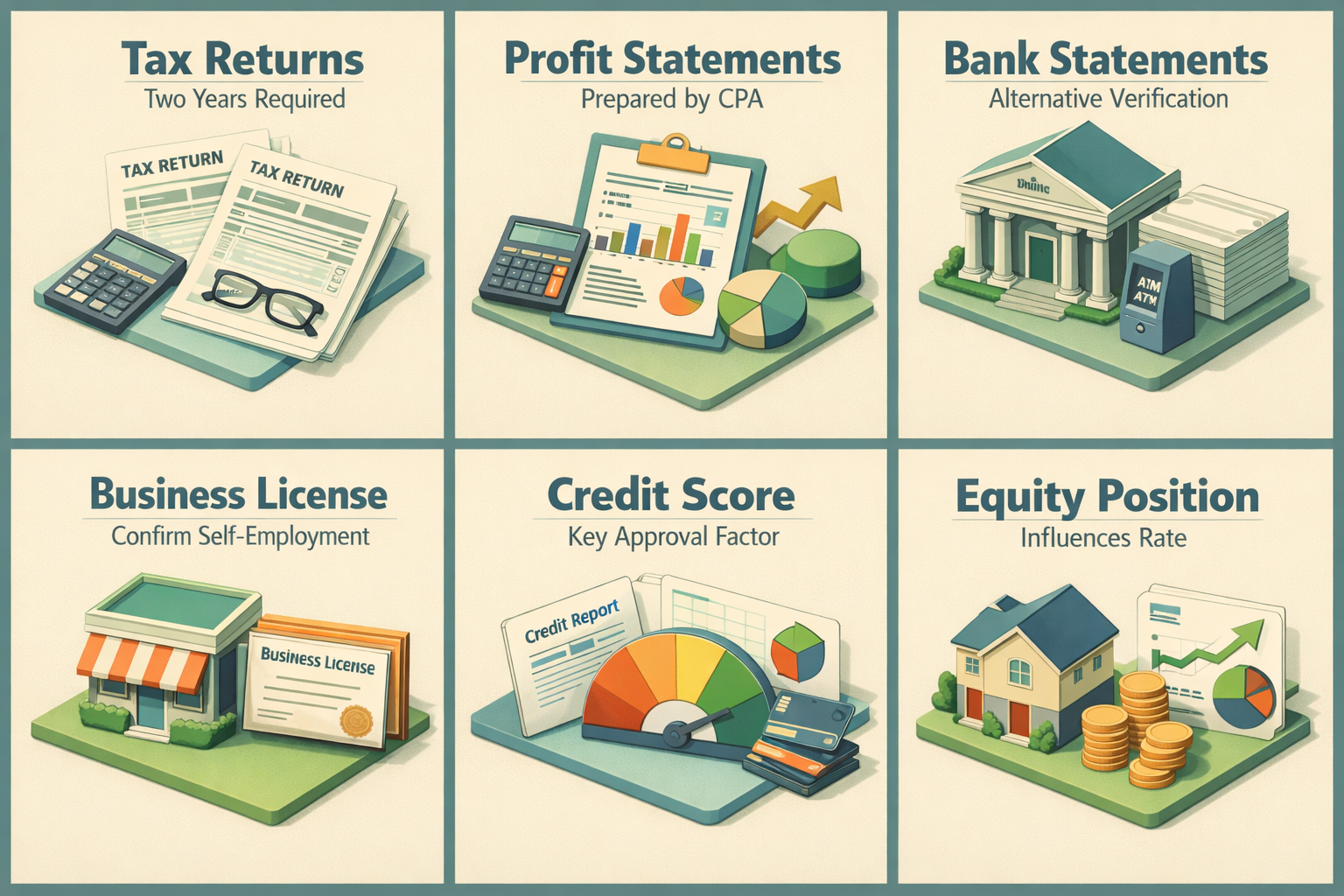
This is where the process can feel most challenging for self-employed homeowners. Traditional lenders typically use tax returns, profit and loss statements, and bank statements to verify income when you don't receive a regular paycheck. Because self-employed individuals often take advantage of legal deductions that reduce their taxable income, lenders may see a lower qualifying income than what you actually earn on a day-to-day basis.
Most conventional lenders will look at two years of personal and business tax returns. They'll calculate your average net income — factoring in business deductions — and use that figure to assess your debt-to-income (DTI) ratio. A lower net income on paper could result in a lower approved credit limit or a higher interest rate to offset perceived risk.
Some lenders offer bank statement programs or non-QM (non-qualified mortgage) products that allow self-employed borrowers to use 12 to 24 months of bank deposits as proof of income rather than tax returns. These programs can be a helpful alternative, though they may come with slightly higher rates or stricter equity requirements. It's worth exploring both conventional and non-QM options to see which works best for your situation.
- Two years of tax returns — the standard documentation most lenders require
- Profit and loss statements — often prepared by a CPA to reflect current business health
- Bank statements — used in alternative income verification programs
- Business license and CPA letter — may be requested to confirm self-employment status
Credit Score and Equity: Key Factors That Influence Your HELOC Rate
Regardless of employment type, your credit score plays a central role in determining what interest rate a lender will offer on a HELOC. Borrowers with higher credit scores — generally 740 and above — are more likely to qualify for the lowest available rates. Those with scores in the mid-600s may still qualify, but could face higher rates or tighter borrowing limits.
For self-employed borrowers, maintaining a strong personal credit profile is especially important because lenders may already view your income as less predictable. A solid credit history helps offset that perceived risk and could make a meaningful difference in the rate you're offered.
Your home equity position matters just as much. The more equity you have — meaning the greater the gap between your home's market value and your outstanding mortgage — the lower the lender's risk. Borrowers with significant equity may qualify for more favorable terms. Conversely, if your equity is slim, lenders may limit your credit line or charge a higher margin above the prime rate.
Other factors that can influence your HELOC rate include your DTI ratio, the lender's current market pricing, and whether you have an existing banking relationship with that institution. Some banks and credit unions offer rate discounts to existing customers or to those who enroll in automatic payments.
Understanding HELOC Interest Rates for Self-Employed Individuals: The Draw Period vs. Repayment Period
One of the most important structural elements of a HELOC is the distinction between the draw period and the repayment period — and how interest is calculated across both phases.
During the draw period, many HELOCs require only interest payments on the amount you've borrowed. This can keep your monthly obligations manageable, which is helpful when business cash flow is unpredictable. However, it's worth remembering that interest-only payments don't reduce your principal balance, meaning you'll owe the full amount borrowed once repayment begins.
When the repayment period kicks in — often lasting 10 to 20 years — payments shift to cover both principal and interest. Depending on how much you've drawn and what the prevailing rate is at that time, your payments could increase substantially. Self-employed borrowers should plan ahead for this transition and consider making voluntary principal payments during the draw period when income allows.
It's also worth noting that some HELOCs convert to a fixed rate during the repayment period, which can provide more payment stability. Others remain variable throughout. Be sure to ask your lender how the rate structure changes — if at all — once the repayment phase begins.
Practical Tips to Strengthen Your HELOC Application as a Self-Employed Homeowner
Preparation is everything when you're self-employed and seeking a HELOC. The more organized and transparent your financial documentation, the smoother the process tends to go. Here are several steps that could improve your approval odds and help you secure a more competitive rate.
- Reduce personal debt before applying: Lowering your DTI ratio — by paying down credit cards or other loans — may help you qualify for a higher credit limit and a better rate.
- Work with a CPA on your documentation: A certified public accountant can help prepare accurate profit and loss statements and ensure your tax returns present your income as clearly as possible to lenders.
- Boost your credit score: Review your credit reports for errors, pay bills on time, and keep credit card balances low in the months leading up to your application.
- Shop multiple lenders: Rates and terms can vary considerably from one institution to another. Comparing offers from banks, credit unions, and online lenders gives you a stronger negotiating position.
- Consider the timing: If interest rates are rising, you may want to act sooner rather than later, or explore whether a fixed-rate home equity loan better suits your needs.
- Explore non-QM lenders: If traditional documentation doesn't capture your true income, a non-QM lender using bank statement verification might offer a more favorable outcome.
Is a HELOC the Right Tool for Your Financial Goals?
A HELOC can be a versatile and cost-effective borrowing tool for self-employed homeowners — but it's not the right fit for every situation. If you need a large, one-time sum for a specific project and prefer a fixed monthly payment, a home equity loan might be a more suitable alternative. If your income is highly unpredictable, the variable nature of HELOC interest rates could introduce financial stress during periods of rising interest rates.
On the other hand, if you have ongoing, flexible funding needs — such as managing business cash flow, handling irregular expenses, or funding phased renovation projects — the revolving structure of a HELOC can be genuinely valuable. You only pay interest on what you actually draw, giving you control over your borrowing costs.
It's also important to remember that a HELOC is secured by your home. If you're unable to make payments, you risk foreclosure. This makes responsible borrowing and realistic repayment planning essential — particularly for self-employed borrowers whose income may not be perfectly steady.
Consulting with a mortgage professional who has experience working with self-employed clients can help you weigh your options objectively. They can review your financial profile, explain lender requirements, and guide you toward the product that aligns with your goals and risk tolerance.
●Conclusion
Understanding HELOC interest rates for self-employed individuals requires more than a quick glance at the prime rate. It means grasping how variable rates interact with your income patterns, how lenders assess self-employment documentation, and how your credit and equity position influence the terms you'll be offered. While the path to approval may involve a few extra steps compared to a salaried borrower, it's entirely achievable with the right preparation. At LoanWise, we work with homeowners at every stage of the borrowing journey — including those who work for themselves. If you're ready to explore your HELOC options, connect with one of our experienced mortgage advisors today.