
Buying a home is one of the most exciting milestones in life, but it can also come with its fair share of financial hurdles. For many aspiring homebuyers, partnering with a co-borrower is a smart way to strengthen a mortgage application. However, when that co-borrower carries deferred student loans, the path to FHA approval can get a little more complex. Understanding the requirements for FHA loan with co-borrower student loan deferment is essential before you begin the homebuying process. This guide walks you through what lenders look for, how deferred student debt is calculated, and what you can do to position yourself for success.
What Is an FHA Loan and Who Can Benefit from One
An FHA loan is a government-backed mortgage insured by the Federal Housing Administration. It's designed to make homeownership more accessible, particularly for first-time homebuyers, buyers with modest incomes, or those who haven't had the chance to build a large down payment. FHA loans typically allow lower credit scores and smaller down payments compared to conventional mortgage products.
Because of these flexible qualifying standards, FHA loans are a popular choice for buyers who might not qualify for a conventional loan on their own. That's also why many borrowers choose to apply with a co-borrower — someone who shares both the financial responsibility and the benefits of the mortgage. A co-borrower's income, assets, and credit history are all factored into the loan application, which can meaningfully improve the chances of approval.
It's worth noting that an FHA loan co-signer and a co-borrower are slightly different. A co-borrower has an ownership interest in the property, while a co-signer typically does not. FHA guidelines generally focus on co-borrowers, but both arrangements involve the inclusion of a second person's financial profile in the underwriting process.
How Deferred Student Loans Factor Into FHA Underwriting
One of the most important aspects of the requirements for FHA loan with co-borrower student loan deferment involves how lenders calculate the co-borrower's student debt obligations. Many borrowers assume that because a student loan is in deferment — meaning payments are temporarily paused — those loans won't count against them. Under FHA guidelines, however, that's generally not the case.
FHA loan rules typically require lenders to include deferred student loan payments in the co-borrower's debt-to-income (DTI) ratio, even if no payment is currently due. According to HUD guidelines, if the actual monthly payment is zero or cannot be documented, lenders are generally required to use a calculated payment amount — often based on a percentage of the outstanding loan balance — to represent the monthly obligation.
This approach can noticeably affect the co-borrower's DTI ratio. A higher DTI may reduce the loan amount you qualify for or, in some cases, affect overall loan eligibility. That's why it's so important to understand how your lender will handle deferred student debt calculations before submitting a full application.
The Standard Calculation Method for Deferred Student Debt
Under current FHA guidelines, when a co-borrower's student loan is in deferment and no monthly payment is reflected on the credit report, lenders may be required to calculate a hypothetical payment. This is typically done by using a set percentage of the total outstanding student loan balance. While the exact percentage can vary based on guideline updates, lenders commonly use figures such as 1% of the outstanding balance as a monthly estimate.
For example, if a co-borrower has $40,000 in deferred student loans, a lender might factor in a monthly obligation of approximately $400 when calculating DTI — even though no payments are currently being made. This hypothetical figure is then added to other monthly debt obligations to determine whether the borrower meets FHA's DTI requirements.
Debt-to-Income Ratio Requirements When a Co-Borrower Has Student Debt
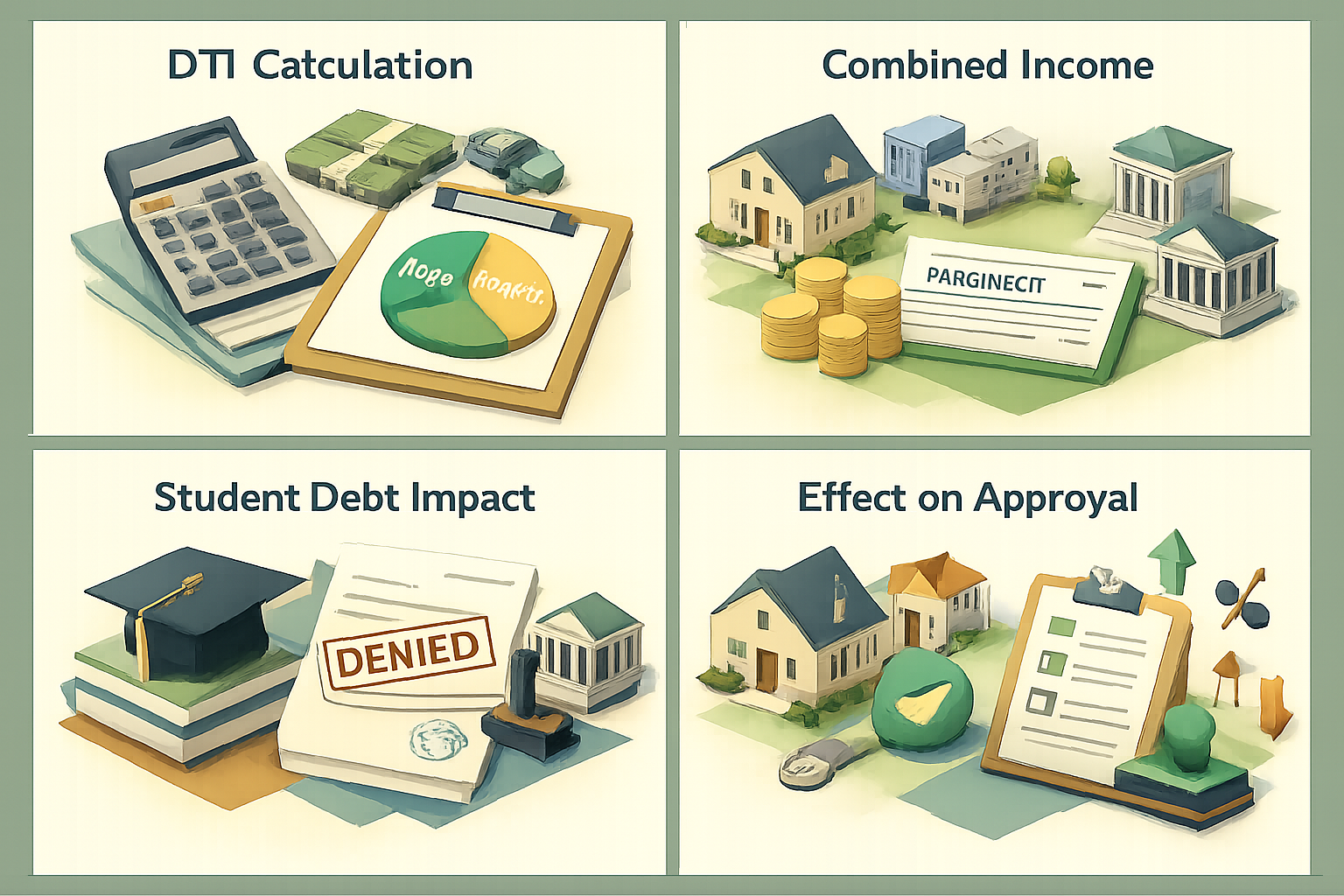
The debt-to-income ratio is one of the most critical factors in any mortgage application. FHA guidelines typically set a maximum DTI threshold, though lenders may have their own overlays that are stricter than FHA minimums. Generally speaking, FHA may allow a back-end DTI — which includes all monthly debt obligations divided by gross monthly income — of up to around 43% to 50% in some cases, depending on compensating factors.
When a co-borrower brings deferred student loans into the picture, those calculated payments are folded into the combined DTI. The good news is that combining incomes with a co-borrower can offset the impact of student debt. If the co-borrower earns a strong income, their contribution to gross monthly income may more than compensate for the added debt obligation that deferred student loans introduce.
Lenders will evaluate the combined financial profile of both borrowers, which includes:
- Combined gross monthly income from all sources
- All recurring monthly debts, including the estimated student loan payment
- The proposed new mortgage payment, including principal, interest, taxes, insurance, and MIP
- Credit scores for both borrowers, with the lower of the two often used for qualifying purposes
It's also important to note that FHA requires mortgage insurance premiums (MIP), which add to the monthly housing cost and must be included in the DTI calculation. Planning for this cost ahead of time can help both borrowers assess how much home they can realistically afford.
Credit Score and Employment Standards for Both Borrowers
FHA loans have relatively accessible credit score requirements compared to conventional mortgages. However, when a co-borrower is added to the application, lenders typically use the lower middle credit score of the two applicants as the qualifying score. This means that if the primary borrower has a strong credit profile but the co-borrower's score is lower, the weaker score may be the one that drives eligibility and interest rate pricing.
For most FHA-approved lenders, a minimum credit score of 580 may allow for the standard 3.5% down payment option. Scores between 500 and 579 might still qualify but could require a larger down payment — typically around 10%. Each lender may also apply their own overlays, so it's worth shopping around if one lender's requirements seem too strict.
Employment history matters as well. FHA guidelines generally look for a two-year employment history for both borrowers. If a co-borrower is a recent graduate who was a student during part of that two-year window, lenders may view the student enrollment as a continuation of their employment history — particularly if they've since entered the workforce in a field related to their degree. This is one area where lender flexibility and underwriter judgment can come into play.
What Lenders Look for in an FHA Loan Co-Signer or Co-Borrower
Whether you're using an FHA loan co-signer or a formal co-borrower, lenders want to see financial stability. Key qualities that lenders typically assess include a reliable income stream, manageable existing debts, a history of on-time payments, and sufficient assets for the down payment and reserves. Having a co-borrower who meets these criteria — even if they carry student debt — can still make a significant positive difference in the overall application.
Strategies to Improve Approval Odds When Student Debt Is in Deferment
If you or your co-borrower has deferred student loans, there are several approval strategies that may help strengthen your FHA application. None of these approaches is a guaranteed fix, but they can meaningfully improve your position when lenders review your file.
- Document the actual payment amount: In some cases, if you can provide written documentation from your loan servicer showing what the actual payment will be when deferment ends — and if that payment is lower than the calculated estimate — some lenders may use that figure instead. Always ask your lender about the key requirements for this option.
- Pay down other debts first: Reducing balances on credit cards or other installment loans before applying can lower your overall DTI, creating more room for the student loan payment to be absorbed without pushing you over the threshold.
- Increase the down payment: While this doesn't directly affect DTI, a larger down payment can strengthen your overall file and may help offset other risk factors in the eyes of the underwriter.
- Leverage the co-borrower's income strategically: If your co-borrower earns a significant income, make sure all income sources are fully documented. This includes part-time work, freelance income, rental income, or any other verifiable earnings.
- Consider refinancing student loans before applying: If a co-borrower's student loans are close to entering repayment, transitioning out of deferment and into an income-driven repayment plan might result in a lower monthly payment that lenders can document directly.
Timing can also play a role. If a co-borrower's deferment is set to expire soon and the resulting payment will be manageable, it may actually be advantageous to allow deferment to end and document the real payment before submitting a mortgage application.
Non-Occupant Co-Borrowers and FHA Eligibility Rules
One unique feature of FHA loans is their allowance for non-occupant co-borrowers. This means that a co-borrower doesn't necessarily have to live in the home being purchased. A parent, sibling, or other family member can co-borrow on an FHA loan to help a primary borrower qualify, even if that co-borrower won't reside in the property.
This flexibility is particularly valuable for young buyers who may have limited credit history or income but have family members willing to assist. However, FHA does impose certain conditions on non-occupant co-borrowers. For instance, the occupying borrower may still need to meet a minimum qualifying credit score on their own, and the property must be a primary residence for the occupying borrower.
When a non-occupant co-borrower has deferred student loans, the same debt calculation rules apply. Their student loan obligations will still be factored into the combined DTI, so it's important to review the full financial picture before proceeding. That said, if the non-occupant co-borrower brings substantial income to the table, their contribution can still be a net positive for the application — even with student debt in the mix.
It's also worth noting that FHA guidelines on non-occupant co-borrowers and student loan treatment can be updated periodically. Working with an experienced FHA-approved lender who stays current on HUD guidelines is one of the best ways to make sure you're working with accurate, up-to-date information.
●Conclusion
Navigating the requirements for FHA loan with co-borrower student loan deferment takes preparation, but it's absolutely achievable. By understanding how deferred student debt is calculated, how DTI ratios are evaluated, and how to use a co-borrower's strengths to your advantage, you can move toward homeownership with confidence. Whether you're working with an FHA loan co-signer or a formal co-borrower, the key is to approach the process informed and proactive. At LoanWise, our team is here to help you evaluate your options, understand your eligibility, and find the right path to the home you've been working toward. Reach out today to speak with a lending specialist who can guide you every step of the way.