
Navigating a mortgage application after a divorce can feel overwhelming — especially when your income comes from freelance work, contracting, or other self-employed sources reported on a 1099. Lenders need to assess your ability to repay a loan, and that assessment largely depends on your debt-to-income ratio, commonly called DTI. But when your financial picture includes divorce settlement income like alimony or child support and 1099 earnings, the calculation becomes more nuanced. Understanding how to calculate DTI with divorce settlement and 1099 income is a crucial first step toward securing the home financing you deserve.
What Is DTI and Why It Matters for Mortgage Qualification
Your debt-to-income ratio is one of the most important metrics lenders use when evaluating a mortgage application. Simply put, DTI measures the percentage of your gross monthly income that goes toward paying debts. Lenders use this figure to determine whether you can comfortably manage a new mortgage payment on top of your existing financial obligations.
There are typically two types of DTI that lenders evaluate:
- Front-end DTI: This compares your proposed housing costs — including principal, interest, taxes, and insurance — to your gross monthly income.
- Back-end DTI: This compares all of your monthly debt obligations, including the housing payment, car loans, student loans, credit card minimums, and any court-ordered payments, to your gross monthly income.
Most conventional loan programs prefer a back-end DTI at or below 43%, though some programs — including FHA loans — may allow higher ratios depending on compensating factors. The key formula is straightforward:
DTI = Total Monthly Debt Payments ÷ Gross Monthly Income × 100
However, when your income sources include 1099 income and divorce settlement payments, both the numerator and the denominator of that equation require careful attention.
How Lenders Count Divorce Settlement Income Like Alimony and Child Support
One of the most common questions divorcing homebuyers ask is whether settlement income — such as alimony or child support — counts as qualifying income for a mortgage. The short answer is: it often can, but lenders apply specific criteria before they'll include it in your DTI calculation.
Key Requirements for Using Settlement Income
For alimony or child support to be counted as qualifying income, lenders typically require all of the following:
- The income must be documented in a finalized divorce decree or separation agreement.
- The payments must have a proven history of being received — usually at least six to twelve months of consistent receipt.
- The payments must be expected to continue for a defined period, often at least three years from the loan closing date.
If these conditions are met, lenders may include the full monthly settlement amount in your gross monthly income figure, which can meaningfully improve your DTI ratio. It's worth noting that the income is counted before taxes since it's reported as gross income — though how alimony is treated for tax purposes has changed under recent federal tax law and may affect your overall financial planning.
When Settlement Payments Are a Debt, Not Income
It's also important to understand the flip side: if you are the one paying alimony or child support rather than receiving it, those payments are treated as monthly debt obligations and increase your total monthly debt load. This raises your DTI and could reduce the loan amount you qualify for a mortgage. Lenders will look at your divorce decree to confirm the required payment amounts and their expected duration.
Understanding How 1099 Income Is Evaluated in Mortgage Lending
Self-employed borrowers, freelancers, and independent contractors who receive 1099 income face a different income verification process than W-2 employees. Rather than relying on pay stubs, lenders typically look at your tax returns — usually the two most recent years — to determine your average monthly income.
How Lenders Calculate 1099 Income
For 1099 earners, lenders generally use your net income after business expenses as reported on your federal tax returns, not the total amount received. This is an important distinction. If you earned $90,000 in gross 1099 income but claimed $30,000 in business deductions, the lender may base your qualifying income on $60,000 annually — or $5,000 per month.
The two-year average is common practice. Lenders add your net self-employment income from both years and divide by 24 months. However, if your income has been declining year over year, some lenders may use only the lower of the two years as a conservative measure. Conversely, if income is rising consistently, there may be some flexibility depending on the loan program and lender guidelines.
Documents You'll Likely Need
- Two years of personal federal tax returns (Form 1040)
- Two years of business returns if applicable (Schedule C, Partnership, or S-Corp returns)
- Year-to-date profit and loss statement prepared by a CPA
- 1099 forms from clients or payers
- Bank statements to confirm consistent deposits
Some lenders offer bank statement loan programs — often categorized as Non-QM or non-qualified mortgage products — that allow 1099 earners to use 12 or 24 months of bank deposits to verify income instead of tax returns. This could be especially useful if your tax deductions significantly reduce your reportable net income.
How to Calculate DTI With Divorce Settlement and 1099 Income Step by Step
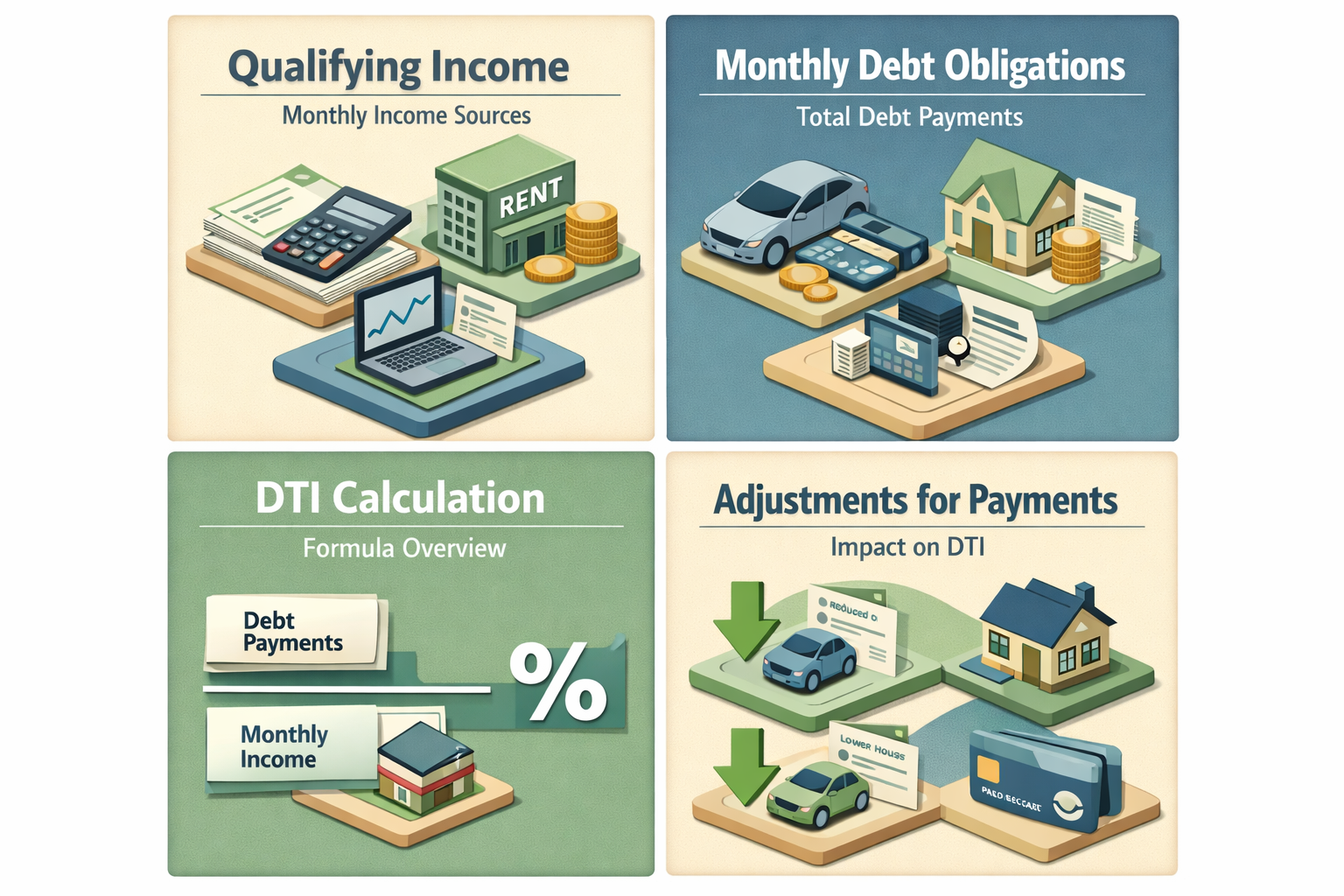
Now that we understand how each income type is evaluated, let's walk through a practical example of how to calculate DTI with divorce settlement and 1099 income together. This step-by-step process mirrors what a lender's underwriter would typically do.
Step 1: Determine Your Qualifying Monthly Income
Start by identifying all income sources the lender will count:
- 1099 Net Income: Add your net self-employment income from the past two tax years and divide by 24. For example, if you had $48,000 net in Year 1 and $60,000 net in Year 2, your average monthly qualifying income from 1099 sources would be ($48,000 + $60,000) ÷ 24 = $4,500/month.
- Alimony or Child Support Received: If you receive $1,200 per month in court-ordered alimony and meet the continuance and documentation requirements, add that amount. Total monthly income: $4,500 + $1,200 = $5,700/month.
Step 2: Add Up All Monthly Debt Obligations
List every required monthly debt payment the lender will count:
- Proposed mortgage payment (principal, interest, taxes, insurance, HOA if applicable): $1,600
- Auto loan payment: $350
- Student loan minimum payment: $200
- Credit card minimum payments: $150
- Total monthly debts: $2,300
Step 3: Apply the DTI Formula
Divide total monthly debts by gross monthly income: $2,300 ÷ $5,700 = approximately 40.4% DTI. In this example, the borrower's back-end DTI falls within the range many lenders consider acceptable, particularly for conventional or FHA loan programs.
Step 4: Adjust for Any Payments You Make
If you pay child support or alimony rather than receive it, add those amounts to your debt column rather than your income column. For example, if the borrower above paid $500/month in child support instead, monthly debts would rise to $2,800, pushing DTI to roughly 49% — a figure that might require compensating factors or a different loan program.
DTI Calculation Divorce Income Split: When Both Parties Are on the Loan
A DTI calculation divorce income split situation can arise when a former spouse is still listed on a joint mortgage after separation. This is a common and often complicated scenario. If you're applying for a new mortgage while your name remains on the old marital home loan, lenders will typically count that existing mortgage payment as part of your monthly debt obligations — even if your ex-spouse is the one making the payments.
There are a few ways this issue is commonly addressed:
- Divorce decree assignment: Some lenders may exclude the existing mortgage from your DTI if the divorce decree clearly assigns responsibility for that property to the other spouse and there's documented evidence of at least 12 months of on-time payments made exclusively by that spouse.
- Refinancing the existing loan: If the former marital home is refinanced solely into your ex-spouse's name, your liability is removed and the old mortgage payment won't appear on your DTI calculation.
- Quitclaim deed plus assumption: In some cases, a combination of removing your name from the title and assuming full responsibility may be required, though lender requirements vary.
It's worth speaking with a mortgage professional early in the process if you're in this situation. The sooner you understand how your existing obligations will be counted — or excluded — the more strategically you can plan your new home purchase or refinance.
Strategies to Improve Your DTI Before Applying for a Mortgage
If your DTI comes out higher than you'd like after combining your 1099 income and divorce settlement figures, there are several steps you might consider to strengthen your application before approaching a lender.
Increase Your Qualifying Income
- If you've recently grown your freelance or contract business, a year-to-date profit and loss statement verified by a CPA may help some lenders recognize your current earning trajectory.
- Ensure all qualifying settlement income is thoroughly documented with court-approved orders and consistent bank deposit records.
- Consider whether a bank statement loan program might capture more of your actual income than your tax returns reflect after deductions.
Reduce Monthly Debt Obligations
- Pay down or pay off revolving credit card balances before applying, as minimum monthly payments raise your back-end DTI.
- Avoid taking on new installment debt — such as a car loan — in the months leading up to your mortgage application.
- If possible, pay off smaller loan balances entirely to eliminate those monthly obligations from the calculation.
Choose the Right Loan Program
Not every loan program has the same DTI thresholds. FHA loans, for example, may allow higher DTI ratios with sufficient compensating factors such as strong reserves, a larger down payment, or excellent credit. Non-QM programs specifically designed for self-employed borrowers might also provide more flexibility in how 1099 income is measured. Working with a lender who understands non-traditional income structures could make a significant difference in your outcome.
Working With a Lender Who Understands Non-Traditional Income Profiles
Not all mortgage lenders are equally equipped to handle the complexities of 1099 income and divorce settlement documentation. Some lenders specialize in working with self-employed borrowers and individuals navigating major life transitions like divorce, and choosing the right lending partner can make a meaningful difference in your experience and outcome.
When shopping for a lender, consider asking the following questions:
- Do you offer bank statement loan programs for 1099 or self-employed borrowers?
- How do you handle divorce decree income for qualifying purposes?
- What compensating factors might help offset a higher DTI in my situation?
- Which loan programs — conventional, FHA, Non-QM — best fit my income profile?
It's also helpful to get pre-qualified or pre-approved before actively house hunting. A pre-approval letter based on your actual income documentation — including 1099 records and your divorce settlement agreement — gives you a realistic picture of your purchasing power and signals to sellers that you're a serious buyer.
At LoanWise, we understand that your financial story is unique. Our team is experienced in helping borrowers with diverse income sources, including those recovering from or transitioning through divorce, find loan solutions that fit their real lives — not just their W-2s.
●Conclusion
Understanding how to calculate DTI with divorce settlement and 1099 income is genuinely empowering. Once you know how lenders evaluate each income source, count court-ordered payments, and apply the DTI formula, you can make informed decisions and take meaningful steps to improve your mortgage readiness. Whether you're purchasing your first post-divorce home, refinancing to remove a former spouse from a joint loan, or simply planning your next financial chapter, a clear understanding of your DTI puts you in the driver's seat. Connect with a LoanWise mortgage specialist today and get the personalized guidance you need to move forward with confidence.