
Buying a condominium can be an exciting step toward homeownership — especially for first-time buyers looking for an affordable entry point into the real estate market. FHA loans are often a popular choice because they offer lower down payment requirements and more flexible credit standards. However, when it comes to condos, there's a bit more complexity involved. Understanding FHA loan limits for condos with high HOA fees is essential before you start shopping, because both the loan ceiling and monthly association dues can significantly affect what you can afford and whether a property even qualifies. This guide breaks it all down so you can move forward with confidence.
How FHA Loan Limits Work for Condo Purchases
FHA loan limits are the maximum dollar amounts the Federal Housing Administration will insure for a given loan in a specific area. These limits are set annually by the U.S. Department of Housing and Urban Development (HUD) and vary by county or metropolitan area based on local home prices.
For condominiums, the same county-level loan limits that apply to single-family homes generally apply. The key distinction is that the FHA has its own layer of eligibility requirements that apply specifically to condo projects — not just individual units. So even if a condo's purchase price falls within the local loan limit, the project itself must also meet HUD's standards before FHA financing can be used.
In high-cost areas, FHA loan limits may reach a significantly higher ceiling, sometimes referred to as the "ceiling limit" for that region. In lower-cost areas, the floor limit applies. Buyers should check the current HUD loan limits for their target county to understand exactly how much FHA financing they may be able to access for a condo purchase.
- Floor limits apply in lower-cost housing markets across the country.
- Ceiling limits apply in high-cost areas like major metropolitan regions.
- Limits are updated annually and may increase or decrease based on median home prices.
What Are FHA Condo Approval Requirements?
One of the most important things to understand when financing a condo with an FHA loan is that the entire condominium project — not just the unit you want to buy — must be approved by HUD. This process is known as FHA condo project approval, and it can be a deciding factor in whether your purchase moves forward.
The FHA condo approval requirements cover a range of factors that speak to the financial and physical health of the condo community. HUD evaluates these requirements to determine whether the project presents an acceptable level of risk for FHA-insured financing.
Key Project-Level Requirements to Know
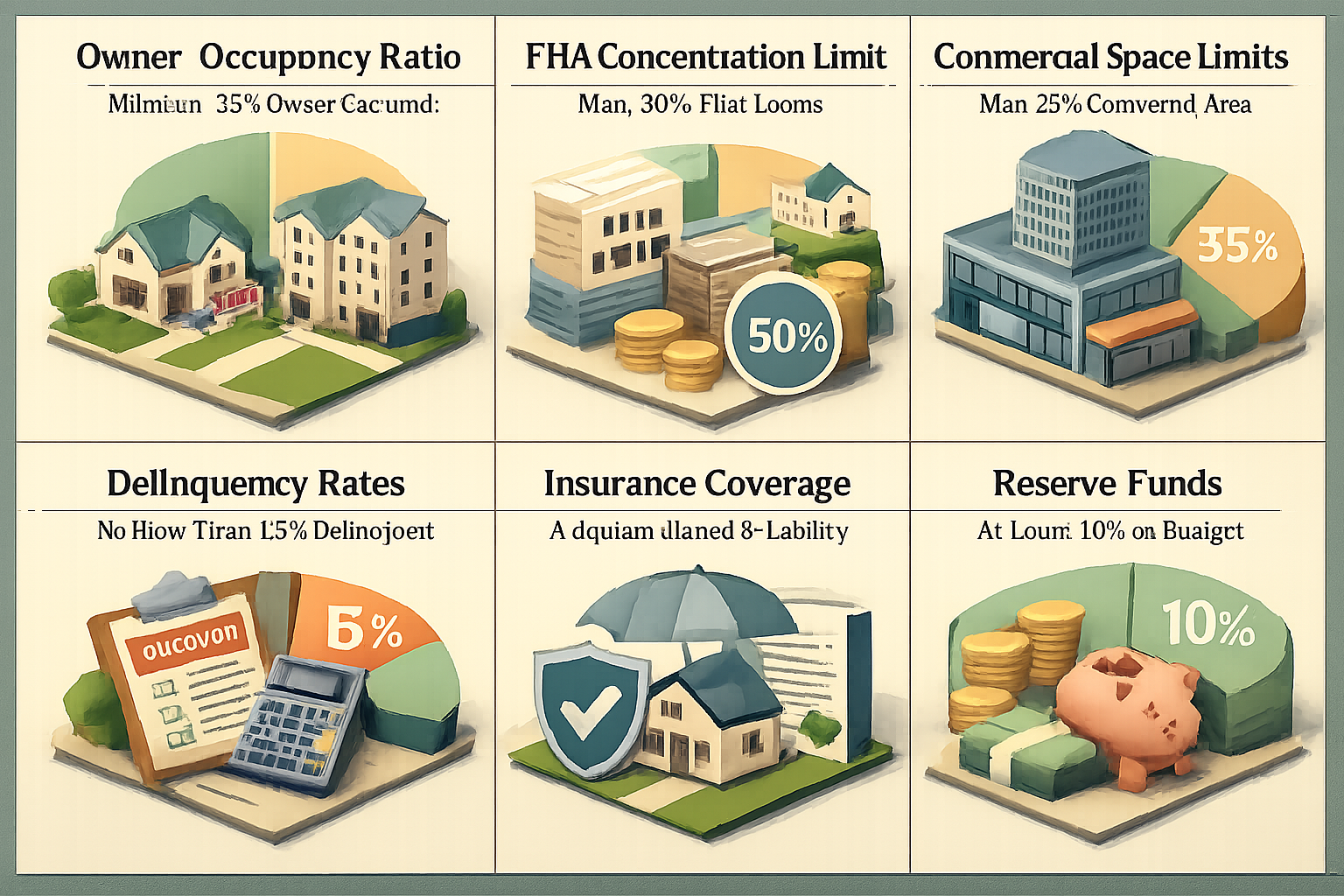
- Owner-occupancy ratio: HUD generally requires that at least 50% of the units in a project be owner-occupied, not rented out. This helps ensure the community is primarily residential rather than investor-driven.
- FHA concentration limit: In most cases, no more than 50% of units in a project may be financed with FHA loans. This prevents overexposure of FHA risk within a single development.
- Commercial space limits: Projects with excessive commercial space may not qualify. Typically, no more than 35% of the total floor area may be used for commercial purposes, though exceptions may apply.
- Delinquency rates: If more than 15% of unit owners are behind on HOA dues, the project may not be eligible for FHA approval.
- Insurance coverage: The HOA must carry adequate hazard, liability, and — where required — flood insurance coverage.
- Reserve funds: The condo association must maintain sufficient reserve funds, typically at least 10% of the annual budget, to cover future repairs and maintenance.
Additionally, since 2019, FHA has offered a "single-unit approval" pathway, also known as spot approval, which allows individual condo units in non-FHA-approved projects to potentially qualify for FHA financing. This has opened up more options for buyers, though not every unit or project will meet the criteria for this route.
How High HOA Fees Affect Your FHA Loan Eligibility
HOA fees are a regular monthly expense that every condo buyer must account for — and they can have a meaningful impact on your ability to qualify for an FHA loan. Here's why: FHA lenders use a debt-to-income (DTI) ratio to evaluate whether a borrower can comfortably manage their monthly obligations. When HOA fees are high, they get factored into this calculation alongside your mortgage payment, property taxes, and insurance.
Specifically, HOA dues are typically included in what's called your housing expense ratio — the portion of your gross monthly income that goes toward housing costs. FHA guidelines generally require this ratio to stay at or below 31%, though lenders may allow slightly higher ratios in certain cases with compensating factors like strong credit scores or significant cash reserves.
A Practical Example to Consider
Imagine you're buying a condo priced at $300,000 with a 3.5% down payment. Your base mortgage payment — including principal, interest, mortgage insurance premium, and property taxes — might come to around $2,000 per month. If the building's HOA fees are $600 per month, your total housing cost rises to $2,600. On a gross monthly income of $7,000, that's a housing ratio of roughly 37%, which could push you outside standard FHA thresholds.
In this scenario, you might need a higher income, a larger down payment to reduce the mortgage payment, or a condo with lower monthly fees to qualify. This is why understanding FHA loan limits for condos with high HOA fees goes hand in hand with understanding how lenders calculate your overall affordability.
Checking the HUD Approved Condo List Before You Make an Offer
Before you fall in love with a particular condo, it's smart to verify whether the project is already on HUD's approved condo list. HUD maintains a searchable online database — the FHA-Approved Condominium Projects list — where buyers and their agents can confirm a project's approval status.
A project can appear in one of several statuses: approved, rejected, withdrawn, or expired. An expired approval doesn't necessarily mean the project is disqualified permanently, but the HOA would need to reapply and receive renewed approval before FHA financing could be used. This process can take time, so it's worth checking early in your home search.
What to Do If a Project Isn't Approved
- Ask the HOA to apply: Some associations may be willing to pursue FHA approval, especially if it helps more buyers qualify for financing and potentially boosts unit values.
- Explore the single-unit approval option: As mentioned, this pathway may allow FHA financing even in non-approved projects, provided the unit and project meet specific criteria.
- Consider alternative loan programs: If FHA approval isn't available, conventional loans, VA loans (if you're eligible), or other financing options might still work for your situation.
Working with a knowledgeable mortgage professional who understands condo financing can make a big difference at this stage. They can help you quickly assess a project's eligibility and identify alternative paths if FHA isn't available.
Financial Health of the HOA: Why It Matters to FHA Lenders
FHA lenders and HUD don't just look at your financial profile — they also scrutinize the financial health of the homeowners association itself. An HOA that's poorly managed or financially stressed can put the entire community at risk, and that risk flows through to the lender's investment.
When evaluating a condo project for FHA eligibility, lenders may review the HOA's budget documents, reserve study, and meeting minutes. They want to see that the association is collecting dues effectively, maintaining adequate reserves, and making informed decisions about major repairs and capital improvements.
High HOA fees aren't automatically a red flag — in fact, they may indicate a well-funded association that properly maintains the property. The concern arises when high fees are accompanied by low reserves, deferred maintenance, or a high rate of delinquent payments from unit owners. These conditions can signal financial instability and may disqualify a project from FHA approval.
- Review the HOA's most recent budget and reserve fund balance before making an offer.
- Ask for the last 12 months of HOA meeting minutes to spot any major disputes or deferred projects.
- Confirm that the HOA delinquency rate is below HUD's 15% threshold.
Tips for Buyers Navigating FHA Condo Financing
Successfully financing a condo with an FHA loan requires a bit more preparation than a standard single-family home purchase. The good news is that with the right approach, many buyers do qualify — and condo living can offer an affordable, low-maintenance path to homeownership. Here are some practical tips to help you navigate the process:
- Start your search with approved projects: Use HUD's online condo search tool early in your home-buying journey to focus on eligible communities and avoid wasted time.
- Understand the full monthly cost: When calculating affordability, always include HOA fees, special assessments, and any projected fee increases in your budget.
- Strengthen your borrower profile: A higher credit score, larger down payment, or lower existing debt can provide more flexibility when HOA fees push your DTI ratio higher.
- Work with an FHA-experienced lender: Not all lenders are equally familiar with FHA condo approval requirements. Choose one who can guide you through both the borrower qualification and the project approval process.
- Get pre-approved before shopping: Pre-approval gives you a clear picture of your purchasing power and signals to sellers that you're a serious buyer.
- Consult a real estate agent familiar with condos: An experienced agent can help you evaluate HOA documents and flag potential issues before you make an offer.
Being proactive and informed can significantly reduce surprises during the closing process. The more you know about understanding FHA loan limits for condos with high HOA fees, the better positioned you'll be to find a property that truly fits your financial situation.
●Conclusion
Financing a condominium with an FHA loan is absolutely possible — but it does require a thorough understanding of both the loan program's boundaries and the property-level requirements that come with it. From verifying project approval status to factoring HOA fees into your monthly budget, each step plays an important role in ensuring a smooth purchase experience. If you're a first-time buyer or a homeowner looking to downsize into a condo, taking the time to learn these details could save you from costly setbacks down the road. LoanWise is here to help you explore your options and connect with lending professionals who specialize in FHA condo financing. Reach out today and take the next step toward owning the condo that fits your life and your budget.