
Co-housing communities are growing in popularity across the United States. These neighborhoods are designed around shared values, collaborative living, and communal spaces — from shared kitchens and gardens to common recreational areas and laundry facilities. For many prospective homebuyers, the appeal is clear: a stronger sense of community, reduced living costs, and a more sustainable lifestyle. But when it comes to financing one of these unique properties, questions often arise. Specifically, understanding FHA loan limits for co-housing communities with shared amenities is something that many buyers, real estate agents, and even lenders find confusing. This guide breaks it all down in plain language so you can approach the process with confidence.
What Is Co-Housing and Why Does It Matter for FHA Financing
Co-housing is a type of intentional community where residents own or rent individual private homes but share ownership or access to common spaces and amenities. These developments typically feature private dwelling units alongside communal areas such as shared dining halls, outdoor spaces, workshops, childcare facilities, or fitness rooms. The community is often self-managed by the residents themselves.
From a financing standpoint, co-housing communities occupy a somewhat unique position. They don't always fit neatly into the categories that mortgage programs — including FHA loans — were originally designed for. The presence of shared amenities, homeowner associations, or cooperative ownership structures can all affect how a lender and the Federal Housing Administration evaluate a property for loan eligibility.
Because FHA loans are among the most accessible mortgage options available — often requiring as little as 3.5% down for qualified borrowers — understanding how they apply to co-housing is especially important for first-time homebuyers and those with moderate credit scores. The rules around shared living FHA financing are worth examining carefully before you fall in love with a particular community.
How FHA Loan Limits Are Determined Across Different Markets
FHA loan limits are set annually by the U.S. Department of Housing and Urban Development (HUD) and vary by county and metropolitan statistical area. The limits are tied to local median home prices and are adjusted each year to reflect changes in the housing market. In general, there are two key thresholds: the "floor" for lower-cost areas and the "ceiling" for high-cost markets.
For a single-family home in most parts of the country, the FHA loan limit floor has historically been a fraction of the conforming loan limit set by the Federal Housing Finance Agency. In high-cost areas — such as parts of California, New York, Hawaii, and other expensive metros — the ceiling limit is significantly higher. These limits apply per unit, which becomes relevant when you're looking at co-housing projects that may include multiple dwelling units on a shared parcel.
It's worth noting that FHA loan limits are not a one-size-fits-all figure. If you're purchasing a unit in a co-housing community located in a high-cost county, you may qualify for a higher loan amount than someone purchasing a similar unit in a lower-cost rural area. Always verify the current limits for your specific county through HUD's official resources or by consulting with an FHA-approved lender.
FHA Property Eligibility Rules That Apply to Shared Living Arrangements
One of the most important factors in FHA loan co-housing financing is whether the property itself meets FHA's eligibility standards. FHA has specific guidelines about what types of properties it will insure, and co-housing communities can sometimes present complications in this area.
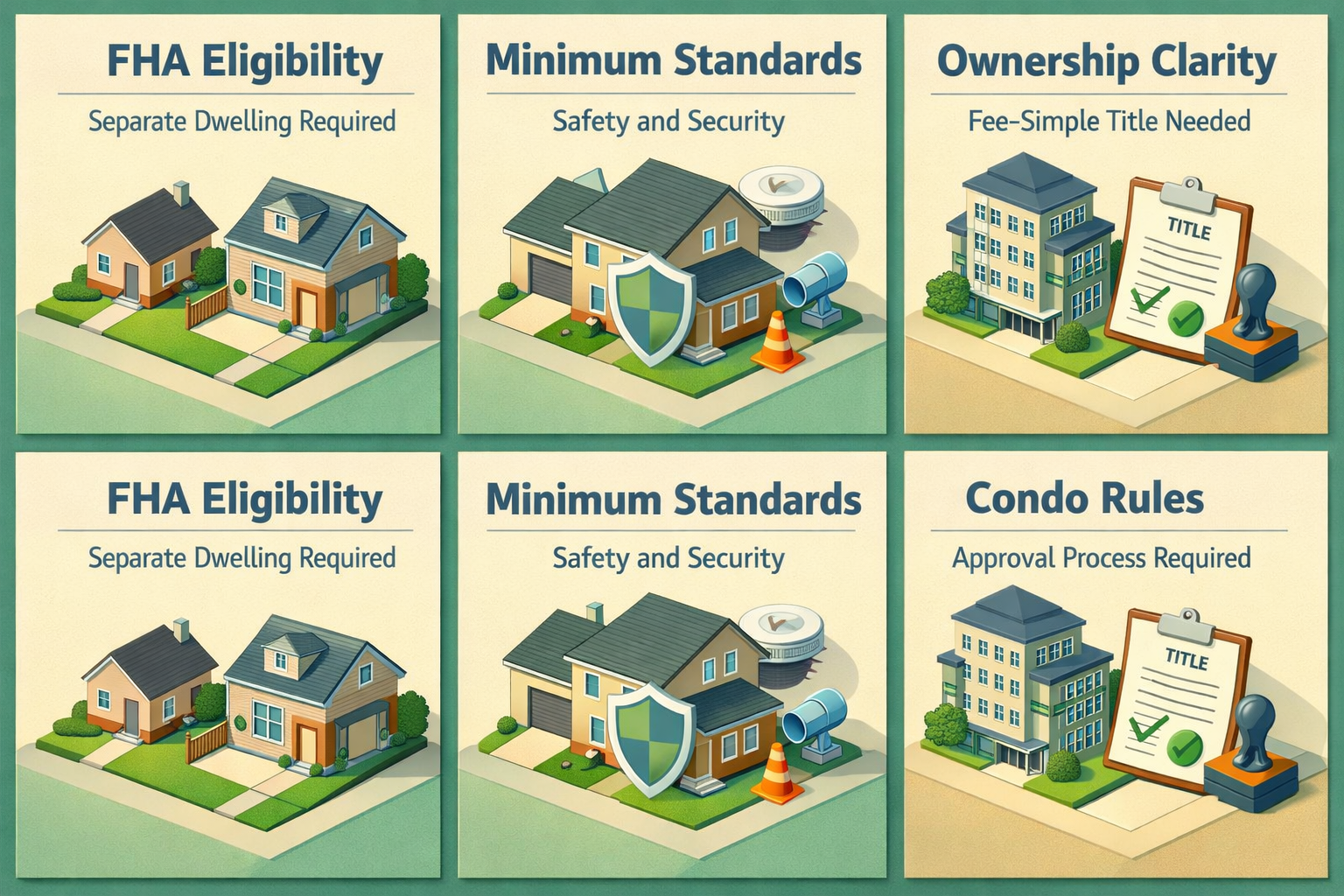
For a property to be FHA-eligible, it typically must meet the following general criteria:
- The unit must be clearly defined as a separate dwelling. FHA financing generally requires that the home being purchased is a distinct, livable unit with its own kitchen, bathroom, and sleeping area — even if communal spaces are shared.
- The property must meet FHA's Minimum Property Standards (MPS). These standards address safety, security, and soundness. A co-housing unit that shares walls or utilities with other units must still meet these baseline requirements.
- Ownership must be clearly established. FHA loans are typically available for properties where the borrower holds fee-simple title or a long-term leasehold interest. Cooperative ownership structures, common in some co-housing models, may not be eligible for standard FHA financing.
- Condo rules may apply. If the co-housing development functions similarly to a condominium — with shared ownership of common areas — then FHA's condo approval process may be required.
These nuances highlight why working with a lender who has experience in community housing FHA limits and specialty property types is so valuable. Not every lender is familiar with the specific documentation and analysis needed to evaluate a co-housing unit properly.
Condominium Approval and Its Relevance to Co-Housing Communities
Many co-housing communities are legally structured as condominium projects. In these cases, FHA's condominium approval rules come directly into play. FHA requires that condominium projects be approved before individual units within them can be financed with an FHA loan. This approval process — known as project approval — involves a review of the homeowners association's financial health, the percentage of owner-occupants versus renters, insurance coverage, and other factors.
There are two main pathways for FHA condo approval: full project approval and single-unit approval (also called spot approval). Single-unit approval allows a buyer to use FHA financing on a unit in an unapproved project, provided that certain conditions are met — including that the project meets a minimum owner-occupancy threshold and is not commercially dominated.
For co-housing communities, this is a significant consideration. Many of these communities have a strong owner-occupant base, which could work in their favor for single-unit approval. However, if the community has an unusual ownership structure or a high number of investor-owned units, it might face challenges meeting FHA's requirements. Buyers interested in using FHA financing for a co-housing unit should inquire early about whether the project is already FHA-approved or whether single-unit approval might be an option.
Understanding FHA Loan Limits for Co-Housing Communities with Shared Amenities in Practice
When you apply the concept of FHA loan limits to a co-housing purchase, a few practical realities emerge. First, the loan limit applies to the individual unit being financed — not to the total value of the shared property or the entire community's real estate holdings. If you're purchasing a standalone cottage within a co-housing community, the FHA loan limit for that unit in your county is what matters.
Second, shared amenities — such as a common house, workshop, or communal garden — may affect how an appraiser values the individual unit. FHA appraisers must assess the fair market value of the property being purchased, and the presence of high-quality shared amenities could either add value to the unit or complicate the appraisal if there are few comparable sales in the area. Co-housing communities are still relatively rare in many markets, which can make finding accurate comparable sales more challenging.
Third, the way shared costs are structured in a co-housing community matters. Homeowners association (HOA) dues that cover maintenance of shared spaces are generally acceptable under FHA guidelines, but buyers should be aware that high HOA fees may affect their debt-to-income ratio calculations — which in turn could affect how much they're approved to borrow.
These layered considerations make it clear that understanding FHA loan limits for co-housing communities with shared amenities isn't just about knowing a dollar figure. It involves understanding property structure, appraisal methodology, HOA compliance, and FHA's broader underwriting framework.
Tips for Homebuyers Seeking FHA Financing in a Co-Housing Community
If you're drawn to the co-housing lifestyle and want to use an FHA loan to make your purchase, there are several proactive steps you can take to improve your chances of a smooth financing experience.
- Start with an FHA-experienced lender. Not every mortgage lender handles co-housing or non-traditional property types regularly. Seek out an FHA-approved lender who has worked with community housing projects or specialty properties before.
- Request community documentation early. Get copies of the co-housing community's governing documents, HOA financials, meeting minutes, and any existing FHA or lender approval status. Lenders will need this information during underwriting.
- Check the FHA loan limit for your county. Visit HUD's website or ask your lender to confirm the current FHA loan ceiling for the area where the community is located. Make sure the purchase price of the unit falls within those limits.
- Understand the ownership structure. Ask whether the community is structured as a condominium, a planned unit development (PUD), a cooperative, or fee-simple ownership. This structure determines which FHA guidelines apply.
- Prepare your finances. FHA loans generally require a minimum credit score of 580 for the 3.5% down payment option, though individual lenders may set higher minimums. Strong financial preparation strengthens your application regardless of property type.
- Consider an FHA appraisal challenge. If comparable sales are scarce in your area, discuss with your lender how the appraiser might handle valuation. In some cases, the appraiser may need to look at broader geographic areas to find relevant comps.
Alternative Financing Options If FHA Doesn't Fit Your Co-Housing Purchase
FHA financing may not always be the right fit for every co-housing purchase. In some cases — particularly when the community has an unconventional ownership structure or hasn't obtained FHA project approval — you may need to explore other mortgage options.
Conventional loans backed by Fannie Mae or Freddie Mac may offer more flexibility in some situations, particularly for buyers with strong credit and a larger down payment. Fannie Mae and Freddie Mac have their own condo and PUD approval guidelines, which differ from FHA's and may be more accommodating in certain co-housing scenarios.
For cooperative co-housing models, some lenders offer co-op loans — though these are far less common and may come with higher rates or stricter terms. Credit unions and community banks may also be worth exploring, as they sometimes have portfolio loan products that allow them to underwrite non-traditional properties based on their own internal standards rather than secondary market guidelines.
If you're a real estate investor rather than an owner-occupant, FHA financing won't be available regardless of property type, since FHA loans are reserved for primary residences. In that case, conventional investment property loans or commercial financing might be more appropriate paths to explore.
●Conclusion
Co-housing communities offer a compelling vision of modern living — one built around connection, sustainability, and shared purpose. But financing these communities requires a thoughtful approach, especially when it comes to government-backed loans. Understanding FHA loan limits for co-housing communities with shared amenities means going beyond the loan dollar amount and grasping the full picture: property eligibility, ownership structure, appraisal challenges, and HOA compliance. The good news is that with the right guidance and a qualified lender by your side, FHA financing can be a viable path into the co-housing lifestyle. At LoanWise, we're here to help you navigate every step of that journey. Reach out today to speak with a lending specialist who can evaluate your specific situation and help you find the financing solution that fits.