
Buying a property that generates rental income while you live in one of the units is one of the smartest moves a homebuyer can make. FHA loans make this strategy more accessible than many people realize. However, before you start touring duplexes and fourplexes, it's important to understand how the program works — especially when it comes to borrowing caps. Understanding FHA loan limits for a multi-family property purchase is the first step toward making a confident and well-informed decision. In this guide, we'll walk you through what those limits are, why they differ across the country, and what you'll need to qualify.
What Makes FHA Loans a Strong Fit for Multi-Family Properties
FHA loans are backed by the Federal Housing Administration and are designed to help borrowers who might not qualify for conventional financing. They're known for their relatively low down payment requirements — often as low as 3.5% for eligible borrowers — and their more flexible credit standards. But what many homebuyers don't immediately realize is that FHA loans can be used to purchase properties with up to four units, not just single-family homes.
This opens the door to a strategy known as house hacking, where you live in one unit and rent out the others. The rental income from those other units may even help you qualify for a larger loan by offsetting your monthly housing costs in the lender's calculation. It's a genuine opportunity to build wealth and reduce your own living expenses at the same time.
That said, there are rules. The most important one is that you must occupy one of the units as your primary residence. This is non-negotiable with FHA financing. Investors who want to purchase a multi-family property without living there will need to explore other loan types, such as conventional investment property loans or commercial financing.
How FHA Multi-Family Property Loan Limits Are Set
The FHA does not set one universal loan limit for every property in the country. Instead, FHA multi-family property loan limits are determined at the county level, and they vary significantly depending on where the property is located. The Department of Housing and Urban Development (HUD) updates these limits annually, typically based on changes in local median home prices and national conforming loan limit adjustments.
There are two key thresholds to understand: the floor and the ceiling. The floor represents the minimum loan limit applied in lower-cost areas of the country. The ceiling represents the maximum allowed in the most expensive housing markets. In high-cost areas — such as parts of California, New York, Hawaii, and the Pacific Northwest — the limits can be substantially higher than in rural or mid-tier markets.
Importantly, these limits also scale based on the number of units in the property. A duplex (two units) will have a higher loan limit than a single-family home. A triplex (three units) will have an even higher limit, and a fourplex (four units) will have the highest allowable limit under the FHA program. This tiered structure reflects the fact that larger properties typically cost more and can generate more rental income.
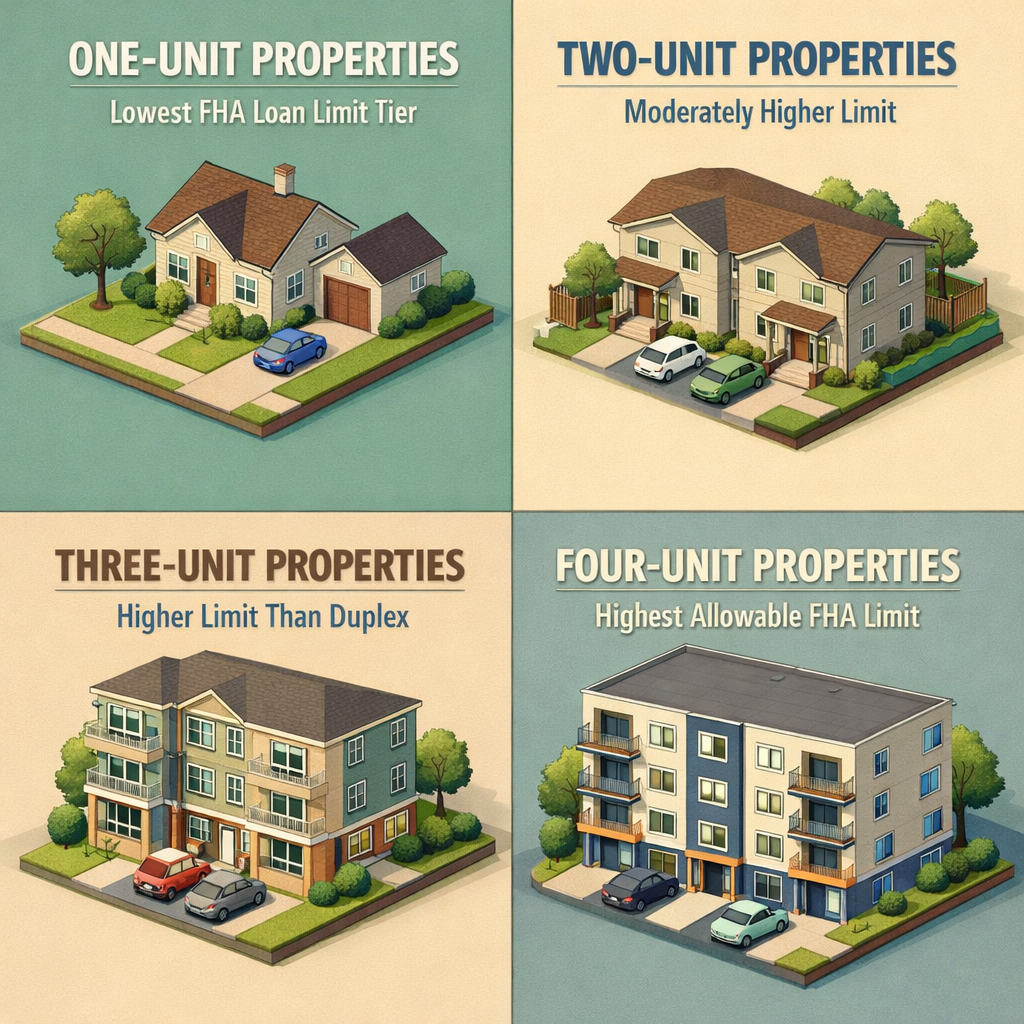
- One-unit properties: Lowest FHA loan limit tier
- Two-unit properties (duplex): Moderately higher limit
- Three-unit properties (triplex): Higher limit than duplex
- Four-unit properties (fourplex): Highest allowable FHA limit
To find the specific limits for a property you're considering, you can look up the current FHA loan limits by county through the HUD website or speak with an FHA-approved lender who can pull this information for your target area.
Why Location Plays Such a Critical Role in Your Borrowing Power
Because FHA loan limits are tied to local housing costs, where you choose to buy can have a major impact on how much financing you can access. In high-cost metropolitan areas, the FHA ceiling limits may allow you to finance a sizeable multi-family property with a relatively low down payment. In contrast, in more affordable rural markets, the floor limits might cap your borrowing at a level that still works well for properties priced in line with the local market.
This county-by-county approach actually makes a lot of sense. A fourplex in San Francisco simply costs far more than a similar property in a smaller Midwestern city. By adjusting limits locally, the FHA program tries to remain relevant and useful across vastly different real estate markets nationwide.
It's also worth knowing that Alaska, Hawaii, Guam, and the U.S. Virgin Islands typically receive higher-than-standard limits due to uniquely elevated construction and housing costs in those areas. If you're buying in one of those locations, your available financing may be even more generous than what applies in most mainland high-cost counties.
For homebuyers and investors doing early-stage research, it's a smart idea to check limits in multiple nearby counties if you have flexibility in where you purchase. Sometimes, a property just across a county line might have a meaningfully different loan limit, which could influence your buying decision.
Qualifying for an FHA Loan on a Multi-Family Property
Understanding the limits is just one piece of the puzzle. You'll also need to meet the FHA's borrower qualification requirements. Here's what lenders will typically evaluate when you apply for an FHA loan on a multi-family property:
- Credit score: Most lenders require a minimum credit score of 580 to qualify for the 3.5% down payment option. Scores between 500 and 579 may still qualify, but you'd likely need a 10% down payment. Below 500 generally disqualifies a borrower from FHA financing, though individual lender overlays may set even higher minimums.
- Debt-to-income ratio (DTI): Lenders will look at your total monthly debt obligations relative to your gross monthly income. FHA guidelines may allow higher DTI ratios than conventional loans in some cases, but you'll generally want to keep your back-end DTI under 50%, with many lenders preferring it lower.
- Down payment: For a multi-family property, you'll still need at least 3.5% down if your credit score is 580 or above. On a higher-priced duplex or fourplex, this could still represent a significant dollar amount, so planning ahead matters.
- Owner-occupancy requirement: As noted, you must intend to live in one of the units as your primary residence. Lenders may ask for documentation to confirm this.
- Property condition: FHA loans come with appraisal and condition requirements. The property must meet HUD's Minimum Property Standards. Fixer-uppers that need major repairs may require an FHA 203(k) loan instead.
One useful feature for multi-family buyers is that lenders may allow a portion of the expected rental income from the non-owner-occupied units to be counted as income when calculating your qualifying ratio. The percentage they'll allow typically depends on the lender and whether you have documented landlord experience. This could meaningfully improve your qualifying position.
The Role of Mortgage Insurance in FHA Multi-Family Financing
One trade-off with FHA financing is mortgage insurance. All FHA loans require both an upfront mortgage insurance premium (UFMIP) and an annual mortgage insurance premium (MIP) paid monthly. These premiums protect the lender in case of borrower default, which is part of what allows the FHA to offer more flexible qualification terms.
The upfront premium is typically financed into the loan, so you don't necessarily need to pay it out of pocket at closing. The annual premium is divided into monthly installments added to your mortgage payment. The exact rates may vary based on your loan term, loan-to-value ratio, and loan amount.
For buyers planning to live in one unit and rent the others, the mortgage insurance cost is often offset by the rental income they'll collect. Over time, if your equity grows and you later refinance into a conventional loan, you may be able to eliminate mortgage insurance entirely — something worth factoring into your long-term financial planning.
Common Mistakes to Avoid When Using FHA Financing for Multi-Unit Homes
Even experienced homebuyers can run into avoidable pitfalls when navigating FHA multi-family purchases. Here are some of the most common issues to watch out for:
- Not checking current loan limits early: Limits change annually and vary by county. Assuming last year's numbers still apply — or that limits are the same across nearby counties — can lead to planning errors. Always verify current limits before making an offer.
- Overestimating rental income: While lenders may count projected rental income in your qualifying calculation, they'll typically use conservative figures based on local market rents, not optimistic personal projections. Overestimating your income potential could lead to surprise shortfalls after closing.
- Ignoring property condition requirements: FHA appraisals are more stringent than conventional ones. A property with deferred maintenance, structural issues, or health and safety concerns may not pass. Get a thorough home inspection before applying and budget for any repairs that could affect appraisal.
- Not having reserves: Lenders may require you to show cash reserves — often equivalent to several months of mortgage payments — especially for larger multi-unit properties. Make sure your savings account for this requirement beyond just the down payment and closing costs.
- Choosing the wrong lender: Not all lenders are equally experienced with FHA multi-family transactions. Working with an FHA-approved lender who has specific experience with buying a duplex, triplex, or fourplex can make the process much smoother.
●Conclusion
Understanding FHA loan limits for a multi-family property purchase is genuinely one of the most empowering things a prospective homebuyer or beginning real estate investor can do. These loans offer a realistic path to owning income-producing property with a lower down payment and flexible credit requirements — advantages that are hard to find elsewhere in the mortgage market. By knowing your county's current limits, meeting the qualification standards, and approaching the process with realistic expectations, you'll be in a much stronger position to make this strategy work for you. At LoanWise, we're here to help you navigate every step of the journey. Reach out today to speak with a knowledgeable lending professional who can help you explore your FHA multi-family financing options with confidence.