
Buying a high-value home in the United States is an exciting goal, but it comes with financing hurdles that go beyond the typical mortgage process. If you earn dividend income from foreign investments and need a US-based co-signer to strengthen your application, the path forward involves a specific set of lender requirements. Understanding the requirements for jumbo loan with foreign dividend income and US co-signer before you apply can save you significant time, reduce stress, and improve your chances of approval. This guide walks you through what lenders typically look for, how foreign income is evaluated, and what role a co-signer plays in this specialized lending scenario.
What Makes Jumbo Loans Different from Conforming Mortgages
Jumbo loans are mortgage products that exceed the conforming loan limits set by the Federal Housing Finance Agency (FHFA). Because these loans can't be purchased by Fannie Mae or Freddie Mac, lenders take on more risk and apply stricter underwriting standards. This means borrowers generally face higher credit score thresholds, larger down payment requirements, and more thorough income verification processes.
For most conforming loans, lenders follow standardized guidelines that make income verification relatively straightforward. Jumbo loans, on the other hand, are portfolio products, meaning each lender sets its own rules. This flexibility can work in your favor if you have foreign dividend income, but it also means requirements may vary considerably from one institution to another.
Typical jumbo loan expectations may include:
- Credit scores of 700 or higher, with many lenders preferring 720 or above
- Down payments ranging from 10% to 30% depending on loan size and borrower profile
- Debt-to-income (DTI) ratios generally kept below 43%, though some lenders allow higher ratios with strong compensating factors
- Significant cash reserves, often 12 months or more of mortgage payments held in liquid assets
When foreign income and a co-signer are involved, these baseline expectations don't disappear. Instead, they become the foundation on which lenders build additional scrutiny.
How Lenders Evaluate Foreign Dividend Income for Mortgage Qualification
Foreign dividend income refers to earnings paid out by non-US companies, funds, or foreign investment accounts. While this is a legitimate and often substantial source of income, US mortgage lenders tend to apply extra caution when evaluating it. The main concern is consistency, verifiability, and the stability of the income over time.
Lenders will typically want to confirm that foreign dividend income has been received regularly over at least a two-year period. They'll also want to assess whether it's likely to continue for at least three years into the future. If a borrower can't demonstrate this stability, lenders may discount the income or exclude it from qualification calculations altogether.
Documentation Commonly Required for Foreign Dividend Income
Because foreign income doesn't flow through standard US tax reporting channels in the same way, lenders often request a broader set of documents. You may be asked to provide:
- Two years of personal tax returns, including any foreign income reported on IRS Form 1116 or Schedule B
- Foreign bank statements showing regular dividend deposits, typically covering 12 to 24 months
- Dividend statements or brokerage account statements from the issuing foreign company or fund
- A letter from a certified public accountant (CPA) or tax professional confirming the income's nature and continuity
- Currency conversion documentation if income is received in a foreign currency
Currency exchange rate fluctuations can also affect how lenders calculate qualifying income. Some lenders may use a conservative average exchange rate rather than the current spot rate, which could reduce the effective income used for qualification purposes. It's worth asking your lender upfront how they handle this calculation.
Not all lenders will accept foreign dividend income. Some institutional lenders and portfolio lenders who specialize in non-QM (non-qualified mortgage) or jumbo products may be more comfortable with this income type. Working with a mortgage broker who has experience in this niche can help you identify the right lending partner.
The Role of a US Co-Signer in a Jumbo Loan Application
A co-signer is someone who agrees to share legal responsibility for a mortgage loan. In the context of a jumbo loan with foreign dividend income, a US-based co-signer can serve as a powerful compensating factor. Their domestic credit history, verifiable US income, and established relationship with American financial institutions may help offset some of the documentation challenges that come with foreign income sources.
However, it's important to understand that a co-signer is not the same as a co-borrower in every context. Some lenders treat co-signers differently, applying varying levels of weight to their income and financial profile. In many jumbo loan scenarios, lenders prefer co-borrowers who will also hold an ownership interest in the property, which creates a stronger legal and financial alignment.
What Lenders Look for in a US Co-Signer
When a US co-signer is part of the application, lenders will typically evaluate them as thoroughly as the primary borrower. Key factors include:
- Credit score: The co-signer's credit profile will be reviewed in detail. A strong score, generally 720 or above for jumbo loans, may strengthen the overall application.
- Income stability: Lenders want to see consistent, documentable US income, typically verified through W-2s, tax returns, or pay stubs covering at least two years.
- Existing debt obligations: The co-signer's existing debts, including any mortgages, car loans, or student loans, will factor into the combined DTI ratio.
- Asset reserves: Co-signers with substantial liquid assets may help meet the reserve requirements lenders impose on large loan amounts.
It's also worth noting that being a co-signer carries real financial risk. If the primary borrower defaults, the co-signer is legally responsible for the loan. Both parties should fully understand this commitment before proceeding.
Meeting the Core Requirements for Jumbo Loan with Foreign Dividend Income and US Co-Signer
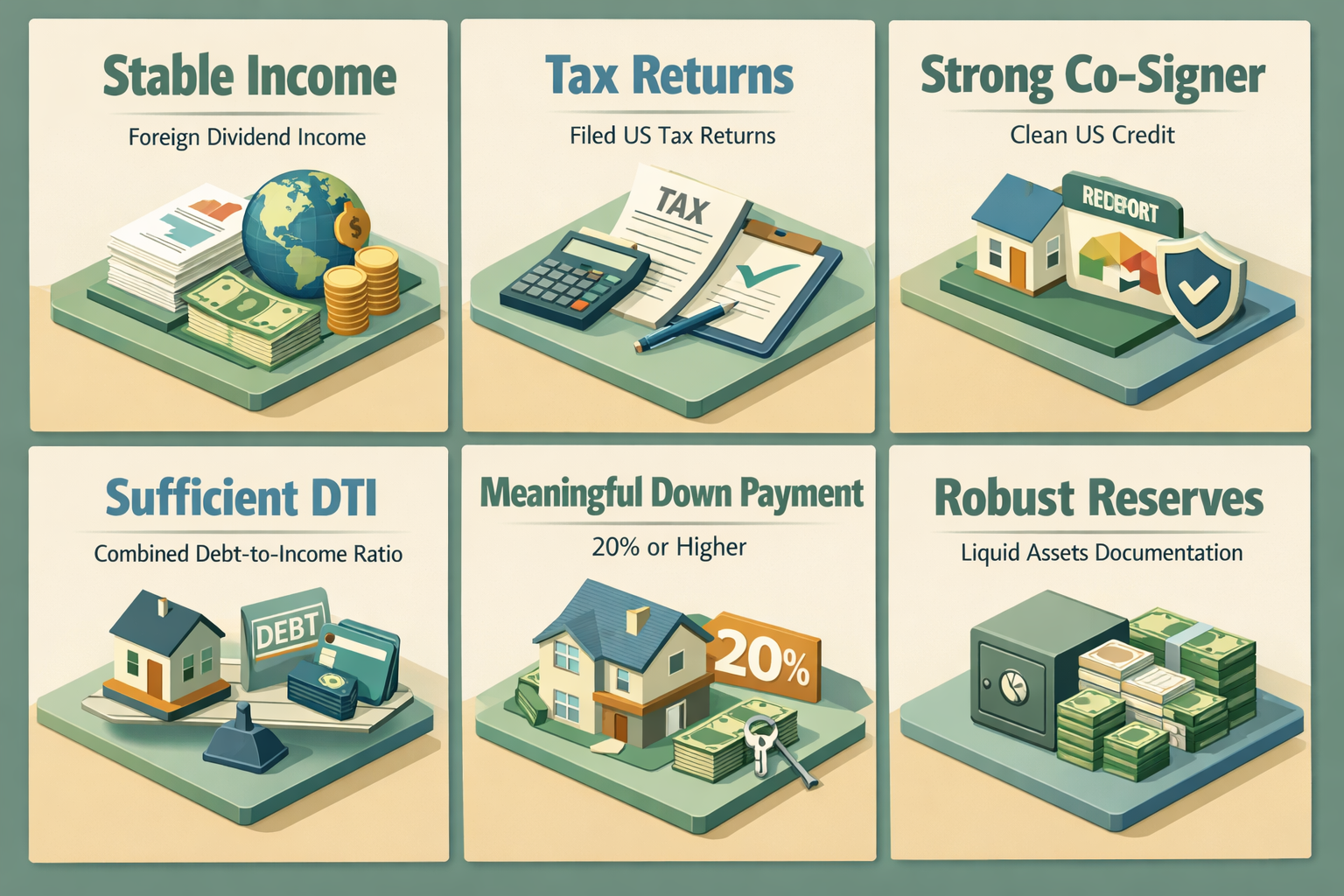
When you combine the complexity of jumbo underwriting, foreign income documentation, and co-signer evaluation, the overall requirements become layered. The requirements for jumbo loan with foreign dividend income and US co-signer aren't impossible to meet, but they do require careful preparation and a clear understanding of what lenders expect from each component of the application.
Here's a practical breakdown of what the combined application typically needs to demonstrate:
- Stable, documented foreign dividend income with a two-year history and reasonable expectation of continuity
- Properly filed US tax returns that reflect foreign income disclosures, such as FBAR filings or Form 8938 if applicable
- A strong co-signer with clean US credit and verifiable domestic income that helps anchor the application
- Sufficient combined DTI that accounts for both the primary borrower's and co-signer's debts against qualified income
- A meaningful down payment, which for jumbo loans with complex income profiles may need to be 20% or higher
- Robust liquid reserves held in US or internationally accessible accounts, with clear source-of-funds documentation
- Property appraisal meeting lender standards, since jumbo properties often require multiple appraisals for very high loan amounts
Lenders may also ask about the borrower's visa status or residency. While some lenders will work with non-resident aliens or foreign nationals, others may limit their programs to US citizens or permanent residents. If the primary borrower isn't a US resident, the co-signer's domestic profile becomes even more critical in the lender's decision-making process.
Choosing the Right Lender for This Specialized Financing Scenario
Not every mortgage lender is equipped to handle applications that involve foreign income and co-signers. Traditional retail banks may have rigid guidelines that exclude or heavily discount non-US income sources. Portfolio lenders, private banks, and certain non-QM lenders are often better positioned to evaluate these applications on a case-by-case basis.
Private banks with international wealth management divisions may be particularly well-suited for high-net-worth borrowers who hold significant foreign investment portfolios. These institutions are accustomed to evaluating global income streams and may offer customized jumbo loan products that align with this borrower profile.
Questions to Ask Potential Lenders
Before committing to a lender, it's wise to ask some targeted questions to gauge their experience with this type of application:
- Do you accept foreign dividend income as qualifying income for jumbo loans?
- How do you handle income received in a foreign currency?
- What documentation is required for the co-signer if they are a US citizen with domestic income?
- Do you require the co-signer to be on the property title?
- What are your minimum reserve requirements for this loan size?
- Do you have experience underwriting loans for non-resident or foreign national borrowers?
A mortgage broker with a strong network of jumbo and non-QM lenders can be a valuable ally here. They can pre-screen lenders based on your specific income structure, residency status, and co-signer profile, saving you from multiple hard credit inquiries and wasted time on applications that were unlikely to succeed from the start.
Practical Steps to Strengthen Your Application Before Applying
Preparation is one of the most effective tools in your approval toolkit. Given the complexity of meeting the jumbo loan foreign income co-signer requirements, taking proactive steps before submitting your application can meaningfully improve the outcome.
Start by organizing your financial documentation thoroughly. This includes gathering at least two years of tax returns for both yourself and your co-signer, collecting foreign brokerage statements and dividend payment records, and ensuring that all foreign income is properly reported on your US tax filings. If you haven't been reporting foreign income correctly, consulting a tax professional before applying for a mortgage is strongly advisable.
Consider these additional preparation strategies:
- Increase your down payment if possible. A larger down payment reduces the lender's exposure and may compensate for documentation limitations related to foreign income.
- Build up your US-based reserves. Having funds in a US bank account that can be easily verified simplifies the reserve documentation process.
- Review your co-signer's credit report. Identify and address any derogatory marks or high balances before applying, as these could negatively affect the combined application.
- Get a CPA letter early. A well-written letter from a qualified accountant explaining the nature, history, and expected continuity of your foreign dividend income can be a persuasive piece of documentation.
- Avoid opening new credit accounts. Both the primary borrower and co-signer should avoid new debt obligations in the months leading up to the application.
Timing also matters. If your foreign dividend income has only been received for one year, waiting another year to establish a two-year history may significantly improve your qualification standing.
●Conclusion
Securing a jumbo loan with foreign dividend income and a US co-signer is a specialized process, but it's one that many borrowers successfully navigate each year with the right preparation and the right lending partner. The key is understanding that lenders evaluating this type of application are looking for stability, transparency, and documentation that tells a clear financial story. By organizing your income records, working with a knowledgeable co-signer, and partnering with a lender experienced in complex jumbo underwriting, you can position yourself for a strong application. At LoanWise, we're here to help you connect with lenders who understand your unique financing profile. Reach out today to explore your options and take the next step toward your home purchase with confidence.