
Growing a small business often means making big investments — purchasing a building, upgrading equipment, or expanding into a new location. These moves require serious capital, and traditional financing doesn't always fit the bill. That's where the SBA 504 loan comes in. Backed by the U.S. Small Business Administration, this program is designed specifically to help entrepreneurs and small business owners access affordable, long-term funding for major fixed assets. Whether you're a first-time commercial borrower or an experienced entrepreneur exploring your options, understanding how the SBA 504 loan works could open the door to significant growth opportunities.
What Is the SBA 504 Loan Program?
The SBA 504 loan is a government-backed financing program administered through the Small Business Administration. It's structured to help small businesses acquire long-term, fixed assets — primarily commercial real estate and heavy equipment — at competitive, below-market interest rates. Unlike general-purpose business loans, the 504 program has a very specific purpose: supporting economic development and job creation by funding tangible, lasting assets.
What makes the SBA 504 loan unique is its three-party structure. The financing is split between a conventional lender (typically a bank or credit union), a Certified Development Company (CDC), and the borrower. Here's how it typically breaks down:
- 50% is funded by a conventional lender
- 40% is funded by a CDC through an SBA-backed debenture
- 10% is contributed by the borrower as a down payment
This structure may allow small business owners to access significant capital with a relatively low upfront contribution — something that's often difficult to achieve through traditional commercial lending alone.
Who Qualifies for an SBA 504 Loan?
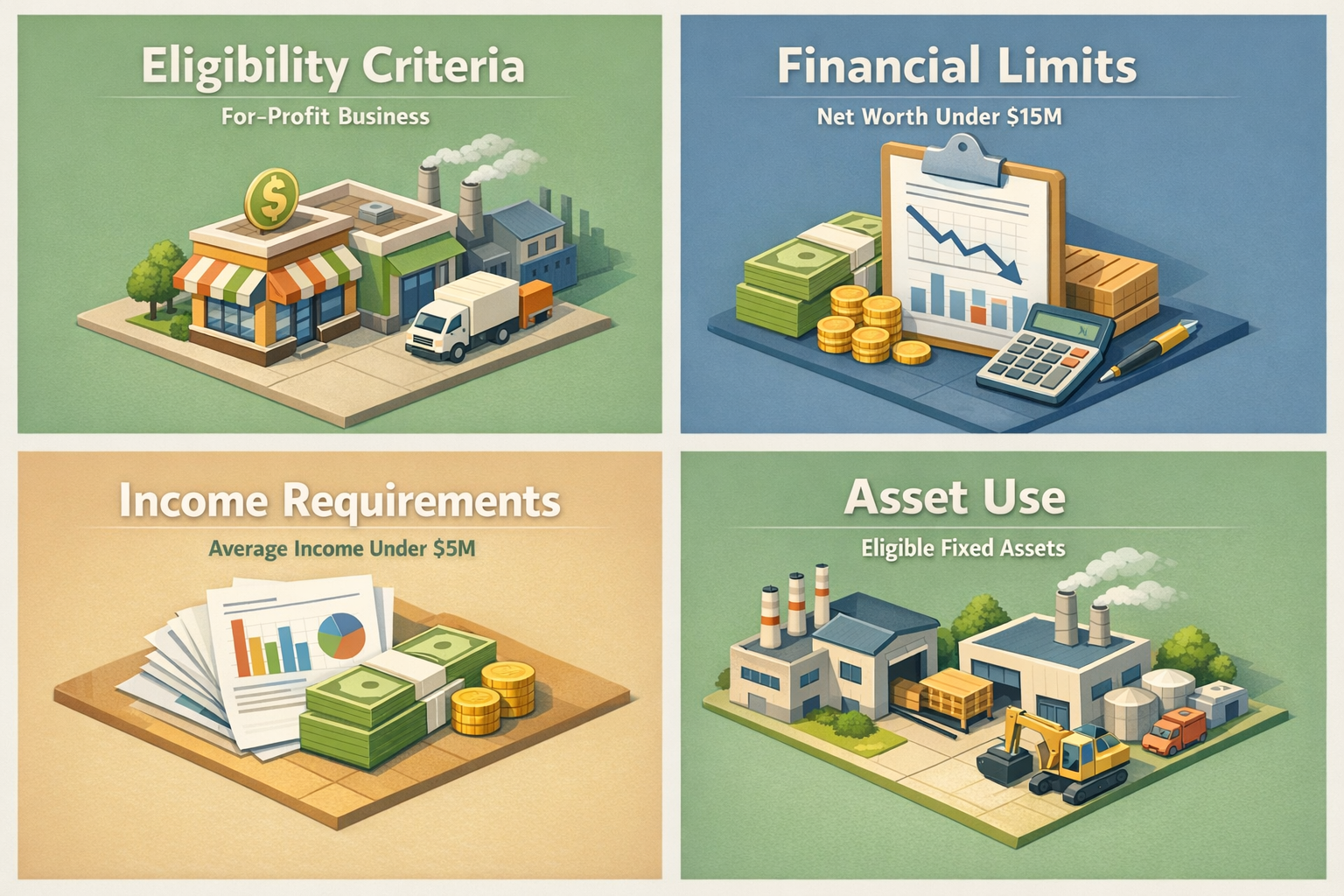
Not every business will qualify for an SBA 504 loan, but eligibility requirements are designed to be accessible for a wide range of small businesses. To be considered, your business generally needs to meet the following criteria:
- Operate as a for-profit business in the United States
- Have a tangible net worth of less than $15 million
- Have an average net income of less than $5 million after federal taxes for the two preceding years
- Plan to use the funds for an eligible fixed asset
- Demonstrate the ability to repay the loan from projected business cash flow
Certain types of businesses are typically excluded, including passive real estate investment firms, financial institutions, and businesses engaged in speculative activities. Entrepreneurs in manufacturing, retail, healthcare, and professional services may find this program particularly well-suited to their needs.
Lenders and CDCs also evaluate the borrower's credit profile, business history, and the economic impact of the project. Having a solid business plan and clean financial records can meaningfully strengthen your application.
What Can SBA 504 Loan Funds Be Used For?
One of the most important things to understand about the SBA 504 loan is that it has strict guidelines on eligible uses of funds. This isn't a flexible line of credit — it's purpose-built for specific types of capital investment. Eligible uses typically include:
- Purchasing existing buildings or land
- Constructing new facilities or making major renovations
- Buying long-life machinery and equipment
- Improving or modernizing commercial property
Ineligible uses generally include working capital, inventory, debt consolidation, and rental real estate not occupied by the borrower. The SBA typically requires that the borrower occupy at least 51% of a purchased building, or at least 60% of a newly constructed facility. This occupancy rule helps ensure the program benefits operating businesses rather than passive investors.
For small business owners eyeing commercial real estate, this requirement is worth planning around carefully. If you're looking to purchase a mixed-use property or a building where you'll lease out a portion, it's a good idea to review eligibility details with a qualified lender or CDC before applying.
Loan Amounts, Terms, and Rate Structure Explained
The SBA 504 program offers borrowers access to substantial financing with terms that can be quite favorable compared to conventional commercial loans. Here's a general overview of what to expect:
- Loan amounts: The CDC portion is typically capped at $5 million, though manufacturers and certain energy-efficient projects may qualify for up to $5.5 million
- Repayment terms: Borrowers may choose between 10-year, 20-year, or 25-year repayment periods depending on the asset type
- Interest rates: The CDC portion carries a fixed interest rate tied to U.S. Treasury bond rates, which may offer long-term cost predictability
The conventional lender's portion — which covers roughly half the project cost — will have its own rate and terms, which can vary. It's worth shopping around or working with a lender experienced in 504 transactions to find the most competitive combined structure.
Because the SBA 504 program uses fixed rates on the CDC portion, business owners can often plan their long-term budgets with greater confidence. Variable-rate debt can be unpredictable, especially during periods of economic fluctuation, so this stability is frequently cited as one of the program's most appealing features.
The Role of Certified Development Companies in the Process
A Certified Development Company, or CDC, is a nonprofit organization authorized by the SBA to deliver the 504 program in a specific geographic region. CDCs play a central role in the application, underwriting, and closing process. They act as a liaison between the borrower, the conventional lender, and the SBA itself.
Working with a CDC typically involves the following steps:
- Initial consultation to assess project eligibility and loan structure
- Application preparation and submission to the SBA
- Coordination with the conventional lender throughout underwriting
- Closing and post-closing compliance monitoring
Because CDCs are mission-driven organizations focused on economic development, they may be more willing to work with businesses that have less conventional profiles — including newer businesses or those in underserved communities. That said, all 504 loans must still meet SBA credit standards, so strong financial documentation remains important.
Finding the right CDC for your project can make a meaningful difference in the experience. Many CDCs specialize in specific industries or regions, so doing a bit of research or asking your bank for a referral could help you find a good match.
How the SBA 504 Loan Compares to Other Business Financing Options
If you're evaluating your financing options, it helps to understand how the SBA 504 program stacks up against alternatives like the SBA 7(a) loan, conventional commercial mortgages, and equipment financing.
- SBA 7(a) vs. SBA 504: The 7(a) loan is more flexible and can cover working capital, inventory, and debt refinancing. However, 7(a) loans often carry variable rates and may require larger down payments for real estate. The 504 program typically offers lower fixed rates for real estate and equipment, making it potentially more cost-effective for long-term asset purchases.
- Conventional commercial mortgage: These loans don't have government backing, which may mean higher rates and stricter qualification requirements. However, they may close faster and have fewer usage restrictions.
- Equipment financing: Standalone equipment loans can be easier to obtain but may have shorter terms and higher rates compared to the 504 program's equipment financing component.
Each option has trade-offs, and the right choice depends heavily on your specific goals, credit profile, and timeline. Many small business owners find that the 504 program's combination of low down payment, fixed rates, and long repayment terms makes it a compelling choice for major capital projects.
●Conclusion
The SBA 504 loan is a powerful tool for small business owners who are ready to invest in commercial real estate or major equipment and want to do so without overextending their cash reserves. With a low down payment requirement, long repayment terms, and fixed interest rates on the CDC portion, it's a program worth exploring carefully if expansion is on your horizon.
That said, the application process can be more involved than a standard business loan, and not every project or borrower will qualify. Working with an experienced lender and a knowledgeable CDC can make the process significantly smoother. If you're a small business owner, entrepreneur, or commercial borrower considering a major capital investment, now may be a great time to learn more about how the SBA 504 program could support your goals. Connect with a LoanWise lending specialist today to explore your options and take the next step toward growing your business.