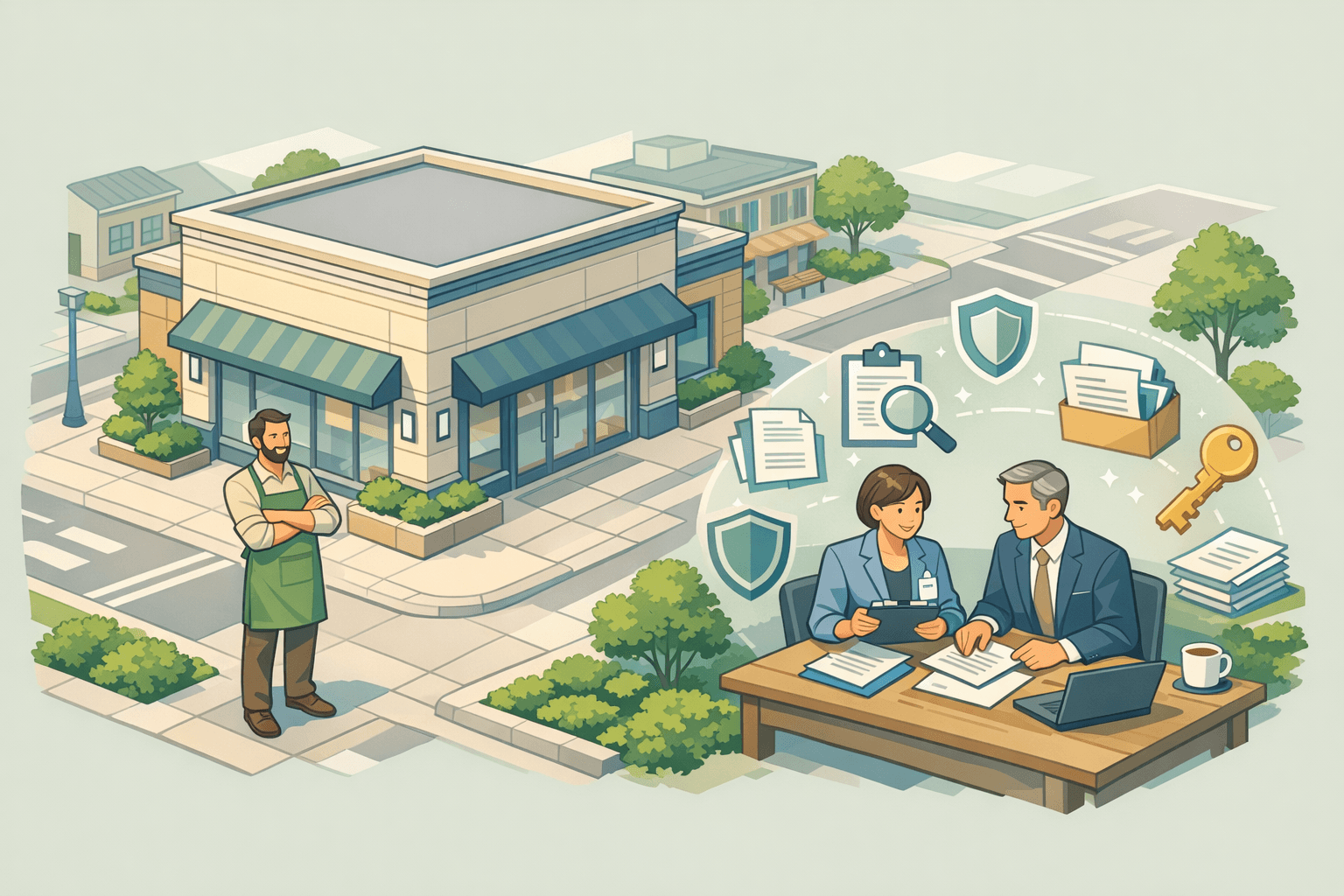
Owning your business's physical space is a goal many entrepreneurs share, but the path to commercial real estate ownership can feel overwhelming. High down payments, short loan terms, and unpredictable interest rates make conventional financing a challenge for many small business owners. That's where the SBA 504 loan comes in. Designed specifically to help small businesses acquire major fixed assets like commercial property and heavy equipment, this program offers long-term, fixed-rate financing that may be far more accessible than traditional alternatives. Whether you're looking to purchase your first commercial building, expand your current facility, or modernize your operations, understanding how the SBA 504 loan works could open a door you didn't know was available.
What Is the SBA 504 Loan and How Does It Work?
The SBA 504 loan is a government-backed financing program administered by the U.S. Small Business Administration. Unlike a standard bank loan, the 504 program uses a unique three-party structure designed to reduce the lender's risk while keeping borrowing costs manageable for small business owners.
Here's how the structure typically works:
- A Certified Development Company (CDC) — a nonprofit organization certified by the SBA — provides up to 40% of the total project cost through a long-term, fixed-rate SBA debenture.
- A private lender, such as a bank or credit union, covers approximately 50% of the project cost through a conventional loan.
- The borrower contributes the remaining 10% as a down payment, though this may increase to 15% or 20% for startups or special-use properties.
This structure means a qualifying small business owner could finance a commercial property purchase with as little as 10% down — a notable advantage compared to the 20% to 30% typically required for conventional commercial real estate loans. The CDC portion of the loan carries a fixed interest rate tied to U.S. Treasury rates, offering predictability over a repayment term that often extends 10, 20, or 25 years.
Eligible Uses: What Can You Finance with an SBA 504 Loan?
One of the most attractive features of the SBA 504 loan is the range of assets it may cover. While it's most commonly associated with commercial real estate, its eligible uses extend beyond property purchases.
Borrowers may be able to use SBA 504 funds for:
- Purchasing owner-occupied commercial real estate, such as office buildings, retail spaces, warehouses, or manufacturing facilities
- Constructing new commercial buildings or making major renovations to existing structures
- Acquiring long-term machinery or heavy equipment with a useful life of at least 10 years
- Site improvements such as grading, street improvements, utilities, and parking lots
It's important to note that the SBA 504 loan is not intended for working capital, inventory, or debt consolidation. Those needs are typically better suited to the SBA 7(a) program or a business line of credit. The 504 program is specifically designed for fixed-asset investments that support the long-term growth and stability of a business.
Entrepreneurs considering a major capital investment in their physical operations may find the 504 loan especially well-suited to their goals — particularly when the asset being acquired will be owner-occupied and primarily used to support the core business.
Key Eligibility Requirements for Small Business Borrowers
The SBA 504 program has specific eligibility criteria that borrowers must meet. Understanding these requirements early can save time and help set realistic expectations during the application process.
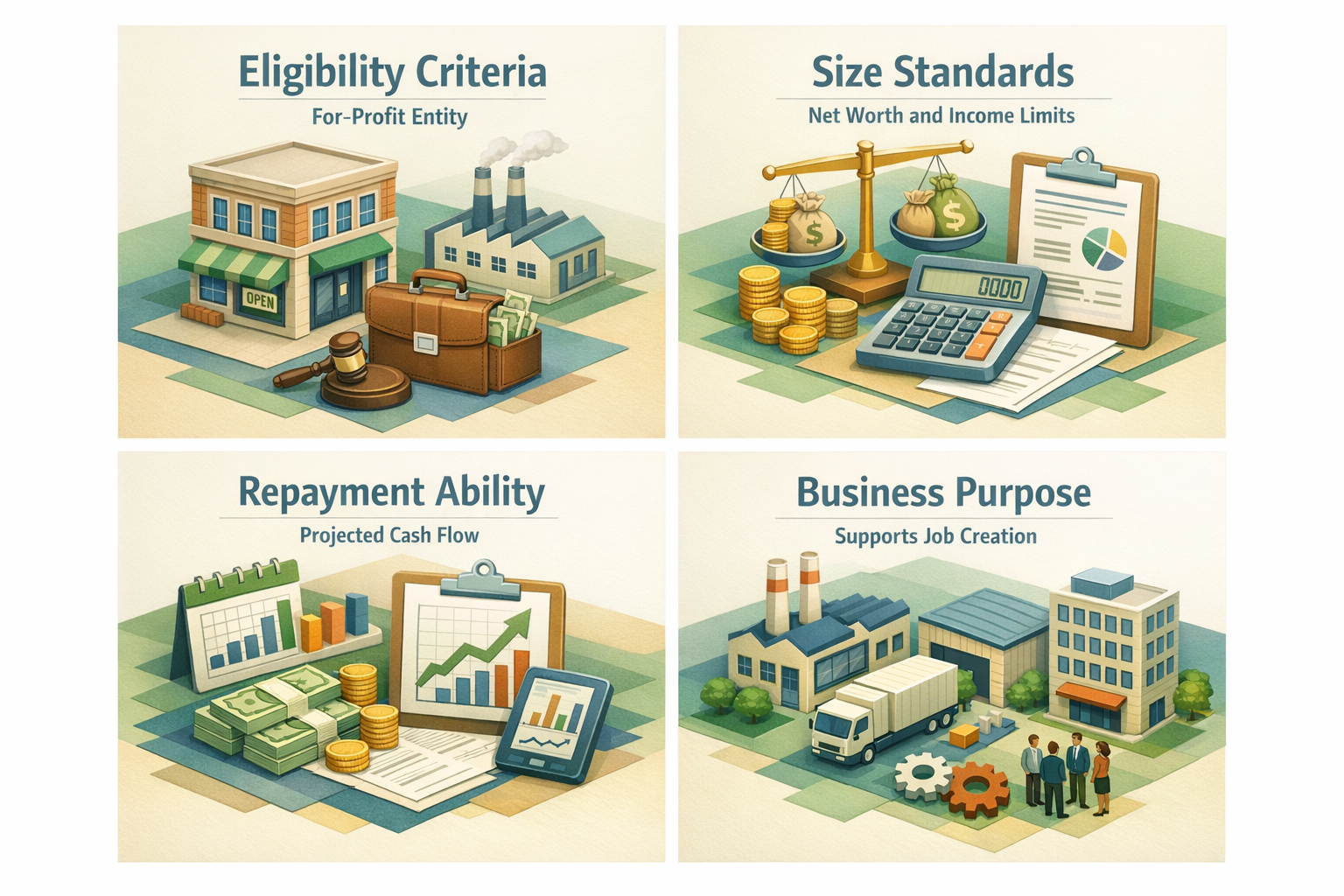
Generally speaking, to qualify for an SBA 504 loan, a business must:
- Operate as a for-profit entity within the United States
- Meet the SBA's size standards — typically defined as having a tangible net worth of less than $20 million and an average net income of less than $6.5 million after taxes for the preceding two years
- Demonstrate a reasonable ability to repay the loan from projected business cash flow
- Have a sound business purpose for the loan and show that the project supports job creation or other community development goals
Public policy goals are an important element of SBA 504 eligibility. Projects that create or retain jobs, support businesses in underserved communities, promote exports, or contribute to energy efficiency may receive additional consideration. In fact, some 504 projects may qualify for higher debenture limits when they meet specific public policy criteria.
Certain businesses are ineligible for the program, including speculative real estate investors, financial businesses primarily engaged in lending, and companies with passive income as their primary revenue source. Owner-occupancy is a critical requirement — typically, the borrower's business must occupy at least 51% of an existing building or 60% of a newly constructed facility.
Understanding the Cost Advantage Over Conventional Commercial Loans
One of the most compelling reasons small business owners explore the SBA 504 loan is its potential cost advantage over conventional commercial financing. While every borrower's situation is different, the structural benefits of the 504 program are worth examining carefully.
The fixed interest rate on the CDC portion of the loan is one of the program's standout features. Because this rate is set at the time of funding and tied to long-term U.S. Treasury benchmarks, it protects borrowers from interest rate fluctuations over a 20- or 25-year repayment period. This kind of long-term rate certainty can be especially valuable for small businesses managing tight cash flows and trying to forecast operating costs accurately.
The low down payment requirement also preserves capital. Rather than tying up 25% or 30% of a property's purchase price in a down payment, a 504 borrower may only need 10%, freeing up funds for hiring, inventory, marketing, or other operational needs. For many entrepreneurs, this capital efficiency is what makes a commercial real estate purchase feasible in the first place.
That said, borrowers should be aware that the 504 loan does come with fees — including SBA fees, CDC fees, and closing costs — that may be financed into the loan but should still be factored into total project cost calculations. Speaking with a certified lender or CDC representative early in the process can help you build a realistic picture of what the full cost of financing will look like.
The Application Process: What to Expect Step by Step
Applying for an SBA 504 loan involves more steps than a conventional business loan, but the process is manageable when you know what to expect. The key is preparation — gathering documentation early and working with experienced lending partners who understand the program.
Here's a general overview of how the process typically unfolds:
- Step 1 — Find a CDC and a private lender. You'll work with both a Certified Development Company and a bank or credit union simultaneously. CDCs are geographically organized, so your project location will determine which CDC serves your area.
- Step 2 — Prepare your documentation. Expect to provide business financial statements for the past two to three years, personal financial statements for all major owners, tax returns, a business plan or project narrative, and details about the property or asset being financed.
- Step 3 — Underwriting and approval. Both the private lender and the CDC will review your application. Once both approve the project, it's submitted to the SBA for final authorization.
- Step 4 — Closing and funding. After SBA approval, the loan closes. The private lender's portion typically funds first, followed by the CDC debenture after the project is complete or the asset is acquired.
Timelines can vary depending on project complexity, lender processing times, and SBA workload. Working with lenders experienced in 504 transactions may help streamline the process and reduce unexpected delays.
How the SBA 504 Loan Supports Long-Term Business Growth
Beyond the immediate financing benefit, owning commercial real estate through an SBA 504 loan can support a small business's growth trajectory in meaningful ways. When a business owns its facility rather than leasing it, it gains a level of operational stability that renting can't always provide.
Fixed mortgage payments replace variable lease payments, making long-term budgeting more predictable. As the property appreciates over time, the business builds equity that may later be tapped for future capital needs. For many small business owners, commercial real estate becomes one of their most valuable long-term assets — contributing not just to operational stability but also to personal wealth building.
There's also a competitive dimension to consider. Owning your space means you're not subject to lease renewals, rent increases, or landlord decisions that could disrupt your business location. That sense of permanence can support brand credibility, customer loyalty, and team retention in ways that renting cannot.
Entrepreneurs who are serious about building lasting enterprises — not just surviving year to year — often find that commercial real estate ownership is a milestone worth pursuing. The SBA 504 loan may be the most accessible path to that milestone for qualifying small businesses.
●Conclusion
The SBA 504 loan is one of the most powerful financing tools available to small business owners who are ready to invest in their physical future. With its low down payment structure, long-term fixed rates, and broad eligibility across commercial real estate and major equipment categories, it offers a compelling alternative to conventional commercial lending. Of course, every business has unique circumstances, and it's worth speaking with a knowledgeable lender or CDC to determine whether the 504 program aligns with your specific goals and financial profile. If you're a small business owner considering a commercial property purchase or major capital investment, exploring the SBA 504 program could be one of the smartest financial decisions you make. Reach out to the LoanWise team today to learn how this program might work for your business.