For eligible veterans, active-duty service members, and surviving spouses, the VA loan program is one of the most powerful home financing tools available in the United States. One of its most celebrated benefits is the ability to purchase a home without putting any money down. But before you can take advantage of this opportunity, it's important to understand the requirements to get a VA loan no down payment. From military service history to lender-specific credit standards, meeting these criteria is what separates a successful application from a denied one. In this guide, we'll walk you through everything you need to know so you can approach the process with confidence.
What Makes the VA Loan Program Unique Among Home Financing Options
The VA loan is a government-backed mortgage program administered by the U.S. Department of Veterans Affairs. Unlike conventional loans, which typically require at least 3% to 20% down, or FHA loans that require a minimum of 3.5%, no down payment VA home loans allow qualified borrowers to finance 100% of the home's purchase price. This alone makes the program stand out in a crowded lending market.
Beyond the zero-down benefit, VA home loans also typically come with competitive interest rates, no private mortgage insurance (PMI) requirement, and limits on certain closing costs. These features can translate into significant savings over the life of a loan, making homeownership more accessible for those who've served our country.
It's worth noting that while the VA sets the overall program guidelines, individual lenders may have their own overlays — meaning they might impose stricter credit or income requirements beyond what the VA technically mandates. That's why shopping around and working with a VA-experienced lender can make a meaningful difference in your experience.
VA Loan Eligibility Requirements Based on Military Service
The foundation of VA loan eligibility requirements is your military service record. The VA has established specific service thresholds that borrowers must meet to qualify. Here's a general overview of who may be eligible:
- Active-duty service members: Generally eligible after 90 continuous days of service during wartime or 181 days during peacetime.
- Veterans: Must meet the same wartime or peacetime service duration requirements, depending on when they served.
- National Guard and Reserve members: Typically need at least six years of service, or 90 days of active-duty service under certain federal orders.
- Surviving spouses: Un-remarried spouses of veterans who died in the line of duty or from a service-connected disability may also qualify.
The type of discharge you received also matters. An honorable discharge is the standard for eligibility. Other than honorable, bad conduct, or dishonorable discharges could disqualify a borrower, though some exceptions and appeals processes may exist depending on the circumstances.
Because service history can be complex — especially for those with multiple enlistments or mixed active and reserve duty — it's a good idea to speak with a VA-approved lender or a HUD-approved housing counselor early in the process.
Understanding the VA Loan Certificate of Eligibility
Once you've confirmed you meet the service requirements, you'll need to obtain a VA loan certificate of eligibility (COE). This document is issued by the Department of Veterans Affairs and formally verifies to lenders that you're entitled to VA loan benefits.
There are several ways to apply for your COE:
- Online through the VA's eBenefits portal: Often the fastest method for many veterans.
- Through your lender: Many VA-approved lenders can pull your COE electronically during the loan application process.
- By mail: You can complete VA Form 26-1880 and mail it to the appropriate VA Eligibility Center.
The COE will also show your entitlement amount, which reflects how much of your loan the VA guarantees. Most first-time VA borrowers have full entitlement, which means there's no loan limit imposed by the VA itself — though lenders may still apply their own maximum loan amounts based on your financial profile.
If you've previously used a VA loan and paid it off or sold the home, you may be able to restore your entitlement and use the benefit again. This is a feature that's often overlooked and can be especially valuable for repeat homebuyers or real estate investors who qualify under VA guidelines.
Credit Score and Income Standards That Lenders Typically Look For
The VA itself does not set a minimum credit score requirement, but most private lenders that issue VA loans do. Many lenders look for a credit score of at least 620, though some may accept scores as low as 580. Working to improve your credit before applying could help you qualify more easily and potentially secure a lower interest rate.
In terms of income, the VA uses a concept called residual income rather than relying solely on a debt-to-income (DTI) ratio. Residual income refers to the amount of money left over each month after all major expenses — including the proposed mortgage payment, taxes, insurance, and debts — have been paid. The VA sets regional residual income thresholds based on family size and geographic location.
That said, many lenders also look at your DTI ratio as part of their own underwriting process. A DTI at or below 41% is often preferred, though lenders may approve borrowers above that threshold if other financial factors are strong, such as solid residual income, significant savings, or a long history of stable employment.
Self-employed veterans or those with non-traditional income may face additional documentation requirements, but VA loans can still be an option with proper preparation and record-keeping.
The Requirements to Get a VA Loan No Down Payment: Property Eligibility Rules
Meeting the borrower-side requirements to get a VA loan no down payment is only part of the equation. The property itself must also meet VA standards. The VA requires that homes financed with its loan program be safe, structurally sound, and sanitary — often referred to as the VA's Minimum Property Requirements (MPRs).
A VA-approved appraiser will assess the home to ensure it meets these standards. This appraisal is separate from a home inspection, though buyers are strongly encouraged to get a private inspection as well. Common issues that can trigger MPR concerns include:
- Roof damage or failure
- Inadequate heating systems
- Evidence of moisture, mold, or wood rot
- Lead-based paint in homes built before 1978
- Faulty electrical or plumbing systems
In terms of property types, VA loans can be used to purchase single-family homes, VA-approved condos, manufactured homes (in some cases), and multi-unit properties up to four units — as long as the borrower occupies one of the units as their primary residence. Investment properties alone are not eligible; the VA loan is designed for owner-occupied housing.
The VA Funding Fee and Other Costs to Plan For
While VA loans eliminate the need for a no down payment and PMI, there is one cost that's unique to this program: the VA funding fee. This is a one-time fee paid to the Department of Veterans Affairs that helps sustain the loan program for future generations of service members.
The funding fee amount varies based on several factors, including:
- Whether it's your first time using a VA loan or a subsequent use
- The size of any down payment you choose to make (even a small voluntary down payment can reduce the fee)
- Your military category (regular military versus Reserves or National Guard)
For a first-time use with no down payment, the funding fee is typically around 2.15% of the loan amount for regular military, and slightly higher for Reserve or Guard members. However, veterans who receive VA disability compensation are generally exempt from paying the funding fee — which can represent thousands of dollars in savings.
The good news is that the funding fee can be rolled into the loan amount, so you don't have to pay it out of pocket at closing. Still, it's important to factor this into your overall loan cost calculations when comparing mortgage options.
Steps to Start Your VA Loan Application With Confidence
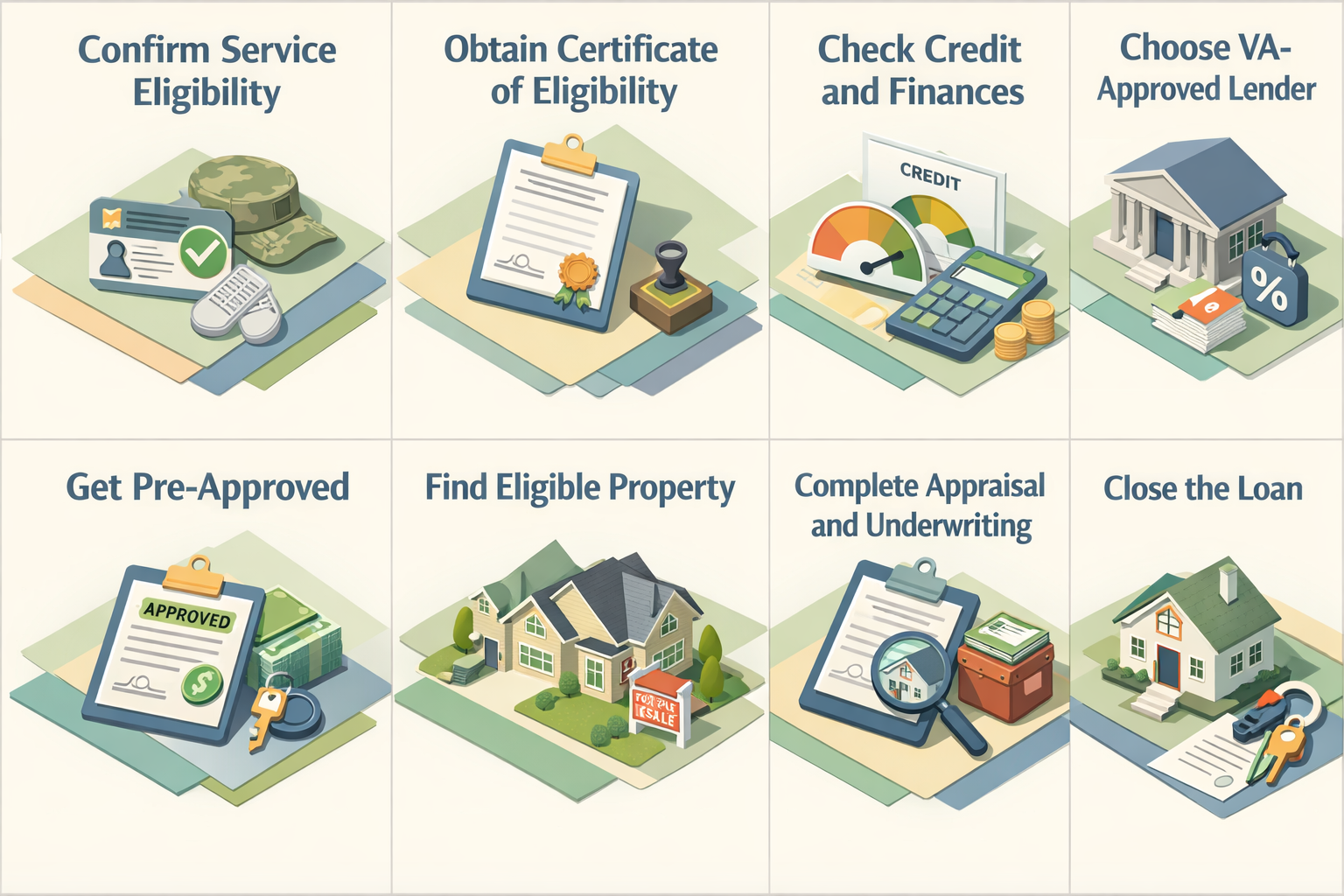
If you believe you meet the VA loan eligibility requirements, here's a practical roadmap to help you move forward efficiently:
- Step 1 – Confirm your service eligibility: Review VA guidelines or contact the VA directly to verify that your service history qualifies.
- Step 2 – Obtain your Certificate of Eligibility: Apply online, through a lender, or by mail. Having this ready speeds up the loan process.
- Step 3 – Check your credit and finances: Pull your credit reports, review your DTI, and calculate your residual income to understand where you stand.
- Step 4 – Choose a VA-approved lender: Not all lenders offer VA loans. Look for lenders experienced with the program who can guide you through their specific requirements.
- Step 5 – Get pre-approved: A pre-approval letter strengthens your position as a buyer and helps you understand your purchasing power before house hunting.
- Step 6 – Find an eligible property: Work with a real estate agent familiar with VA transactions to identify homes likely to meet VA appraisal standards.
- Step 7 – Complete the appraisal and underwriting: A VA-assigned appraiser will evaluate the home, and your lender will finalize underwriting before issuing a clear to close.
The process may feel detailed, but each step is designed to protect both the borrower and the integrity of the loan program. With the right preparation and a knowledgeable lending team, many eligible borrowers find the experience smoother than expected.
●Conclusion
The VA loan program remains one of the most generous and accessible home financing options in the country for those who qualify. Understanding the requirements to get a VA loan no down payment — from service eligibility and your certificate of eligibility to property standards and the funding fee — puts you in a strong position to take full advantage of this well-earned benefit. Whether you're a first-time homebuyer or a veteran returning to the housing market, the zero-down structure of VA loans could help you achieve homeownership sooner than you might think. At LoanWise, we're committed to helping you navigate every step of the process with clarity and confidence. Reach out today to connect with a VA-experienced mortgage specialist who can review your unique situation and help you move forward.