
Short-term vacation rentals have become a significant source of income for many homeowners and real estate investors. Platforms like Airbnb and VRBO have made it easier than ever to generate revenue from a property — sometimes substantial revenue. But when it comes time to apply for a large home loan, the picture gets more complicated. Understanding the requirements for jumbo loan with income from short-term vacation rentals is essential for any borrower hoping to leverage that rental history in their favor. Jumbo loans, which exceed conforming loan limits set by the Federal Housing Finance Agency, come with stricter qualification standards by nature. Add a non-traditional income source like vacation rental earnings, and lenders will want to see strong documentation, solid credit, and meaningful financial reserves before moving forward.
What Makes Jumbo Loans Different from Conventional Mortgages
A jumbo loan is any mortgage that surpasses the conforming loan limits established annually by the Federal Housing Finance Agency. In most parts of the United States, that threshold sits above $766,550 for a single-family home, though it may be higher in designated high-cost areas. Because these loans can't be purchased or backed by Fannie Mae or Freddie Mac, lenders take on more risk — and they respond by setting tighter qualification standards.
For a standard borrower with W-2 employment income, jumbo lending is already more demanding than conventional financing. Lenders typically expect higher credit scores, larger down payments, and more months of cash reserves in the bank. Now imagine layering in income that fluctuates by season, depends on occupancy rates, and comes from a relatively new category of the rental market. That's exactly the scenario facing borrowers who rely on short-term vacation rental earnings.
That said, many lenders — particularly portfolio lenders and non-QM (non-qualified mortgage) lenders — have developed specific frameworks for evaluating vacation rental property loan applications. It's not impossible to qualify. It simply requires preparation and a clear understanding of what underwriters are looking for.
How Lenders Evaluate Short-Term Vacation Rental Income for Jumbo Qualification
One of the first questions underwriters ask is: how long has this income been flowing, and how consistent is it? Unlike a salaried job that produces the same paycheck every two weeks, short-term rental income can swing dramatically based on travel trends, seasons, local events, and platform algorithm changes. Lenders are well aware of this volatility, and it shapes how they calculate qualifying income.
Most lenders who accept short-term rental income for a jumbo mortgage for rental income qualification will want to see at least one to two years of documented rental history. This documentation may include:
- IRS Schedule E from your federal tax returns, which captures rental income and allowable expenses
- 1099-K forms issued by platforms like Airbnb or VRBO
- Bank statements showing consistent deposits from rental activity
- A history of occupancy rates and nightly rates, sometimes pulled directly from the rental platform
Some lenders use a methodology where they average the gross rental income over the past 12 to 24 months and then subtract vacancy allowances, operating expenses, and any property management fees before arriving at a net qualifying figure. Others may use a Debt Service Coverage Ratio (DSCR) model, which evaluates whether the property's rental income is sufficient to cover its own mortgage payment — often without requiring the borrower to show personal income at all.
It's worth noting that lenders may apply a more conservative vacancy factor to short-term rentals than they would to traditional long-term leases. A long-term tenant provides a lease agreement as proof of future income. A vacation rental offers no such guarantee, which is why historical performance carries so much weight in the underwriting process.
Credit Score and Financial Profile Expectations for Jumbo Borrowers with Rental Income
Because jumbo loans are not backed by any government agency, lenders rely heavily on the borrower's overall financial strength to offset risk. For most jumbo programs, a credit score of at least 700 is often the starting point — and many lenders prefer scores of 720 or higher. Borrowers using vacation rental income as a primary qualification source may face even stricter credit requirements, since the income itself introduces an additional layer of unpredictability.
Beyond the credit score, lenders will look carefully at the following aspects of your financial profile:
- Debt-to-income ratio (DTI): Most lenders prefer a DTI below 43%, and some jumbo programs cap it at 38% to 40%. If your rental income is being used to lower your effective DTI, lenders will scrutinize how that income was calculated.
- Cash reserves: Jumbo borrowers are typically expected to have anywhere from 6 to 24 months of mortgage payments in liquid reserves after closing. When the income source is a vacation rental, lenders may lean toward the higher end of that range.
- Employment or other income stability: Having a primary W-2 income in addition to your rental earnings can significantly strengthen your application. Lenders feel more confident when rental income supplements a stable base rather than serving as the sole qualifier.
If you're self-employed and your vacation rental income flows through a business entity, you may also need to provide business tax returns, profit and loss statements, and possibly a CPA letter attesting to the stability of your income. This falls into the broader category of non-QM mortgage underwriting, where documentation requirements can vary considerably from lender to lender.
Down Payment Requirements and Loan-to-Value Considerations
Jumbo loans generally require larger down payments than conforming mortgages. While some conventional loans allow down payments as low as 3% to 5%, most jumbo programs start at 10% and many prefer 20% or more — especially when non-traditional income is part of the equation. A larger down payment reduces the lender's exposure and signals that the borrower has the financial discipline and resources to manage a high-value mortgage.
For a vacation rental property loan involving a jumbo-sized mortgage, lenders may require a loan-to-value (LTV) ratio of no more than 75% to 80%. That means if you're purchasing a $1.5 million vacation property, you might need to bring $300,000 to $375,000 to the table as a down payment. This is not a universal rule — individual lender policies vary — but it reflects the general risk posture that most portfolio lenders adopt when underwriting large loans secured by income-dependent properties.
It's also important to understand how the property's intended use affects the loan terms. There's a meaningful difference between a primary residence, a second home, and an investment property in the eyes of a lender. If you plan to rent the home out for more than 14 days per year — and especially if rental income is part of your qualification — the lender may classify it as an investment property, which typically comes with higher rates and more stringent guidelines than a second home designation.
DSCR Loans as an Alternative Path for Vacation Rental Investors
For real estate investors who own or plan to purchase high-value vacation rental properties, Debt Service Coverage Ratio (DSCR) loans have emerged as a practical alternative to traditional income verification. Rather than analyzing the borrower's personal tax returns or employment history, a DSCR lender focuses on one central question: does the property generate enough rental income to cover its own monthly debt obligations?
A DSCR of 1.0 means the property's income exactly covers the mortgage payment. Most lenders prefer a ratio of 1.1 to 1.25 or higher, meaning the property generates 10% to 25% more income than the loan costs each month. For short-term rentals, lenders calculating DSCR may use a mix of actual historical income from platform statements and market-rate projections from appraisal-based rental income analyses.
DSCR loans that reach into jumbo territory — often defined as those exceeding conforming limits — may carry slightly higher interest rates than conventional jumbo products, but they offer a significant advantage: they remove the complexity of documenting irregular personal income. For seasoned vacation rental investors with strong occupancy histories, this structure can be an efficient route to financing high-value properties.
It's worth consulting with a lender who specializes in non-QM or investment property lending to determine whether a DSCR approach is available for your specific loan amount and property type.
Documentation Checklist for Meeting the Requirements for Jumbo Loan with Income from Short-Term Vacation Rentals
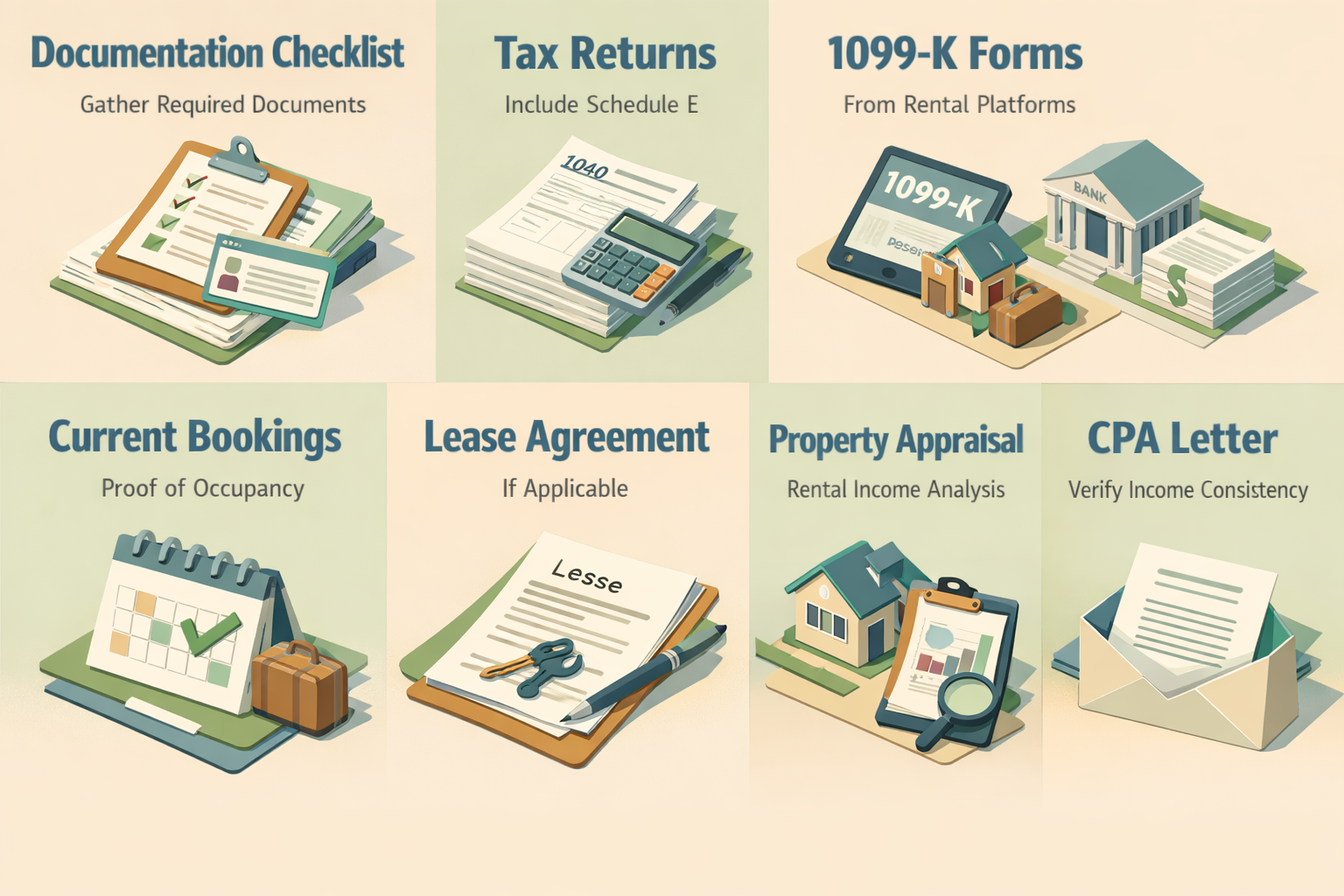
Meeting the requirements for jumbo loan with income from short-term vacation rentals means coming to the table fully prepared. Underwriters are detail-oriented by nature, and any gaps in documentation could delay or derail an approval. Here's a general list of what you may need to gather:
- Two years of federal tax returns, including Schedule E for rental property income and expenses
- Two years of 1099-K forms from Airbnb, VRBO, or other platforms
- 12 to 24 months of bank statements showing rental deposits
- Proof of current bookings or occupancy history from your rental platform dashboard
- A current lease agreement (if applicable for any portion of the rental period)
- A property appraisal that includes a rental income analysis or market rent estimate
- Business financial statements if the rental is operated through an LLC or S-Corp
- A letter from a CPA verifying income consistency, especially if you're self-employed
- Documentation of liquid reserves — typically bank or investment account statements covering the most recent two to three months
Lenders may also request an explanation letter if there are significant fluctuations in your rental income year over year. Being able to provide context — such as a major renovation, a regional event, or platform policy changes — can help underwriters view your application more favorably.
Finding the Right Lender for a Vacation Rental Jumbo Mortgage
Not every lender accepts short-term rental income for jumbo loan qualification — and among those who do, guidelines can differ significantly. Large retail banks may apply very conservative standards, while portfolio lenders, credit unions, and non-QM specialty lenders are often more flexible in how they underwrite unique income scenarios.
When shopping for a jumbo mortgage for rental income, it pays to work with a mortgage broker or advisor who has specific experience with investment properties and non-traditional income documentation. They can help you identify which lenders are most likely to view your file favorably and which programs — whether traditional jumbo, DSCR, or bank statement loans — align with your financial profile.
Before applying, consider taking these preparatory steps:
- Organize at least two years of rental income documentation from your platform and tax records
- Check your credit report and address any inaccuracies or outstanding debts
- Build up your liquid reserves to exceed the lender's minimum requirements
- Consult with a tax professional to ensure your Schedule E accurately reflects your rental activity
- Get pre-qualified with multiple lenders to compare how they calculate your qualifying income
The jumbo lending market is relationship-driven. Taking the time to find a lender who understands the vacation rental space could make a meaningful difference in your approval odds and the terms you receive.
●Conclusion
Qualifying for a large home loan using vacation rental earnings is absolutely achievable — but it requires more groundwork than a standard mortgage application. The requirements for jumbo loan with income from short-term vacation rentals are demanding by design, reflecting the higher loan amounts and non-traditional income sources involved. Strong credit, ample reserves, thorough documentation, and a well-performing rental history are the pillars of a compelling application. Whether you pursue a traditional jumbo product or explore a DSCR-based vacation rental property loan, the key is working with knowledgeable lending professionals who understand how to evaluate your income accurately. At LoanWise, we're here to help you navigate the process and connect with lenders who specialize in exactly this kind of financing. Reach out today to start the conversation.