
If you earn commission-based income or make alimony payments, understanding how lenders view your finances is essential before you apply for a mortgage. Your debt-to-income ratio, commonly known as DTI, plays a major role in whether you qualify for a home loan and what terms you'll receive. But when your income isn't a simple salary and your monthly obligations include court-ordered support payments, the calculation becomes more nuanced. Knowing how to calculate DTI with commission income and alimony payments can help you prepare smarter, avoid surprises, and strengthen your application before you ever talk to a lender.
What Is DTI and Why It Matters for Mortgage Approval
Your debt-to-income ratio is a simple but powerful metric that mortgage lenders use to assess your ability to manage monthly debt payments alongside your income. It's expressed as a percentage and calculated by dividing your total monthly debt obligations by your gross monthly income.
For example, if your gross monthly income is $6,000 and your total monthly debts add up to $2,100, your DTI would be 35%. Lenders typically look at two versions of this ratio:
- Front-end DTI: This compares only your proposed housing payment — including principal, interest, taxes, and insurance — to your gross income.
- Back-end DTI: This compares all monthly debt obligations, including the housing payment, credit cards, car loans, student loans, and support payments, to your gross income.
Lenders generally focus more on the back-end DTI. Most conventional loan programs prefer a back-end DTI at or below 43%, though some programs may allow higher ratios with compensating factors. FHA loans can sometimes accommodate higher DTI levels depending on the borrower's overall financial profile. Understanding where you fall on this spectrum is the first step toward a successful mortgage application.
How Lenders Evaluate Commission-Based Income for DTI
Commission income introduces variability that lenders must account for carefully. Unlike a salaried employee who receives the same paycheck every two weeks, a commissioned worker's earnings may fluctuate month to month. Because of this, lenders typically won't accept your most recent commission check as the sole measure of your income.
Instead, most lenders require a two-year history of commission earnings to calculate a reliable average. Here's how the process generally works:
- Lenders will request your last two years of federal tax returns (W-2s and/or 1040s) along with recent pay stubs.
- They'll add up your total commission income from both years and divide by 24 months to arrive at a monthly average.
- If your commission income has been declining year over year, lenders may use the lower figure or flag the instability as a concern.
- If your commission income has been increasing, lenders may use the average of both years — though some programs allow more flexibility.
It's important to note that if you've been in a commission-based role for less than two years, qualifying may be more difficult. Some lenders might consider exceptions if you recently transitioned from a salaried role in the same field, but this typically requires additional documentation and underwriter discretion.
When you calculate your gross monthly income for DTI purposes, you'll want to use the lender-accepted average — not your peak month or your current pay stub alone. This is a common mistake that leads to miscalculated DTI estimates and surprises during underwriting.
Step-by-Step: How to Calculate DTI With Commission Income and Alimony Payments
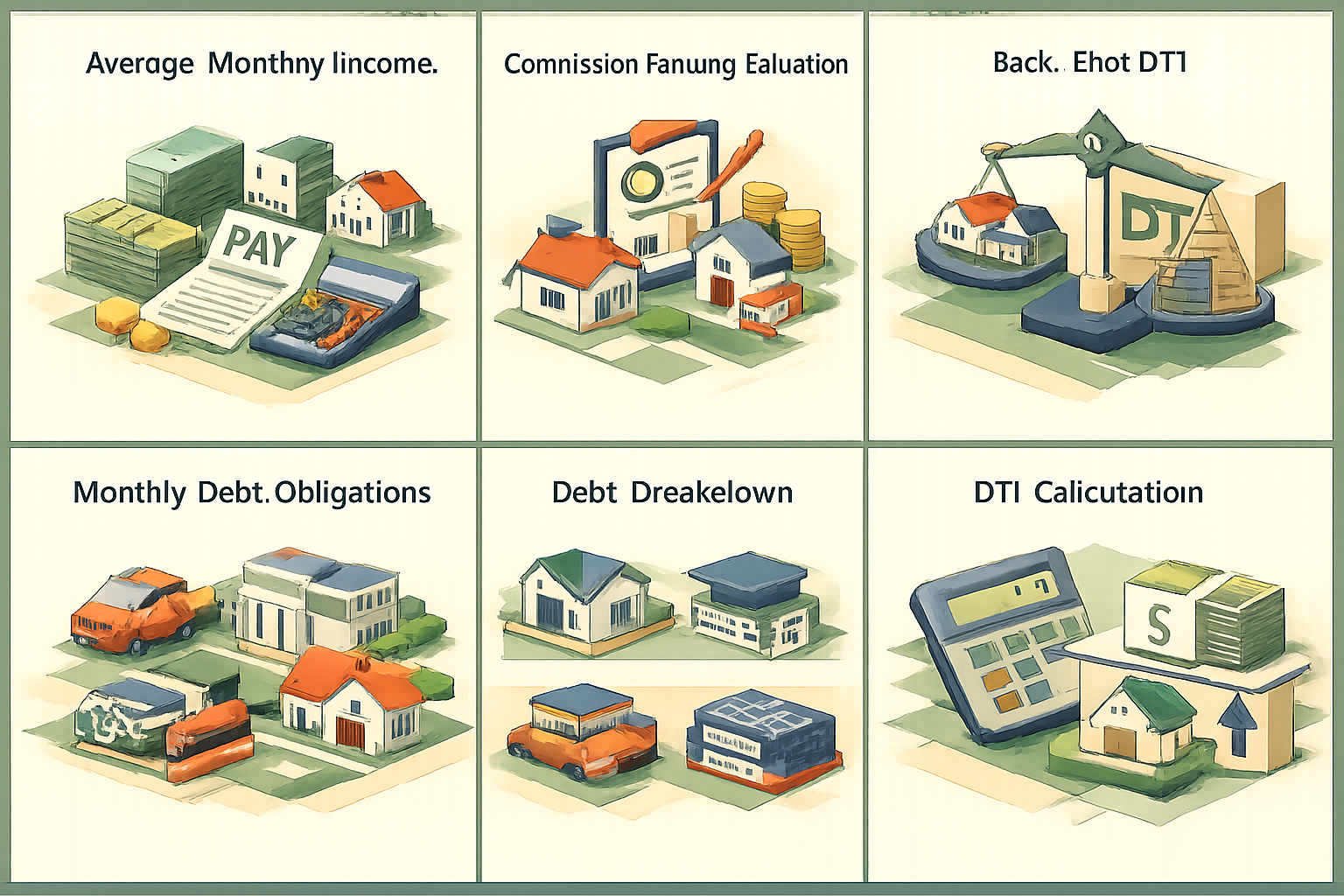
Now that you understand how lenders assess commission earnings, let's walk through how to calculate DTI with commission income and alimony payments using a practical example.
Step 1: Determine your average monthly commission income.
Let's say you earned $72,000 in commission over Year 1 and $84,000 in Year 2. Your two-year total is $156,000. Divide by 24 months: $156,000 ÷ 24 = $6,500 per month in commission income.
If you also receive a base salary of $2,000 per month, your total gross monthly income would be: $6,500 + $2,000 = $8,500 per month.
Step 2: Add up your monthly debt obligations.
List all recurring monthly debts as they'd appear on a credit report or court order:
- Proposed mortgage payment (principal, interest, taxes, insurance): $2,200
- Car loan: $450
- Student loan: $300
- Credit card minimum payments: $150
- Alimony payments: $800
Total monthly debts: $3,900
Step 3: Calculate your back-end DTI.
Divide total monthly debts by gross monthly income: $3,900 ÷ $8,500 = approximately 45.9%
In this scenario, your DTI may be above what some conventional programs prefer. However, with strong compensating factors — like a solid credit score, significant reserves, or a lower loan-to-value ratio — some loan programs may still be accessible. This illustrates why running these numbers before you apply is so valuable.
How Alimony Payments Affect Your Debt-to-Income Ratio in Commission Earnings Scenarios
Alimony payments are treated as a monthly debt obligation by mortgage lenders, much like a car payment or credit card minimum. This means every dollar you're legally required to pay in alimony increases your back-end DTI — which directly affects how much home you may qualify for.
There are a few important nuances to understand about how alimony interacts with the debt to income ratio commission earnings alimony calculation:
- Duration matters: Lenders typically only count alimony payments that have more than a certain number of months remaining — often 10 months or more. If your alimony obligation is set to end soon, some lenders may exclude it from the DTI calculation. Confirm this threshold with your loan officer, as guidelines can vary by loan program.
- Documentation is required: You'll need to provide your divorce decree or separation agreement to verify the payment amount, terms, and duration. Lenders won't take your word for it — they'll want to see the court order.
- Alimony received is treated differently: If you receive alimony rather than pay it, that income may actually help your DTI — provided it has a documented history and is expected to continue for at least three years. This is the flip side of the equation and can meaningfully boost qualifying income.
For commission earners who also pay alimony, the combination can create a tight squeeze on DTI ratios. That's why it's worth running realistic projections well before applying. Understanding your numbers gives you the opportunity to pay down other debts, build reserves, or explore loan programs with more flexible DTI thresholds.
Loan Programs That May Offer More Flexibility for Variable Income Borrowers
Not every mortgage program handles commission income and support payments the same way. If your DTI is elevated due to your commission-based earnings structure or alimony obligations, certain loan types may offer paths forward that a conventional loan might not.
FHA Loans
FHA loans are government-backed mortgages known for their more accommodating qualification standards. They may allow higher DTI ratios — sometimes up to 50% or more — with strong compensating factors. FHA guidelines do require a two-year commission income history, but they can be more flexible in how that income is averaged and interpreted.
Non-QM (Non-Qualified Mortgage) Programs
For borrowers who don't fit neatly into conventional or government-backed loan boxes, non-QM programs can be a valuable alternative. These lenders often use bank statement income averaging, asset depletion methods, or alternative documentation to assess income. Commission earners with variable or hard-to-document income may find non-QM programs particularly useful. Keep in mind that these loans often come with higher interest rates to offset the lender's added risk.
Conventional Loans with Compensating Factors
Even when your DTI is higher than the standard guideline, conventional lenders may approve your application if you have strong compensating factors, such as a high credit score (typically 720 or above), substantial liquid reserves, a large down payment, or a long history of stable employment in your industry.
Speaking with a mortgage professional who specializes in complex income scenarios can make a significant difference in identifying the right program for your situation.
Tips to Lower Your DTI Before Applying for a Mortgage
If your initial DTI calculation reveals a ratio that's too high for the loan amount or program you're targeting, don't be discouraged. There are several practical strategies that may help bring it down before you formally apply.
- Pay down revolving debt: Credit card balances directly influence your minimum monthly payments. Paying them down — or ideally paying them off — can meaningfully reduce your back-end DTI.
- Avoid taking on new debt: Opening a new car loan or personal loan in the months before your mortgage application will add to your monthly obligations and raise your DTI. Hold off on major purchases until after your loan closes.
- Boost your documented income: If you've recently received a raise or your commission earnings have grown, make sure you have solid documentation. In some cases, lenders may be able to use a more recent 12-month average if the trend is clearly upward — though this depends on the program and underwriter discretion.
- Consider a co-borrower: Adding a co-borrower with stable income to your application can increase your combined qualifying income, which effectively lowers the DTI percentage.
- Target a less expensive property: A lower purchase price means a smaller proposed mortgage payment, which reduces your front-end and back-end DTI. This might mean starting with a starter home and refinancing or moving up later.
Small adjustments in the months before you apply can add up to a meaningfully stronger application. Working with a knowledgeable loan officer early in the process gives you the time you need to optimize your financial picture.
●Conclusion
Understanding how to calculate DTI with commission income and alimony payments is one of the most important things a commission-based borrower can do before pursuing a mortgage. The calculation itself isn't complicated once you know the rules lenders follow — but the variables involved, from income averaging to how alimony is counted, can significantly shift your qualifying numbers. Whether you're buying your first home, refinancing an existing property, or investing in real estate, getting your DTI right from the start puts you in a far stronger position. At LoanWise, we're here to help you work through the details, explore loan programs that fit your income profile, and move forward with confidence. Connect with one of our mortgage specialists today to get a personalized DTI analysis based on your actual income and obligations.