
Buying a high-value home is an exciting milestone, but financing it through a jumbo mortgage comes with a higher bar for qualification. If a significant portion of your earnings comes from commissions or overtime pay, you may be wondering how lenders view that type of income — and whether it's enough to get approved. The good news is that commission and overtime income can count toward your qualifying figures, but lenders apply specific rules to how it's documented and averaged. Understanding the requirements for jumbo loan with commission-based overtime income before you apply could save you time, stress, and costly surprises along the way.
What Makes a Jumbo Loan Different from a Conventional Mortgage
A jumbo loan is a mortgage that exceeds the conforming loan limits set by the Federal Housing Finance Agency (FHFA). In most parts of the United States, that threshold sits around $766,550 for a single-family home in 2024, though higher-cost areas may have elevated limits. Because jumbo loans aren't eligible for purchase by Fannie Mae or Freddie Mac, lenders take on the full risk themselves — and that means they typically apply stricter underwriting standards.
For borrowers relying on variable income sources like commissions or overtime, this stricter environment matters. Lenders want to feel confident that your income is stable, consistent, and likely to continue. Variable pay that fluctuates month to month naturally raises more questions than a fixed salary, so expect a more thorough review of your earnings history when applying for a jumbo mortgage.
- Higher loan amounts: Jumbo loans cover purchase prices beyond conforming limits, making them common in competitive real estate markets.
- Portfolio products: Since these loans are kept on lenders' books, each institution may set its own guidelines, creating some variation in requirements.
- Stricter income scrutiny: Lenders often want stronger proof that your income will remain consistent over time.
How Lenders Define and Verify Commission Income
Commission income refers to earnings tied directly to sales performance or business generation rather than a fixed hourly or salaried rate. It's common in industries like real estate, finance, insurance, automotive sales, and technology. While commission pay can be substantial, it's inherently variable — and that variability is precisely what underwriters focus on during a jumbo mortgage application.
For most jumbo lenders, commission income is considered acceptable only if it has a documented history — typically spanning at least two years. Lenders will generally average your commission earnings over that two-year period to arrive at a monthly qualifying figure. If your commission income has been declining year over year, some lenders may use the lower figure or request additional explanation.
Key Documents Typically Required for Commission Income
- Two years of federal tax returns (personal and, if applicable, business): These confirm what you actually earned and reported to the IRS after deductions.
- Two years of W-2 forms: These show your gross wages and any employer-reported commission payments.
- Recent pay stubs (usually 30 days): These provide a current snapshot of your earnings and year-to-date commission totals.
- Employer verification letter: Some lenders request written confirmation that your commission structure is ongoing and expected to continue.
It's worth noting that self-employed commission earners — such as independent contractors or those with 1099 income — may face additional documentation hurdles, since their income arrives without employer withholding and often involves business expense deductions that reduce qualifying figures.
Overtime Pay and Its Role in Jumbo Mortgage Qualification
Overtime income refers to wages earned above your standard scheduled hours, typically at a higher pay rate. Like commission income, overtime pay can be unpredictable — it depends on employer needs, seasonal demand, and individual availability. Because of this, jumbo lenders treat overtime earnings with careful scrutiny rather than accepting it at face value.
To use overtime income toward your qualifying figures, lenders will generally want to see that the overtime pay has been received consistently for at least two years and that it's likely to continue. If your employer can't confirm that overtime opportunities will remain available, some lenders may discount that income or exclude it altogether from their calculations.
How Overtime Income Is Typically Averaged
Lenders usually calculate qualifying overtime income by averaging the total overtime earnings over a 24-month period. For example, if you earned a combined $20,000 in overtime over two years, lenders might count approximately $833 per month toward your qualifying income. The exact methodology can vary by lender, especially for jumbo products that fall outside standard agency guidelines.
If your overtime income has increased significantly in recent months, lenders may not give you full credit for the higher current figure — they'll often stick to the two-year average to ensure a conservative and defensible income calculation. On the other hand, if your overtime has been decreasing, underwriters may use the most recent and lower figure to be cautious.
Meeting the Core Requirements for Jumbo Loan with Commission-Based Overtime Income
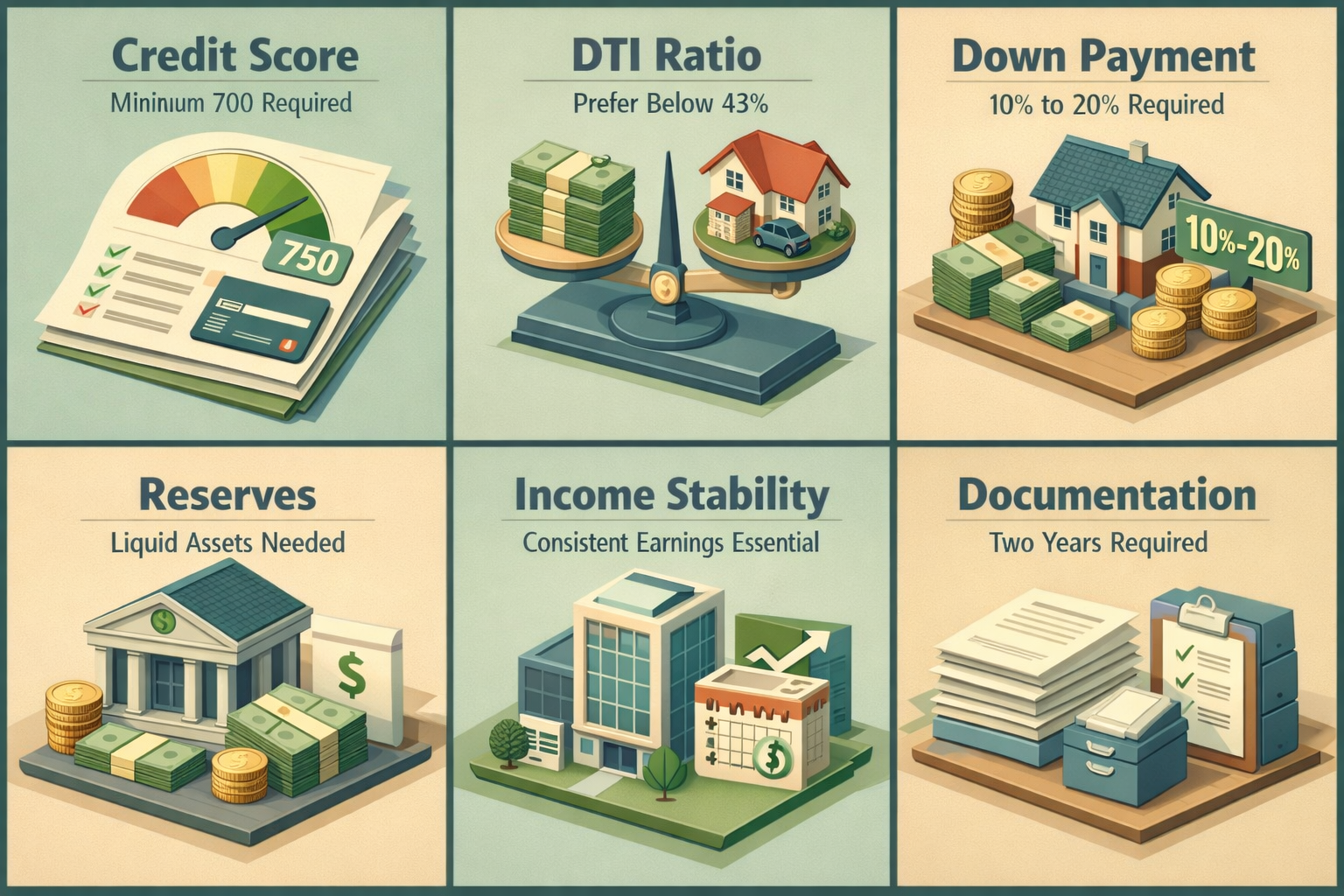
Understanding the full picture of requirements for jumbo loan with commission-based overtime income means looking beyond income documentation alone. Jumbo lenders typically evaluate several interconnected factors, and variable income borrowers need to be strong across all of them to maximize their approval chances.
Credit Score Expectations
Jumbo loans typically require higher credit scores than conforming mortgages. Many lenders look for a minimum score of 700 or higher, and some may require 720 or even 740 for the most competitive rate tiers. If your credit score is near the lower end of the acceptable range, a strong income profile and substantial assets may help offset some of that risk in the lender's eyes.
Debt-to-Income Ratio Considerations
Your debt-to-income (DTI) ratio compares your monthly debt obligations to your gross monthly income. For jumbo loans, lenders often prefer a DTI at or below 43%, though some portfolio lenders may allow slightly higher ratios for borrowers with compensating factors like significant cash reserves. When your income includes variable commission and overtime figures, the averaged qualifying income is what drives this calculation — not your highest earning month.
Down Payment and Reserves
Jumbo loans commonly require a down payment of 10% to 20% or more of the purchase price, depending on the loan amount and the lender's guidelines. Beyond the down payment, many jumbo lenders also require post-closing reserves — meaning you'll need to demonstrate liquid assets equal to several months of mortgage payments after the loan closes. This reserve requirement can be especially important for commission-based borrowers, since it signals financial stability even during slower earning periods.
Self-Employed and 1099 Commission Earners Face Extra Scrutiny
If you earn commissions as an independent contractor or run your own sales-driven business, qualifying for a jumbo mortgage may involve additional layers of documentation. Unlike W-2 employees whose income is straightforward to verify, self-employed borrowers must demonstrate not just what they earned but what they kept after business expenses.
Lenders will typically review two years of personal and business tax returns, profit and loss statements, and bank statements. The qualified income figure is often derived from your net income after deductions — which can be meaningfully lower than your gross revenue. High earners who aggressively write off business expenses sometimes find that their taxable income looks modest on paper, even when their actual cash flow is healthy.
Non-QM Jumbo Options for Variable Income Borrowers
For borrowers whose income documentation doesn't fit the traditional mold, non-qualified mortgage (Non-QM) jumbo products may offer a viable path. Some specialty lenders offer bank statement programs that use 12 to 24 months of personal or business bank statements to calculate income rather than relying solely on tax returns. These programs can be particularly helpful for commission-heavy borrowers whose tax returns understate their true earning power. However, Non-QM products often come with higher interest rates and may require larger down payments as a trade-off for the flexible qualification approach.
Strategies to Strengthen Your Jumbo Mortgage Application
If you're preparing to apply for a jumbo loan and your income includes commission or overtime pay, a few strategic steps can strengthen your application and help you secure more favorable terms.
- Build a consistent income track record: The longer your history of commission and overtime earnings, the more confidence lenders will have in those figures. If you're early in a commission-based role, it may be worth waiting until you have two full years of documented history before applying.
- Minimize business deductions strategically: For self-employed commission earners, aggressive tax deductions can reduce qualifying income. Working with a tax professional to understand the trade-off between tax savings and mortgage qualification is worth considering.
- Increase your cash reserves: Lenders feel more comfortable with variable-income borrowers who have substantial liquid assets. Building reserves beyond what's required can serve as a strong compensating factor.
- Pay down existing debts: Lowering your DTI ratio by reducing outstanding balances on credit cards, auto loans, or other liabilities can help bring your overall debt load into a more favorable range.
- Get an employer letter confirming continuity: A written statement from your employer confirming that your commission structure and overtime opportunities are expected to continue can carry meaningful weight during underwriting.
- Work with a lender experienced in jumbo qualification: Not all lenders handle variable income the same way. A specialist who understands jumbo mortgage qualification commission overtime scenarios may have more flexible guidelines or be better positioned to advocate for your file.
●Conclusion
Navigating the requirements for jumbo loan with commission-based overtime income is certainly more involved than a standard mortgage application, but it's far from impossible. With the right documentation, a solid two-year income history, strong credit, and healthy reserves, many variable-income borrowers successfully qualify for jumbo financing each year. The key is preparation — understanding what lenders are looking for and positioning your financial profile accordingly before you submit your application. If you're ready to explore your options or want guidance tailored to your income situation, connecting with a knowledgeable mortgage professional at LoanWise could be your most valuable next step.