
Buying a high-value home is an exciting milestone, and for many commission-based freelancers, it's an entirely achievable goal. However, securing a jumbo loan when your income comes from 1099 earnings, commissions, or self-employment introduces a layer of complexity that's worth understanding before you apply. Lenders view variable income differently than a traditional salaried paycheck, which means the path to approval may require more preparation, more documentation, and a stronger overall financial profile. If you're a freelancer or independent contractor eyeing a luxury property or a home above the conforming loan limits, this guide walks you through the essential requirements for jumbo loan with commission-based freelance income — so you can approach the process with confidence.
What Makes Jumbo Loans Different from Conventional Mortgages
A jumbo loan is a mortgage that exceeds the conforming loan limits set by the Federal Housing Finance Agency (FHFA). Because these loans are too large to be purchased or guaranteed by Fannie Mae or Freddie Mac, lenders assume significantly more risk when issuing them. That risk typically translates into stricter qualification standards across the board.
For most borrowers, the differences include higher credit score thresholds, larger down payment requirements, and more rigorous income verification. For commission-based freelancers specifically, the underwriting process can feel even more demanding because income consistency — something lenders prize — can be harder to demonstrate when earnings fluctuate month to month or project to project.
It's also worth noting that jumbo loan guidelines are not standardized the way conforming loans are. Each lender sets its own criteria, which means there can be meaningful variation in what's required depending on where you apply. Some lenders may be more experienced with self-employed borrowers and more flexible in how they interpret income, while others may apply very conservative standards. Shopping around is not just advisable — it could make the difference between approval and denial.
How Lenders Evaluate Commission-Based and Freelance Income for Jumbo Approval
When a lender reviews your application as a commission-based freelancer, they're primarily trying to answer one question: is this income stable and likely to continue? Unlike a W-2 employee whose monthly earnings are predictable, a freelancer's income can swing dramatically. Lenders generally account for this by averaging income over a defined period — most commonly two years — to establish a baseline figure they're willing to use for qualification purposes.
If your income has been growing steadily over those two years, lenders may use the average or even the most recent year's earnings. However, if your income declined from year one to year two, some lenders may use the lower figure or require a written explanation. This is an important consideration for freelancers who had an exceptionally strong year followed by a slower one.
Commission-based income — even when earned as a W-2 employee — is often treated similarly to self-employment income by jumbo lenders. If commissions represent a significant portion of your total earnings, underwriters will typically want to see that this income has been consistent and sustainable, not a one-time spike. The longer your track record in the same field or industry, the more favorably lenders tend to view your income history.
Key Documentation You'll Need as a 1099 Freelancer Applying for a Jumbo Loan
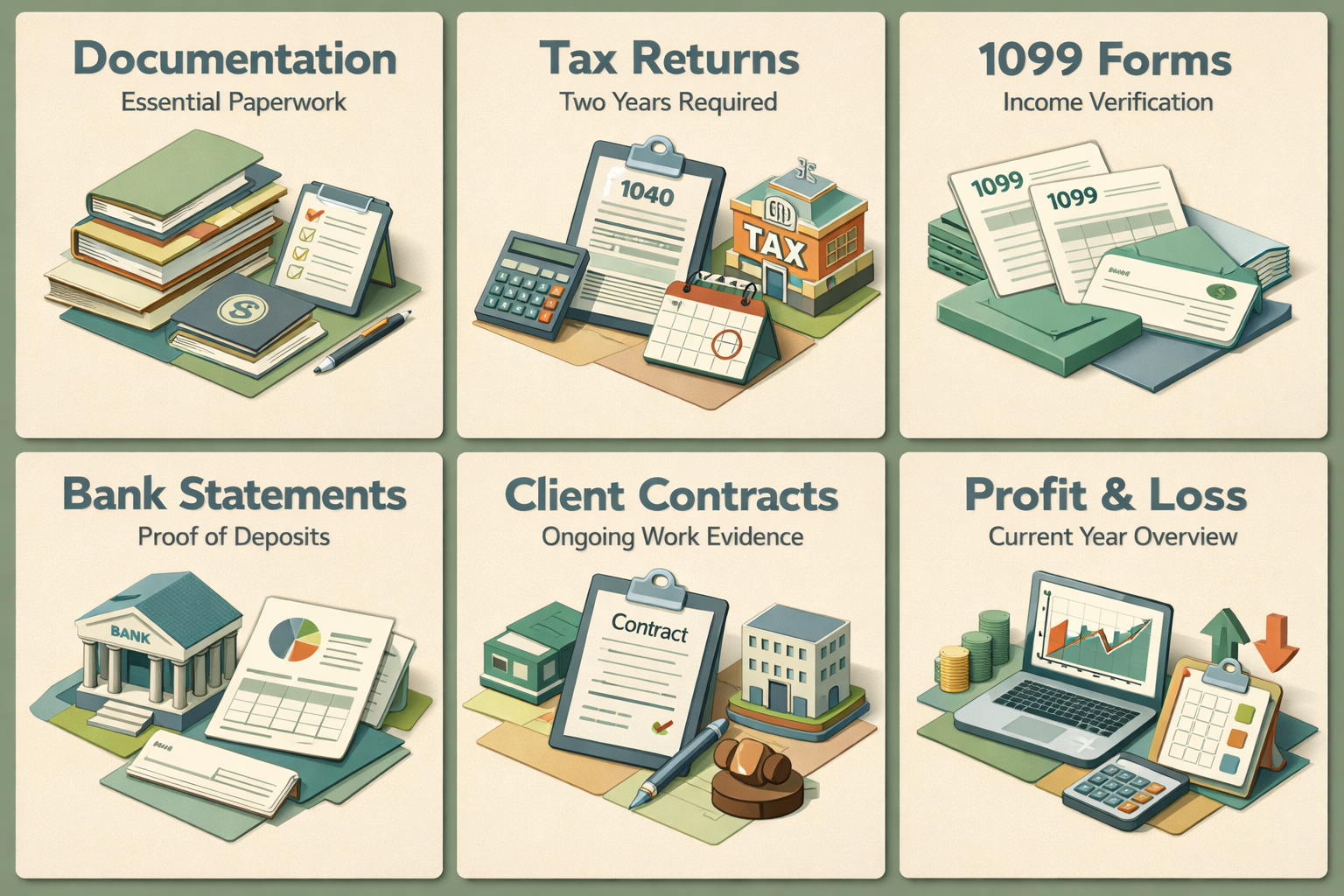
Meeting the requirements for jumbo loan with commission-based freelance income starts with being prepared to document your earnings thoroughly. Lenders will typically request more paperwork from self-employed borrowers than from salaried applicants. Here's what you should generally expect to provide:
- Two years of personal federal tax returns: These are the cornerstone of income verification for freelancers. Underwriters will analyze your Schedule C (for sole proprietors) or K-1 forms if you operate through a partnership or S-corporation. They'll look at net income after deductions, which can sometimes be significantly lower than gross revenue.
- Two years of business tax returns: If your freelance work is structured as an LLC or corporation, lenders will often request business returns in addition to personal ones.
- 1099 forms: These confirm the sources and amounts of your commission or freelance income. Having 1099s from multiple clients can actually strengthen your application by showing income diversification.
- Profit and loss statements: Some lenders — particularly those familiar with jumbo loan requirements 1099 freelance situations — may accept a current-year P&L prepared by a licensed CPA to supplement tax returns.
- Bank statements: Twelve to twenty-four months of personal and business bank statements may be requested to verify that reported income is actually deposited and accessible.
- Client contracts or letters of engagement: Evidence of ongoing work relationships can help demonstrate that your income is likely to continue, which is especially helpful if you have recurring clients.
Being organized and proactive with your documentation can significantly streamline the underwriting process and reduce delays.
Credit Score and Debt-to-Income Standards for High-Balance Freelance Borrowers
Beyond income documentation, jumbo lenders typically apply stricter credit and financial benchmarks to all applicants, and commission-based freelancers are no exception. Understanding these thresholds ahead of time can help you assess your readiness before submitting a formal application.
Credit Score Requirements
Most jumbo lenders look for a credit score of at least 700, though many prefer scores of 720 or higher for loan amounts that are significantly above the conforming limit. Some lenders may require 740 or above for the most competitive rates or for very large loan amounts. As a freelancer, maintaining a strong credit score is one of the most effective ways to offset lender concerns about income variability.
Debt-to-Income Ratio
Lenders use your debt-to-income (DTI) ratio to measure how much of your monthly income goes toward debt obligations. For jumbo loans, lenders often prefer a DTI of 43% or lower, though some may allow up to 45% depending on compensating factors such as significant reserves or a large down payment. Because freelance income is averaged — and because business deductions on tax returns can reduce your qualifying income — your effective DTI may be higher than you expect. Working with a mortgage professional before applying can help you model different scenarios.
Cash Reserves
Jumbo lenders commonly require borrowers to demonstrate substantial cash reserves after closing. This might mean having anywhere from six to twelve months of mortgage payments — or more — sitting in liquid accounts. For commission-based freelancers, strong reserves serve as a financial buffer that reassures lenders during slower income periods. Retirement accounts, investment portfolios, and savings accounts may all count toward reserves, though policies vary by lender.
Down Payment Expectations and How They Affect Your Application
Jumbo loans typically require larger down payments than conforming mortgages. While conventional loans may allow as little as 3% to 5% down, jumbo lenders often expect 10% to 20% or more, depending on the loan amount and the borrower's profile. For commission-based freelancers, a larger down payment can do more than just meet a minimum requirement — it can actively strengthen an application that might otherwise raise underwriting questions.
A down payment of 20% or more may also help you avoid private mortgage insurance (PMI), though jumbo loans handle this differently than conventional products and policies vary. More importantly, a larger equity stake reduces the lender's exposure and may make underwriters more comfortable with income that's inherently variable.
It's also worth considering where your down payment funds are coming from. Lenders will typically want to see that funds have been in your account for at least 60 to 90 days — sometimes called seasoning — to confirm they're genuinely yours and not borrowed. Gift funds from family members may be acceptable in some cases, but jumbo lenders often have stricter gift fund policies than conforming loan programs.
Alternative Income Documentation Options Worth Exploring
If your tax returns don't fully capture your earning power — a common situation for freelancers who take advantage of legitimate business deductions — there may be alternative documentation paths worth exploring. Some lenders offer what are called bank statement loans or non-QM (non-qualified mortgage) products specifically designed for self-employed borrowers.
With a bank statement loan, lenders use 12 to 24 months of personal or business bank deposits to calculate qualifying income, rather than relying on tax returns. This can be especially beneficial for freelancers whose net income on paper is lower than their actual cash flow. However, these products often come with trade-offs: slightly higher interest rates, larger down payment requirements, or stricter reserve standards.
For those navigating jumbo loan requirements 1099 freelance situations, working with a lender or mortgage broker who specializes in self-employed borrowers can open doors to programs that a conventional lender might not even offer. Specialty lenders and portfolio lenders — those who hold loans on their own books rather than selling them — often have more flexibility in how they evaluate non-traditional income.
It's important to weigh the full cost of any alternative documentation product against the benefits. A slightly higher rate on a jumbo loan can translate into meaningful additional interest over time, so running the numbers carefully is always a smart step.
Practical Steps to Strengthen Your Jumbo Loan Application Before You Apply
Preparation is your most powerful tool when you're a commission-based freelancer pursuing a jumbo mortgage. Taking deliberate steps before you submit an application can meaningfully improve your chances of approval and help you secure better terms.
- File clean, consistent tax returns: Lenders scrutinize tax returns closely. Inconsistencies between years or between personal and business returns can trigger additional questions. Working with a CPA who understands mortgage qualification can help you present your income in the most favorable — and fully accurate — light.
- Reduce outstanding debt: Paying down credit card balances, auto loans, or other obligations before applying can lower your DTI ratio and improve your credit score simultaneously.
- Build your reserves: Start setting aside liquid savings well in advance of your application. The more reserves you have, the more flexibility you give lenders to view your variable income as manageable risk.
- Maintain consistent income: If possible, try to demonstrate income stability in the months leading up to your application. Avoid taking on large tax deductions that could sharply reduce your net qualifying income in the final year before you apply.
- Get pre-qualified early: A preliminary conversation with a lender can reveal potential issues before you're under contract on a property. It also gives you time to address gaps without the pressure of a closing deadline.
- Work with experienced professionals: A mortgage broker or loan officer who regularly works with self-employed and commission-based borrowers will understand the nuances of your situation and can advocate effectively on your behalf during underwriting.
●Conclusion
Qualifying for a jumbo mortgage as a freelancer or commission-based earner is absolutely achievable — it just requires a more thorough approach than a salaried borrower might need. The requirements for jumbo loan with commission-based freelance income center on demonstrating income stability through solid documentation, maintaining strong credit, building meaningful reserves, and preparing a larger down payment. While lender standards vary and no outcome is guaranteed, borrowers who understand the landscape and plan ahead are far better positioned to succeed. At LoanWise, we're here to help you navigate the process with clarity — connect with one of our lending specialists today to explore your options and take the next step toward your home purchase.