
If you're a freelancer earning income from two separate clients or contracts, buying a high-value home might feel out of reach — but it doesn't have to be. Understanding the requirements for jumbo loan with 1099 income from two freelance jobs is the first step toward turning that dream into a real financing plan. Jumbo loans allow borrowers to finance properties that exceed conventional loan limits, but they come with stricter qualification standards. For self-employed individuals, those standards can feel even more demanding. The good news is that with the right preparation, documentation, and lender match, qualifying is absolutely possible. This guide walks you through exactly what you need to know.
What Makes a Jumbo Loan Different from a Conventional Mortgage
A jumbo loan is a mortgage that exceeds the conforming loan limits set by the Federal Housing Finance Agency (FHFA). In most parts of the United States, that limit sits around $766,550 for a single-family home, though it may be higher in certain high-cost areas. Because jumbo loans can't be purchased by Fannie Mae or Freddie Mac, lenders take on more risk — and they respond by setting tighter eligibility requirements.
For traditionally employed borrowers, qualifying for a jumbo loan typically means providing W-2s, pay stubs, and tax returns. But freelancers who receive 1099 forms instead of W-2s face a different process. Lenders may need to work harder to verify your income, and you'll likely need to demonstrate more financial stability than a salaried borrower would.
That said, jumbo loans are widely available through private lenders, credit unions, and mortgage banks. And many of these lenders have developed specific underwriting processes for self-employed borrowers — particularly those with multiple income streams.
How Lenders View 1099 Income from Two Freelance Jobs
When you're self-employed and earning from two separate freelance sources, lenders typically want to see that both income streams are consistent, reliable, and likely to continue. This is where things can get nuanced. Lenders generally won't simply add up your gross 1099 earnings and use that number as your qualifying income. Instead, they'll look at your net income after business expenses, as reported on your tax returns.
For most jumbo loan underwriters, income is averaged over a two-year period using your Schedule C or Schedule SE filings. If your income has been growing, some lenders may use a weighted average that gives more credit to your most recent year. If it's been declining, however, underwriters may use the lower figure — or even flag the trend as a concern.
Having income from two freelance jobs may actually work in your favor in some cases. It can demonstrate income diversification, which reduces the risk that your earnings will drop significantly if one client relationship ends. However, lenders will still want to see that both income sources have been active for at least two years, ideally with documented history through tax returns and 1099 forms from both employers or clients.
It's also worth noting that some lenders offer bank statement loan programs as an alternative to traditional income verification. These programs — often categorized as non-QM (non-qualified mortgage) products — allow borrowers to qualify for a jumbo mortgage based on 12 to 24 months of bank deposits rather than tax returns. This can be especially helpful if your tax deductions reduce your reported net income significantly.
Core Requirements for Jumbo Loan with 1099 Income from Two Freelance Jobs
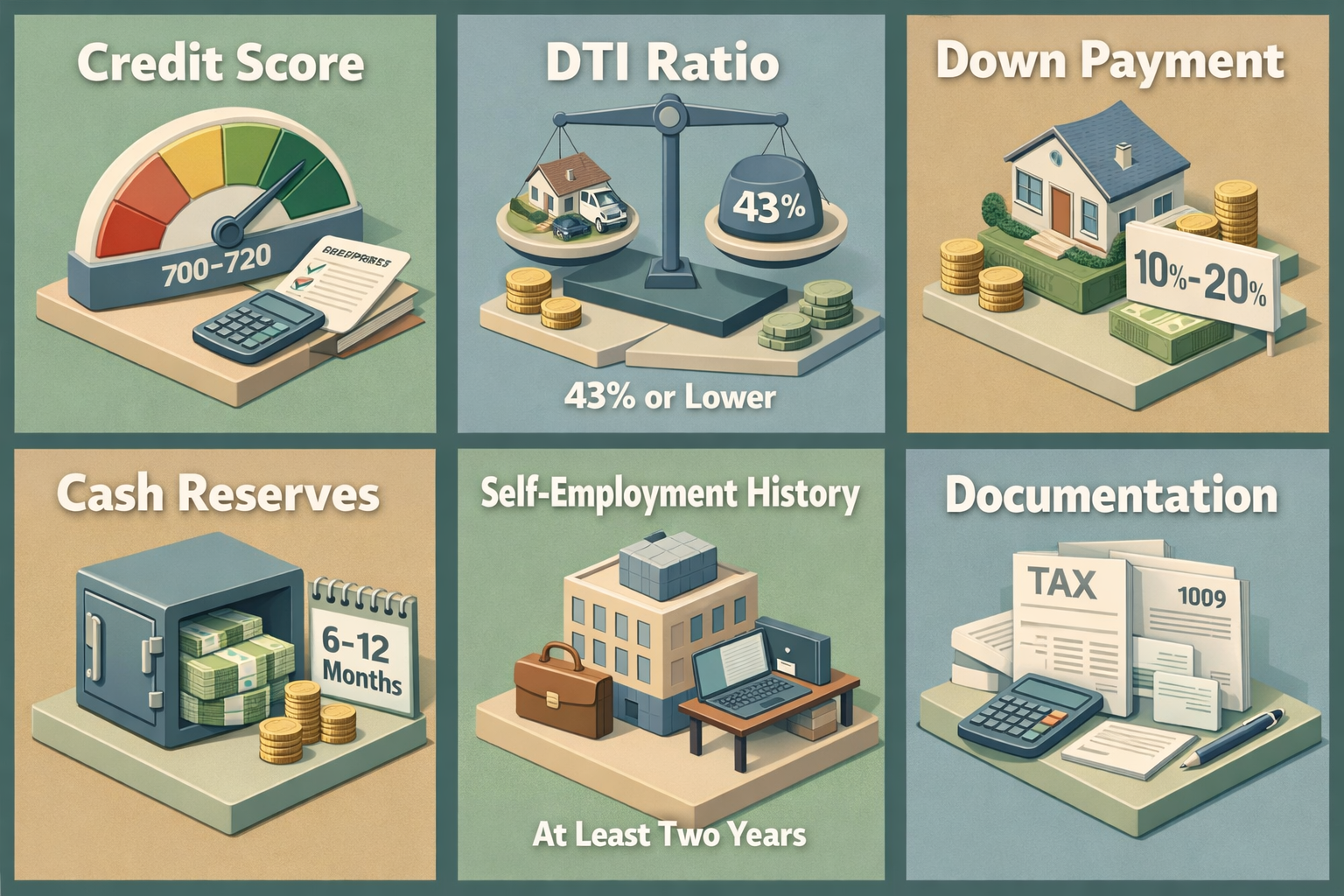
While specific requirements vary by lender, there are several common benchmarks that most jumbo lenders expect self-employed borrowers to meet. Understanding these thresholds before you apply can help you avoid surprises and strengthen your application.
Credit Score
Jumbo loans typically require a higher credit score than conventional mortgages. Most lenders look for a minimum score of 700 to 720, and some may require 740 or higher for the most competitive rates. A strong credit profile signals to lenders that you manage debt responsibly — a key concern when extending a large loan to a self-employed borrower.
Debt-to-Income Ratio (DTI)
Lenders generally prefer a debt-to-income ratio of 43% or lower for jumbo loans, though some may allow up to 45% or even 50% with strong compensating factors like significant reserves. Your DTI is calculated by dividing your monthly debt payments by your gross monthly income — which for 1099 earners means your verified net income after deductions.
Down Payment
Expect to put down at least 10% to 20% for a jumbo loan, though many lenders prefer 20% or more, especially for self-employed borrowers. A larger down payment reduces the lender's risk and may also help you secure a better interest rate.
Cash Reserves
Jumbo lenders commonly require borrowers to hold significant cash reserves after closing — often 6 to 12 months of mortgage payments in liquid or semi-liquid assets. For self-employed borrowers with variable income, this reserve requirement may be on the higher end.
Self-Employment History
Most lenders want to see at least two years of self-employment history, verified through business licenses, CPA letters, or tax transcripts from the IRS. This applies to both freelance income sources, so if one of your contracts is relatively new, it may not count toward your qualifying income.
Documents You'll Need to Gather Before Applying
Preparation is everything when it comes to the requirements for jumbo loan with 1099 income. Lenders will conduct a thorough review of your financial history, so having your documents organized can speed up the process and reduce delays.
- Two years of personal federal tax returns (including all schedules, particularly Schedule C and Schedule SE)
- 1099 forms from both freelance clients for the past two years
- Two years of business tax returns, if applicable (for LLCs or sole proprietors with separate filings)
- Year-to-date profit and loss statement, ideally prepared or reviewed by a licensed CPA
- 12 to 24 months of bank statements for both personal and business accounts
- Proof of business existence, such as a business license, DBA filing, or professional website
- Letter from a CPA confirming the nature and continuity of your self-employment
- Asset and investment account statements showing reserves and net worth
If you're applying for a bank statement loan, the focus shifts to deposit history, so clean and consistent monthly deposits across your accounts can significantly strengthen your case. Be prepared for lenders to apply a expense factor — typically 10% to 50% — to reduce your gross deposits to an estimated net income figure.
Strategies to Strengthen Your Jumbo Mortgage Application
As a freelancer applying for a jumbo mortgage for self-employed borrowers, there are several proactive steps you can take to improve your odds of approval and potentially secure better loan terms.
Work with a CPA Before Applying
One of the most common challenges for 1099 earners is that aggressive tax deductions reduce their reported income — which is great at tax time but can hurt during underwriting. Working with a CPA a year or two in advance can help you balance legitimate deductions with a stronger income picture for lenders.
Build Your Reserves
Because jumbo lenders place significant emphasis on liquid reserves, growing your savings and investment accounts before applying can make a meaningful difference. Try to maintain at least 12 months of projected mortgage payments in accessible accounts.
Reduce Existing Debt
Paying down credit cards, auto loans, or student debt before applying can lower your DTI ratio and improve your credit score simultaneously. Even a modest reduction in monthly obligations can bring your DTI into a more favorable range.
Consider a Non-QM or Portfolio Lender
Not all lenders follow the same underwriting guidelines. Portfolio lenders — institutions that keep loans on their own books rather than selling them — often have more flexibility with jumbo mortgage for self-employed with multiple income streams situations. Non-QM lenders specialize in alternative documentation programs that may suit your income profile better than traditional underwriting.
Get Pre-Qualified Early
Before you start house hunting, connect with a mortgage professional who has experience with self-employed jumbo borrowers. A pre-qualification review can identify potential gaps in your application and give you time to address them before a formal submission.
Understanding Rate Differences for Self-Employed Jumbo Borrowers
It's worth knowing that jumbo loan rates don't always follow the same patterns as conventional mortgage rates. Because these loans aren't backed by government-sponsored enterprises, lenders price them based on their own risk models. For self-employed borrowers, this may mean a slightly higher rate compared to a salaried borrower with an identical credit profile.
However, rates can vary considerably from lender to lender. Some portfolio lenders and private banks that focus on high-net-worth clients may actually offer very competitive jumbo rates, especially if you can demonstrate strong assets, consistent income, and a solid banking relationship.
If you're using a bank statement program rather than tax returns, expect rates to run somewhat higher than traditional jumbo products. This premium reflects the additional flexibility in documentation, but it may still be worth it if traditional underwriting doesn't capture your true income accurately.
Shopping with multiple lenders is particularly important for freelancers. Even a small difference in rate — say a quarter of a percent — can translate to tens of thousands of dollars in additional interest over the life of a jumbo loan. Don't settle for the first offer you receive.
●Conclusion
Navigating the requirements for jumbo loan with 1099 income from two freelance jobs takes planning, documentation, and the right lending partner — but it's far from impossible. Freelancers with two active income streams, strong credit, healthy reserves, and two years of consistent earnings are well-positioned to compete for jumbo financing. The key is understanding what lenders want to see and giving yourself enough time to prepare before applying.
Whether you go the traditional tax return route or explore a bank statement loan, working with a mortgage professional who understands jumbo mortgage for self-employed with multiple income streams scenarios can save you time, money, and frustration. At LoanWise, we're here to help you find the right path to your next home. Reach out today to speak with a specialist who understands the unique challenges and opportunities that come with freelance income.