
Buying a home is one of the biggest financial steps you'll ever take, and it's okay to accept a little help along the way. Many homebuyers receive financial gifts from family members, but what happens when the money comes from a close friend, employer, or charitable organization instead? Understanding the requirements for FHA loan with gift funds from non-relative and large down payment is essential before you move forward with your purchase. FHA loans are known for their flexible guidelines, yet when gift funds enter the picture — especially from a non-relative — lenders look more carefully at the source, the documentation, and how the funds are applied. This article breaks down everything you need to know so you can approach your mortgage application with confidence.
What Makes FHA Loans Attractive for Homebuyers Using Gift Money
FHA loans, backed by the Federal Housing Administration, are among the most accessible mortgage options available in the United States. They're designed to help borrowers who may not qualify for conventional financing due to lower credit scores, limited savings, or less-than-perfect credit histories. One of the standout features of FHA financing is that the entire down payment may be funded through gift money — something that's far more restrictive with conventional loans.
For a standard FHA purchase, the minimum down payment is 3.5% of the purchase price, assuming the borrower's credit score meets the required threshold. Borrowers with lower scores may need to put down 10%. What makes FHA particularly appealing is that these funds don't have to come entirely from the borrower's own savings. Gift contributions are permitted, and that flexibility opens the door for many first-time homebuyers who might otherwise struggle to save enough on their own.
That said, not all gift sources are treated equally. The FHA draws a clear line between gifts from relatives and gifts from non-relatives, and understanding that distinction could significantly affect your loan approval process.
Who Qualifies as a Non-Relative Gift Donor Under FHA Guidelines
Under FHA guidelines, a relative is broadly defined to include a wide circle: parents, grandparents, siblings, children, aunts, uncles, nieces, nephews, and even close friends with a documented history of the relationship. Non-relatives, by contrast, typically include employers, labor unions, charitable organizations, and government agencies or programs authorized to provide down payment assistance.
When a gift comes from a non-relative, the FHA still permits it — but lenders may apply additional scrutiny. The concern is ensuring that the gift is truly a gift and not a disguised loan or payment arrangement. Lenders want to see that the donor has no financial interest in the transaction and won't benefit from the home sale.
Here's a summary of common acceptable non-relative gift sources under FHA rules:
- Employers: A gift from a borrower's employer is generally acceptable, provided it meets FHA documentation requirements.
- Labor unions: Union members may receive gift contributions from their labor organizations.
- Charitable organizations: HUD-approved charities may provide gift funds for down payments, subject to program rules.
- Government entities: Certain federal, state, or local programs may offer gift-type assistance that qualifies under FHA guidelines.
- Close friends: A close friend may be considered an acceptable donor if the borrower can demonstrate a genuine, established relationship — though some lenders may require additional documentation in these cases.
It's worth noting that the seller, real estate agent, builder, or anyone else with a financial interest in the transaction is not permitted to provide gift funds under FHA rules. This is a firm boundary lenders enforce without exception.
Core Documentation Requirements for FHA Loan with Gift Funds from Non-Relative and Large Down Payment
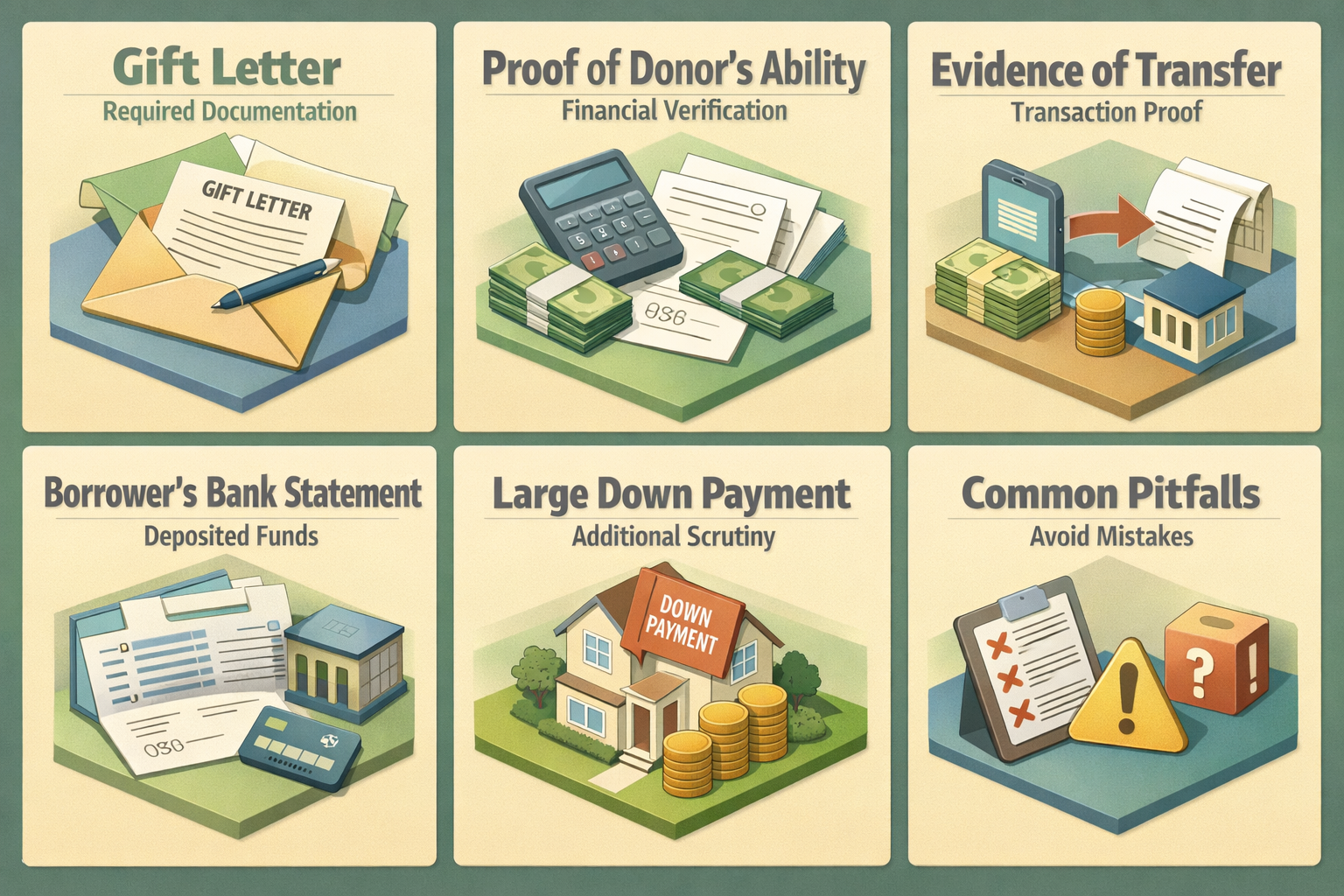
When it comes to meeting the requirements for FHA loan with gift funds from non-relative and large down payment, documentation is everything. Lenders need a clear paper trail that shows where the money came from, how it was transferred, and that the donor expects no repayment. Incomplete or inconsistent records are one of the most common reasons gift fund applications run into trouble.
Here's what lenders typically require:
- Gift letter: A signed letter from the donor stating the amount of the gift, the donor's relationship to the borrower, the property address, and a clear statement that no repayment is expected or required.
- Proof of donor's ability to give: This may include the donor's bank statements showing the funds were available before the transfer.
- Evidence of transfer: A bank statement or wire transfer confirmation showing the funds moving from the donor's account to the borrower's account.
- Borrower's bank statement: Showing the gifted funds have been deposited into the borrower's account.
When the gift amount is large down payment — meaning it covers a substantial portion of the down payment or the full amount — lenders may ask for even more detailed sourcing. A large, unexplained deposit raises flags during the underwriting process, so the cleaner and more complete your documentation is, the smoother your closing experience tends to be.
If there's any gap between when the gift was given and when it appears in the borrower's account, lenders may request additional explanation. It's always a good idea to transfer gift funds early in the process and keep records of every step.
How a Large Down Payment Affects Your FHA Loan Terms
While FHA loans only require a minimum 3.5% down payment requirements, putting down more than the minimum — especially through a combination of personal savings and gift funds — can work in your favor in several meaningful ways.
First, a larger down payment reduces your loan-to-value ratio (LTV), which means you're borrowing less relative to the home's purchase price. This directly lowers your monthly mortgage payment and reduces the total interest you'll pay over the life of the loan. It may also make lenders more comfortable with your application, particularly if there are other risk factors like a moderate credit score or recent credit events.
Second, while FHA loans require mortgage insurance premiums (MIP) regardless of down payment size — unlike conventional loans where a 20% down payment eliminates private mortgage insurance — a higher down payment could still influence how long you carry that premium. FHA loan MIP rules are specific and have changed over time, so it's worth confirming current guidelines with your lender.
Third, if the gift funds bring your total down payment to a significantly higher percentage of the purchase price, some lenders may view your application more favorably from a risk management standpoint. This could potentially make it easier to negotiate terms or qualify despite other credit challenges.
Keep in mind that even when using gifted funds for a large down payment, the sourcing and documentation requirements don't change. The funds still need to be fully documented, and the gift letter must clearly reflect the final amount contributed.
Avoiding Common Pitfalls When Using Non-Relative Gift Funds
Even with the best intentions, mistakes in how gift funds are handled can delay your closing or jeopardize your loan approval. Here are some of the most common pitfalls to watch out for:
- Treating a loan as a gift: If the donor expects repayment — even informally — FHA guidelines classify it as a loan, not a gift. This changes how it's counted in your debt-to-income ratio and could disqualify the funds entirely.
- Missing transfer documentation: Cash gifts are problematic. If you receive cash and deposit it, lenders may not be able to verify the source. Electronic transfers with clear records are much easier to document.
- Late transfers: Transferring gift funds too close to closing can create last-minute underwriting questions. Moving the funds early — and getting them seasoned in your account — may help avoid delays.
- Incorrect or incomplete gift letters: A gift letter that's missing the donor's contact information, the property address, or the specific dollar amount could be rejected. Use a lender-provided template when possible.
- Non-approved donor sources: Always confirm with your lender that the specific non-relative donor qualifies under current FHA guidelines before relying on those funds for your down payment.
Working with an experienced mortgage loan officer who understands FHA gift fund rules can make a real difference. They can catch potential issues early and guide you through the documentation process before problems arise.
Combining Gift Funds with Other FHA Down Payment Assistance Options
One often-overlooked strategy is combining non-relative gift funds with other forms of down payment assistance. Many state and local housing finance agencies offer grants, forgivable loans, or matched savings programs that can be layered with FHA financing. When structured correctly, these programs can significantly reduce — or even eliminate — the out-of-pocket cost of buying a home.
For example, a borrower might receive a gift from a charitable employer to cover part of the 3.5% down payment and then use a state homebuyer assistance program to cover the remainder. As long as each source is properly documented and meets FHA eligibility requirements, this combination may be permitted.
It's important to note that not all assistance programs are compatible with FHA guidelines. Some programs impose restrictions on loan types, property types, or income limits. Your lender or a HUD-approved housing counselor can help you identify which programs are available in your area and which ones stack well with FHA financing.
When putting together a layered assistance strategy, organization is key. You'll be managing multiple documentation requirements from different sources simultaneously. Creating a checklist and working closely with your loan officer will help ensure nothing slips through the cracks.
●Conclusion
Navigating the requirements for FHA loan with gift funds from non-relative and large down payment may seem complex, but it's very manageable with the right preparation. FHA loans offer real flexibility for buyers who need assistance covering their down payment, and non-relative gift sources are a legitimate option when properly documented. The key is understanding who qualifies as a donor, what paperwork is required, and how a large gifted down payment can actually strengthen your application.
Whether you're a first-time buyer, a repeat homeowner looking to use a gift contribution, or simply exploring your financing options, it pays to work with a knowledgeable lending professional who can walk you through every step. At LoanWise, we're here to help you understand your options and move forward with confidence. Reach out to a LoanWise mortgage specialist today and let's talk about how gift funds and FHA financing might work for your home purchase.